School of Information Engineering, East China Jiaotong University, Nanchang 330031, China.
School of Information Science and Engineering, Southeast University, Nanjing 210096, China.
Sensors (Basel). 2020 Jan 11;20(2):415. doi: 10.3390/s20020415.
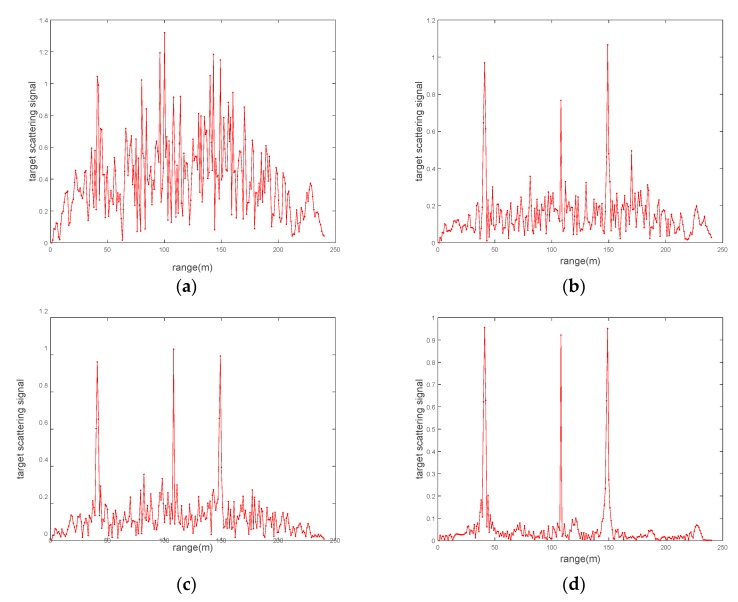
A frequency-hopping (FH)-based dual-function multiple-input multiple-output (MIMO) radar communications system enables implementation of a primary radar operation and a secondary communication function simultaneously. The set of transmit waveforms employed to perform the MIMO radar task is generated using FH codes. For each transmit antenna, the communication operation can be realized by embedding one phase symbol during each FH interval. However, as the radar channel is time-variant, it is necessary for a successive waveform optimization scheme to continually obtain target feature information. This research work aims at enhancing the target detection and feature estimation performance by maximizing the mutual information (MI) between the target response and the target returns, and then minimizing the MI between successive target-scattering signals. The two-step cognitive waveform design strategy is based upon continuous learning from the radar scene. The dynamic information about the target feature is utilized to design FH codes. Simulation results show an improvement in target response extraction, target detection probability and delay-Doppler resolution as the number of iterations increases, while still maintaining high data rate with low bit error rates between the proposed system nodes.
基于跳频 (FH) 的双功能多输入多输出 (MIMO) 雷达通信系统能够同时实现主雷达操作和辅助通信功能。用于执行 MIMO 雷达任务的发射波形集是使用 FH 码生成的。对于每个发射天线,在每个 FH 间隔期间嵌入一个相位符号即可实现通信操作。然而,由于雷达信道是时变的,因此需要连续的波形优化方案来不断获取目标特征信息。这项研究旨在通过最大化目标响应与目标回波之间的互信息 (MI) 并最小化连续目标散射信号之间的 MI 来提高目标检测和特征估计性能。两步认知波形设计策略基于从雷达场景中持续学习。利用目标特征的动态信息来设计 FH 码。仿真结果表明,随着迭代次数的增加,目标响应提取、目标检测概率和延迟多普勒分辨率都得到了改善,同时在保持高数据速率的同时,系统节点之间的误码率仍然很低。