Department of Medical Retina, Moorfields Eye Hospital NHS Foundation Trust and National Institute for Health Research (NIHR) Biomedical Research Centre (BRC) at Moorfields Eye Hospital, London, United Kingdom.
Medical Affairs Region Europe, Ophthalmology, Novartis Pharma AG, Basel, Switzerland.
PLoS One. 2020 Jan 21;15(1):e0227557. doi: 10.1371/journal.pone.0227557. eCollection 2020.
To assess the 1-year effectiveness, safety, and treatment patterns of ranibizumab in patients with myopic choroidal neovascularization (mCNV) enrolled in the LUMINOUS study.
This 5-year, prospective, multicenter, observational, study enrolled 30,138 patients across all approved ranibizumab indications from outpatient ophthalmology clinics. 297 consenting patients (≥18 years) with mCNV who were treatment-naïve or prior-treated with ranibizumab or other ocular treatments were enrolled, and treated with ranibizumab according to the local product label. The main outcomes are visual acuity (VA; Early Treatment Diabetic Retinopathy Study letters or equivalent), adverse events during the study, and treatment exposure over 1 year. Results are presented by prior treatment status of the study eye and injection frequency.
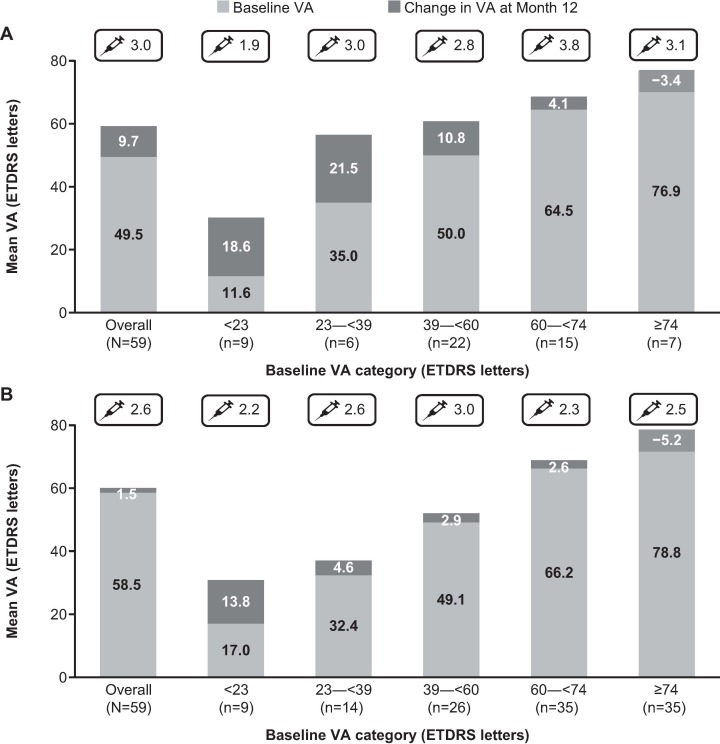
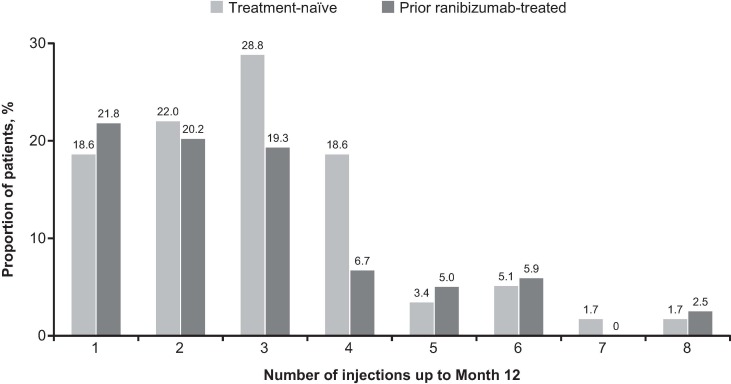
Of the 297 mCNV patients recruited in the study, 108 were treatment-naïve and 175 were prior ranibizumab-treated. At baseline, the mean age of patients was 57.6 years, and 59.0 years and 80.6% and 65.7% were female in the treatment-naïve and prior ranibizumab-treated groups, respectively. Most were Caucasian (treatment-naïve, 88.9%; prior ranibizumab-treated, 86.9%). The mean (±standard deviation [SD]) VA letter changes to 1 year were +9.7 (±17.99) from 49.5 (±20.51) and +1.5 (±13.15) from 58.5 (±19.79) and these were achieved with a mean (SD) of 3.0 (±1.58) and 2.6 (±2.33) injections in the treatment-naïve and prior ranibizumab-treated groups, respectively. Presented by injection frequencies 1-2, 3-4 and ≥5 injections in Year 1, the mean (SD) VA changes were +15.0 (±14.70), +7.7 (±19.91) and -0.7 (±16.05) in treatment-naïve patients and +1.5 (±14.57), +3.1 (±11.53) and -3.6 (±11.97) in prior ranibizumab-treated patients, respectively. The safety profile was comparable with previous ranibizumab studies.
Ranibizumab treatment for mCNV showed robust VA gains in treatment-naïve patients and VA maintenance in prior ranibizumab-treated patients in a clinical practice setting, consisting mainly of Caucasians. No new safety signals were observed during the study.
评估在 LUMINOUS 研究中接受雷珠单抗治疗的近视性脉络膜新生血管(mCNV)患者的 1 年疗效、安全性和治疗模式。
这是一项为期 5 年的前瞻性、多中心、观察性研究,共纳入了来自门诊眼科诊所的所有批准的雷珠单抗适应证的 30138 名患者。共纳入了 297 名符合条件的(≥18 岁)mCNV 患者,这些患者为初治或既往接受过雷珠单抗或其他眼部治疗,根据当地产品标签接受雷珠单抗治疗。主要结局为视力(VA;早期治疗糖尿病视网膜病变研究字母或等效物)、研究期间的不良事件以及 1 年内的治疗暴露情况。结果按研究眼的既往治疗情况和注射频率进行呈现。
在这项研究中,共纳入了 297 名 mCNV 患者,其中 108 名患者为初治,175 名患者为既往雷珠单抗治疗。在基线时,患者的平均年龄为 57.6 岁,初治组和既往雷珠单抗治疗组的患者分别为 59.0 岁和 80.6%和 65.7%为女性。大多数为白种人(初治组,88.9%;既往雷珠单抗治疗组,86.9%)。至 1 年时 VA 字母变化的平均值(±标准偏差[SD])为:初治组从 49.5(±20.51)增加到+9.7(±17.99),既往雷珠单抗治疗组从 58.5(±19.79)增加到+1.5(±13.15),分别使用了 3.0(±1.58)和 2.6(±2.33)次注射。按 1-2、3-4 和≥5 次注射的频率在第 1 年呈现,初治患者的平均(SD)VA 变化分别为+15.0(±14.70)、+7.7(±19.91)和-0.7(±16.05),既往雷珠单抗治疗组患者的平均(SD)VA 变化分别为+1.5(±14.57)、+3.1(±11.53)和-3.6(±11.97)。安全性概况与以往的雷珠单抗研究相似。
在临床实践环境中,雷珠单抗治疗 mCNV 可使初治患者获得显著的 VA 增益,并使既往接受雷珠单抗治疗的患者维持 VA,主要为白种人。在研究期间未观察到新的安全性信号。