Interdisciplinary Consortium on Advanced Motion Performance (iCAMP), Michael E. DeBakey Department of Surgery, Baylor College of Medicine, Houston, TX 77030, USA.
Sensors (Basel). 2020 Jan 16;20(2):505. doi: 10.3390/s20020505.
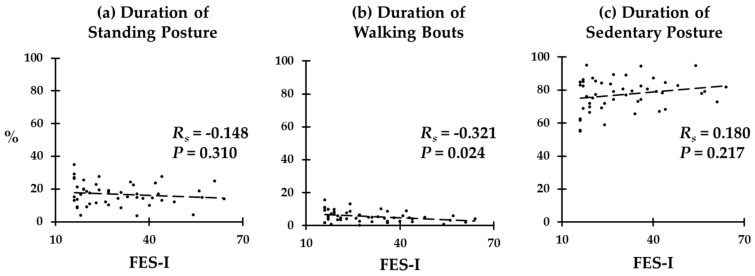
Concern about falling is prevalent and increases the risk of falling in people with peripheral neuropathy (PN). However, the assessment of concern about falling relies on self-report surveys, and thus continuous monitoring has not been possible. We investigated the influence of concern about falling on sensor-based daily physical activity among people with PN. Forty-nine people with PN and various levels of concern about falling participated in this study. Physical activity outcomes were measured over a period of 48 hours using a validated chest-worn sensor. The level of concern about falling was assessed using the falls efficacy scale-international (FES-I). The low concern group spent approximately 80 min more in walking and approximately 100 min less in sitting/lying compared to the high concern group. In addition, the low concern group had approximately 50% more walking bouts and step counts compared to the high concern group. Across all participants, the duration of walking bouts and total step counts was significantly correlated with FES-I scores. The duration of walking bouts and total step counts may serve as eHealth targets and strategies for fall risk assessment among people with PN.
对跌倒的担忧普遍存在,并会增加周围神经病变(PN)患者跌倒的风险。然而,对跌倒的担忧的评估依赖于自我报告的调查,因此无法进行持续监测。我们研究了对跌倒的担忧对 PN 患者基于传感器的日常身体活动的影响。49 名患有 PN 且对跌倒的担忧程度不同的患者参与了这项研究。使用经过验证的胸部佩戴传感器在 48 小时内测量身体活动结果。使用国际跌倒效能量表(FES-I)评估对跌倒的担忧程度。与高担忧组相比,低担忧组的步行时间大约多 80 分钟,而坐/躺时间大约少 100 分钟。此外,低担忧组的步行次数和步数比高担忧组多约 50%。在所有参与者中,行走时间和总步数与 FES-I 评分呈显著相关。行走时间和总步数可能是针对 PN 患者跌倒风险评估的电子健康目标和策略。