School of Health Sciences, Western Sydney University, Campbelltown Campus, Locked Bag 1797, Penrith, NSW 2571, Australia.
Australian Centre for Public and Population Health Research, Faculty of Health, University of Technology Sydney, Ultimo, NSW 2007, Australia.
Nutrients. 2020 Jan 19;12(1):258. doi: 10.3390/nu12010258.
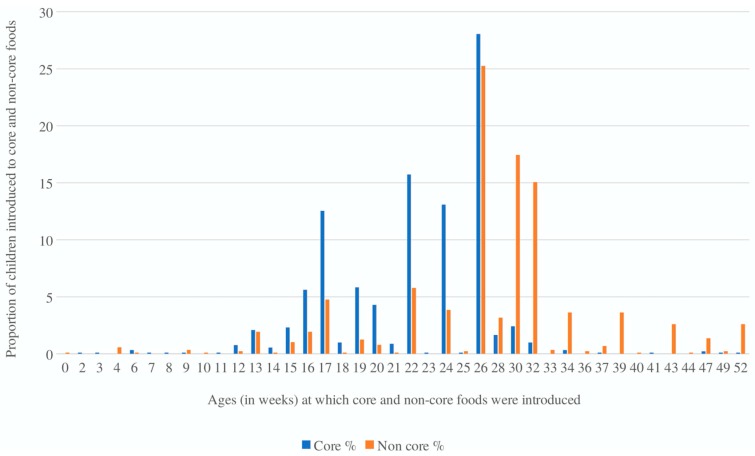
Early introduction of complementary foods can have a detrimental impact on children's long-term health. This study examined the timing and determinants of early introduction of core and discretionary foods among infants in Sydney, Australia. Mothers ( = 1035) from an ongoing population-based birth cohort study were interviewed at 8, 17, 34 and 52 weeks postpartum. The outcome was 'age at which particular core and discretionary food items were first introduced'. Multivariable logistic regression models were used to investigate family and infant-related determinants of early introduction of core (<17 weeks of age) and discretionary foods (<52 weeks of age). Of the 934 mother-infant dyads interviewed, 12% ( = 113) of infants were introduced core foods before 17 weeks of age (median: 22). Mothers working part-time (adjusted odds ratio (OR): 3.42, 95% confidence interval (CI): 1.54-7.62) and those exclusively formula-feeding their babies at four-weeks postpartum (adjusted OR 3.26, 95% CI: 1.99-5.33) were most likely to introduce core foods early. Ninety-five percent ( = 858) of infants were introduced discretionary foods before 52 weeks of age (median: 28). Low socio-economic status was significantly associated with early introduction of discretionary foods (adjusted OR: 3.72, 95% CI: 1.17-11.78). Compliance with infant feeding guidelines related to core foods was better; however, discretionary foods were introduced early in most infants.
早期引入补充食品可能对儿童的长期健康产生不利影响。本研究调查了澳大利亚悉尼婴儿早期引入核心和非核心食品的时间和决定因素。对一项正在进行的基于人群的出生队列研究中的母亲(=1035 人)在产后 8、17、34 和 52 周进行了访谈。结果是“首次引入特定核心和非核心食品的年龄”。使用多变量逻辑回归模型调查了家庭和婴儿相关因素对核心食品(<17 周龄)和非核心食品(<52 周龄)早期引入的影响。在接受访谈的 934 对母婴中,有 12%(=113)的婴儿在 17 周龄之前引入了核心食品(中位数:22 周)。兼职工作的母亲(调整后的优势比(OR):3.42,95%置信区间(CI):1.54-7.62)和产后 4 周完全配方奶喂养婴儿的母亲(调整后的 OR 3.26,95% CI:1.99-5.33)最有可能早期引入核心食品。95%(=858)的婴儿在 52 周龄之前引入了非核心食品(中位数:28 周)。低社会经济地位与非核心食品的早期引入显著相关(调整后的 OR:3.72,95% CI:1.17-11.78)。核心食品的婴儿喂养指南遵守情况较好;然而,大多数婴儿早期就引入了非核心食品。