
环境光的 redirected 提高了日行性鱼类的捕食者 detection 能力。
Redirection of ambient light improves predator detection in a diurnal fish.
机构信息
Animal Evolutionary Ecology, Institute of Evolution and Ecology, Department of Biology, Faculty of Science, University of Tübingen, Auf der Morgenstelle 28, 72076 Tübingen, Germany.
Department of Psychology, Memorial University of Newfoundland, 232 Elizabeth Avenue, St John's, NL Canada, A1B 3X9.
出版信息
Proc Biol Sci. 2020 Jan 29;287(1919):20192292. doi: 10.1098/rspb.2019.2292. Epub 2020 Jan 22.
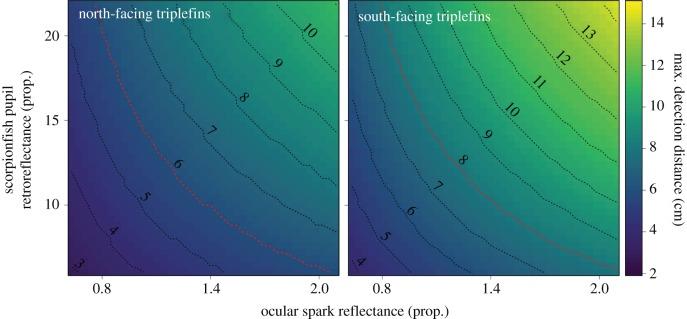
Cases where animals use controlled illumination to improve vision are rare and thus far limited to chemiluminescence, which only functions in darkness. This constraint was recently relaxed by studies on , a small triplefin that redirects sunlight instead. By reflecting light sideways with its iris, it has been suggested to induce and detect eyeshine in nearby micro-prey. Here, we test whether 'diurnal active photolocation' also improves 's ability to detect the cryptobenthic sit-and-wait predator a scorpionfish with strong daytime retroreflective eyeshine. Three independent experiments revealed that triplefins in which light redirection was artificially suppressed approached scorpionfish significantly closer than two control treatments before moving away to a safer distance. Visual modelling confirmed that ocular light redirection by a triplefin is sufficiently strong to generate a luminance increase in scorpionfish eyeshine that can be perceived by the triplefin over 6-8 cm under average conditions. These distances coincide well with the closest approaches observed. We conclude that light redirection by small, diurnal fish significantly contributes to their ability to visually detect cryptic predators, strongly widening the conditions under which active sensing with light is feasible. We discuss the consequences for fish eye evolution.
动物利用可控照明来改善视力的情况很少见,到目前为止仅限于化学发光,而这种发光方式仅在黑暗中起作用。这种限制最近在对一种小型三鳍鱼的研究中得到了放宽,这种鱼会重新引导阳光。通过用虹彩将光线侧向反射,据推测它可以诱导和检测附近微猎物的眼睛反射光。在这里,我们测试了“昼间主动光定位”是否也能提高“三鳍鱼”检测潜伏在暗处、采用伏击策略的捕食者——一种具有强烈日间反向反射眼睛反射光的蝎子鱼的能力。三个独立的实验表明,与两种对照处理相比,在转移到更安全的距离之前,人为抑制光线重定向的三鳍鱼会更接近蝎子鱼。视觉建模证实,三鳍鱼的眼部光线重定向足以在蝎子鱼的眼睛反射光中产生足够的亮度增加,这可以被三鳍鱼在平均条件下 6-8 厘米的距离内感知到。这些距离与观察到的最接近的接近距离非常吻合。我们的结论是,小型昼间鱼类的光线重定向显著有助于它们视觉检测隐匿捕食者的能力,大大拓宽了主动用光探测的可行条件。我们讨论了这对鱼类眼睛进化的影响。


 Zotero 插件