Analytical Science Laboratories, Kao Corporation, 2606 Akabane, Ichikai-machi, Haga-gun, Tochigi, 321-3497, Japan.
Biological Science Laboratories, Kao Corporation, 2606 Akabane, Ichikai-machi, Haga-gun, Tochigi, 321-3497, Japan.
Sci Rep. 2020 Jan 21;10(1):804. doi: 10.1038/s41598-020-57878-y.
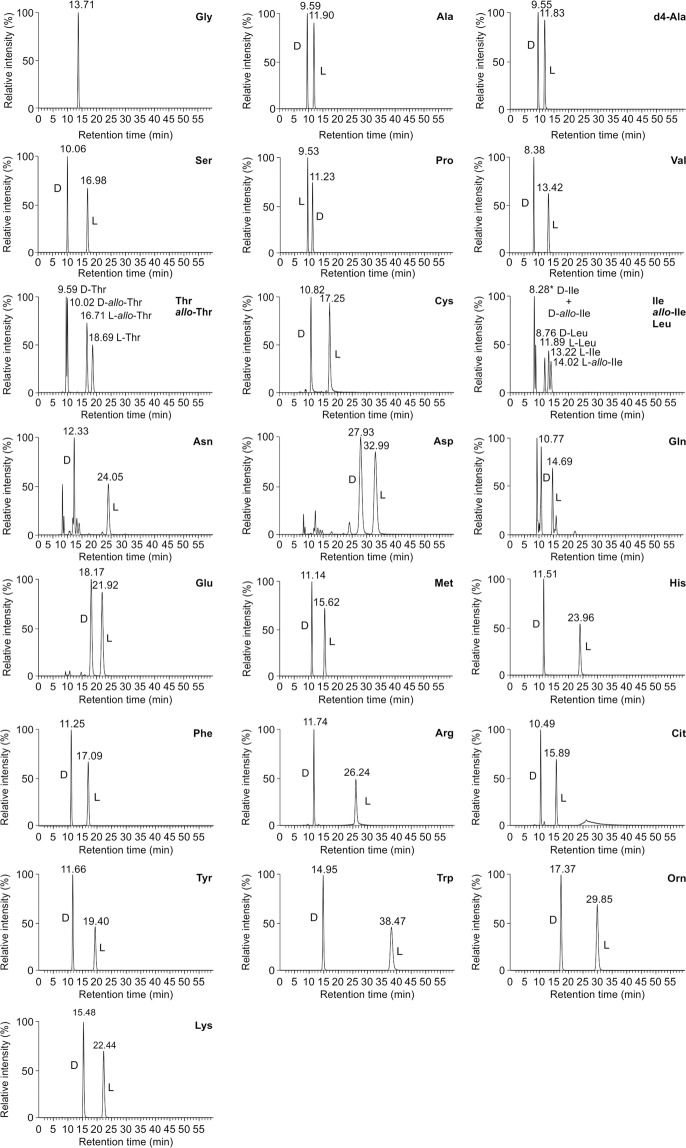
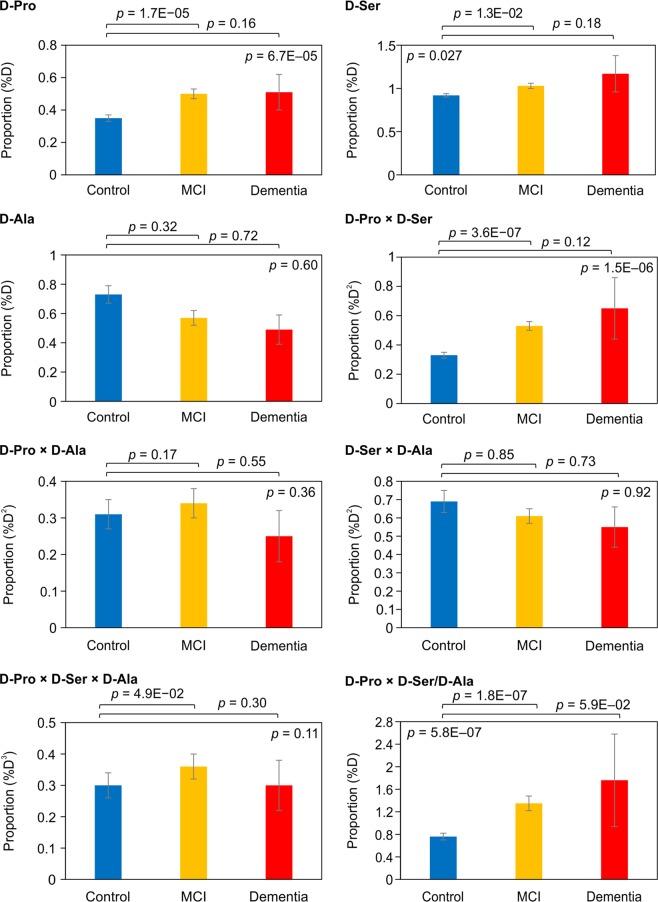
The incidence of dementia, a clinical symptom characterized by severe cognitive decline, is increasing worldwide. Predictive biomarkers are therefore required for early identification and management. D-amino acids in the brain contribute to cognitive function and are suggested as useful biomarkers for diagnosing dementia risk. To clarify their relationship with human cognitive decline, we developed an identification method of chiral metabolomics for detecting slight differences in chiral amino acid amounts. Chiral tandem liquid chromatography-tandem mass spectrometry systems were applied for sensitive and selective amino acid species along with chiral species determination based on anion and zwitterion exchange mechanisms. In a comprehensive health cohort (cross-sectional study), we measured blood chiral amino acid levels from 305 women (65-80 years old) classified into Control, Mild-cognitive-Impairment (MCI), and Dementia groups using the Mini-Mental State Examination. MCI exhibited higher D-Pro (D-Pro/(D-Pro + L-Pro)) proportion vs the Control group, suggesting this proportion as a useful biomarker for MCI. Biomarker accuracy was improved in combination with D-Ser proportion. Receiver operating characteristics analysis of the Control vs. MCI proportion obtained area under the curve (0.80) with 70% sensitivity and 84% specificity at the optimal cutoff value (0.30). Thus, dementia monitoring can be improved by including trace D-amino acids measurements.
痴呆症的发病率在全球范围内不断上升,其临床症状表现为严重的认知能力下降。因此,需要预测性生物标志物来进行早期识别和管理。大脑中的 D-氨基酸有助于认知功能,被认为是诊断痴呆症风险的有用生物标志物。为了阐明它们与人类认知能力下降的关系,我们开发了一种手性代谢组学鉴定方法,用于检测手性氨基酸数量的微小差异。手性串联液相色谱-串联质谱系统应用于敏感和选择性氨基酸种类,以及基于阴离子和两性离子交换机制的手性物质鉴定。在一个全面的健康队列(横断面研究)中,我们使用 Mini-Mental State Examination 对 305 名女性(65-80 岁)进行了血液手性氨基酸水平的测量,这些女性被分为对照组、轻度认知障碍(MCI)组和痴呆症组。MCI 组的 D-Pro(D-Pro/(D-Pro+L-Pro))比例高于对照组,表明该比例可作为 MCI 的有用生物标志物。与 D-Ser 比例相结合,可提高生物标志物的准确性。在控制组与 MCI 组比例的受试者工作特征分析中,最佳截断值(0.30)下获得了 0.80 的曲线下面积(AUC),灵敏度为 70%,特异性为 84%。因此,通过包括痕量 D-氨基酸测量,痴呆症监测可以得到改善。