Department of Medical Genetics, Faculty of Medicine and Dentistry, University of Alberta, Edmonton, AB T6G2H7, Canada.
The Friends of Garrett Cumming Research & Muscular Dystrophy Canada, HM Toupin Neurological Science Research Chair, Edmonton, AB T6G2H7, Canada.
Int J Mol Sci. 2020 Jan 22;21(3):729. doi: 10.3390/ijms21030729.
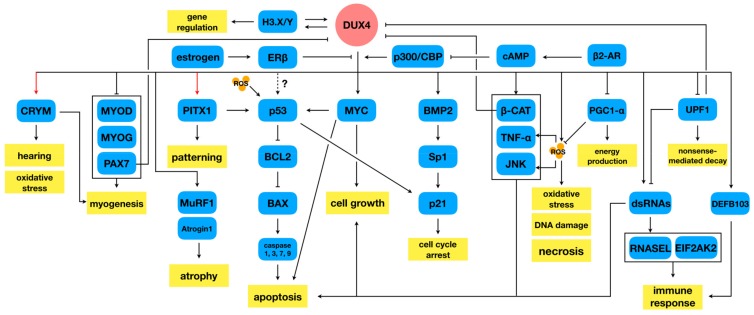
Facioscapulohumeral muscular dystrophy (FSHD) is a disabling inherited muscular disorder characterized by asymmetric, progressive muscle weakness and degeneration. Patients display widely variable disease onset and severity, and sometimes present with extra-muscular symptoms. There is a consensus that FSHD is caused by the aberrant production of the double homeobox protein 4 (DUX4) transcription factor in skeletal muscle. DUX4 is normally expressed during early embryonic development, and is then effectively silenced in all tissues except the testis and thymus. Its reactivation in skeletal muscle disrupts numerous signalling pathways that mostly converge on cell death. Here, we review studies on DUX4-affected pathways in skeletal muscle and provide insights into how understanding these could help explain the unique pathogenesis of FSHD.
面肩肱型肌营养不良症(FSHD)是一种使人丧失能力的遗传性肌肉疾病,其特征是肌肉不对称、进行性无力和退化。患者的发病和严重程度差异很大,有时还会出现肌肉外症状。人们普遍认为,FSHD 是由双同源框蛋白 4(DUX4)转录因子在骨骼肌中的异常产生引起的。DUX4 在早期胚胎发育过程中正常表达,然后在除睾丸和胸腺以外的所有组织中被有效沉默。其在骨骼肌中的重新激活会破坏许多信号通路,这些信号通路主要集中在细胞死亡上。在这里,我们回顾了骨骼肌中受 DUX4 影响的通路研究,并提供了对这些通路的深入了解,这些了解有助于解释 FSHD 的独特发病机制。