Division of Gastroenterology and Hepatology, University of Michigan, Ann Arbor, Michigan; Department of Internal Medicine, University of Michigan, Ann Arbor, Michigan.
Department of Human Genetics and Rogel Cancer Center, University of Michigan, Ann Arbor, Michigan.
Cell Mol Gastroenterol Hepatol. 2020;9(4):689-704. doi: 10.1016/j.jcmgh.2020.01.006. Epub 2020 Jan 23.
BACKGROUND & AIMS: Fifty percent of colorectal cancers show elevated microsatellite alterations at selected tetranucleotide repeats (EMAST) and are associated with inflammation, metastasis, and poor patient outcome. EMAST results from interleukin 6-induced nuclear-to-cytosolic displacement of the DNA mismatch repair protein Mutated S Homolog 3, allowing frameshifts of dinucleotide and tetranucleotide but not mononucleotide microsatellites. Unlike mononucleotide frameshifts that universally shorten in length, we previously observed expansion and contraction frameshifts at tetranucleotide sequences. Here, we developed cell models to assess tetranucleotide frameshifts in real time.
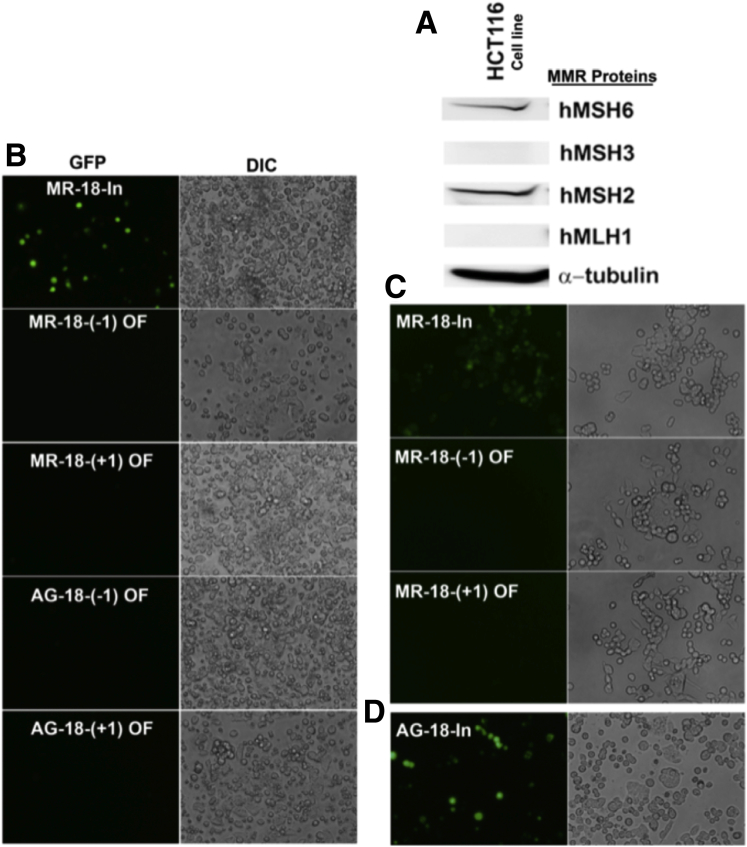
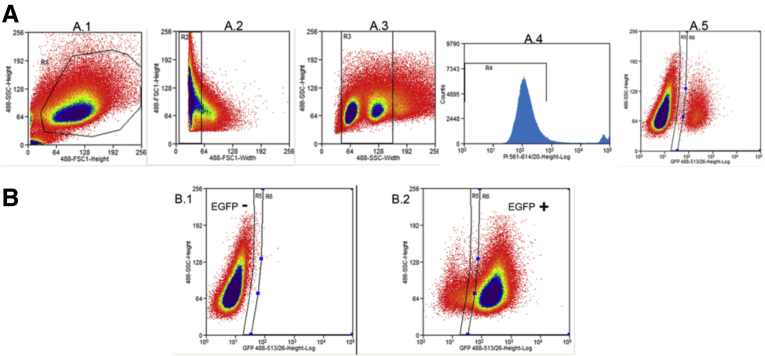
We constructed plasmids containing native (AAAG) and altered-length ([AAAG] and [AAAG]) human D9S242 locus that placed enhanced green fluorescent protein +1 bp/-1 bp out-of-frame for protein translation and stably transfected into DNA mismatch repair-deficient cells for clonal selection. We used flow cytometry to detect enhanced green fluorescent protein-positive cells to measure mutational behavior.
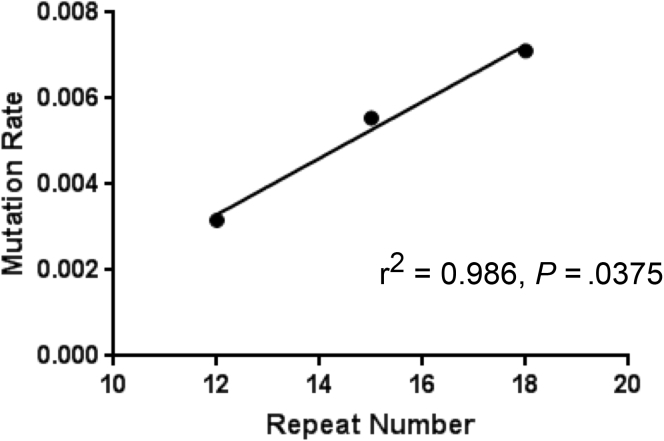
Frameshift mutation rates were 31.6 to 71.1 × 10 mutations/cell/generation and correlated with microsatellite length (r = 0.986, P = .0375). Longer repeats showed modestly higher deletion over insertion rates, with both equivalent for shorter repeats. Accumulation of more deletion frameshifts contributed to a distinct mutational bias for each length (overall: 77.8% deletions vs 22.2% insertions), likely owing to continual deletional mutation of insertions. Approximately 78.9% of observed frameshifts were 1 AAAG repeat, 16.1% were 2 repeats, and 5.1% were 3 or more repeats, consistent with a slipped strand mispairing mutation model.
Tetranucleotide frameshifts show a deletion bias and undergo more than 1 deletion event via intermediates, with insertions converted into deletions. Tetranucleotide markers added to traditional microsatellite instability panels will be able to determine both EMAST and classic microsatellite instability, but needs to be assessed by multiple markers to account for mutational behavior and intermediates.
50%的结直肠癌表现出选定四核苷酸重复序列(EMAST)的高度微卫星改变,与炎症、转移和患者预后不良有关。EMAST 是由白细胞介素 6 诱导的 DNA 错配修复蛋白 Mutated S Homolog 3 的核质易位引起的,允许二核苷酸和四核苷酸但不允许单核苷酸微卫星的移框。与普遍缩短长度的单核苷酸移框不同,我们之前观察到四核苷酸序列的扩展和收缩移框。在这里,我们开发了细胞模型来实时评估四核苷酸移框。
我们构建了含有天然(AAAG)和改变长度([AAAG]和[AAAG])人 D9S242 基因座的质粒,将增强型绿色荧光蛋白+1 bp/-1 bp 置于蛋白质翻译的框外,并稳定转染到 DNA 错配修复缺陷细胞中进行克隆选择。我们使用流式细胞术检测增强型绿色荧光蛋白阳性细胞来测量突变行为。
移框突变率为 31.6 至 71.1×10 个突变/细胞/代,与微卫星长度相关(r=0.986,P=0.0375)。较长的重复序列显示出略高的缺失率高于插入率,对于较短的重复序列则两者相等。更多缺失移框的积累导致每种长度的独特突变偏倚(总体:77.8%缺失与 22.2%插入),可能是由于插入的连续缺失突变。观察到的移框突变中约 78.9%为 1 个 AAAG 重复,16.1%为 2 个重复,5.1%为 3 个或更多重复,与滑链错配突变模型一致。
四核苷酸移框显示出缺失偏向,并通过中间体经历超过 1 个缺失事件,插入转化为缺失。添加到传统微卫星不稳定性面板中的四核苷酸标记将能够确定 EMAST 和经典微卫星不稳定性,但需要通过多个标记进行评估,以解释突变行为和中间体。