Department of Cardiothoracic Surgery, Erasmus MC, University Medical Center, Rotterdam, The Netherlands.
Erasmus School of Health Policy and Management, Erasmus University, Rotterdam, The Netherlands.
Eur J Health Econ. 2020 Jun;21(4):557-572. doi: 10.1007/s10198-020-01159-y. Epub 2020 Jan 25.
Aortic valve disease is the most frequent indication for heart valve replacement with the highest prevalence in elderly. Tissue-engineered heart valves (TEHV) are foreseen to have important advantages over currently used bioprosthetic heart valve substitutes, most importantly reducing valve degeneration with subsequent reduction of re-intervention. We performed early Health Technology Assessment of hypothetical TEHV in elderly patients (≥ 70 years) requiring surgical (SAVR) or transcatheter aortic valve implantation (TAVI) to assess the potential of TEHV and to inform future development decisions.
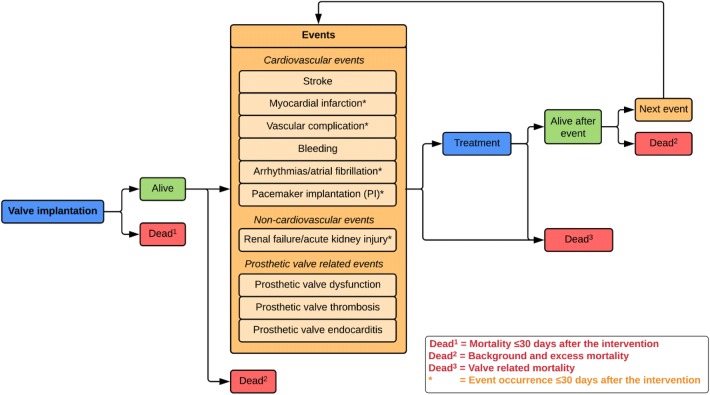
Using a patient-level simulation model, the potential cost-effectiveness of TEHV compared with bioprostheses was predicted from a societal perspective. Anticipated, but currently hypothetical improvements in performance of TEHV, divided in durability, thrombogenicity, and infection resistance, were explored in scenario analyses to estimate quality-adjusted life-year (QALY) gain, cost reduction, headroom, and budget impact.
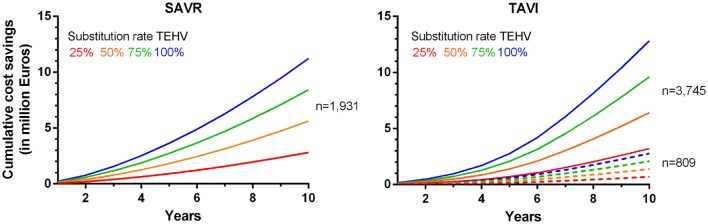
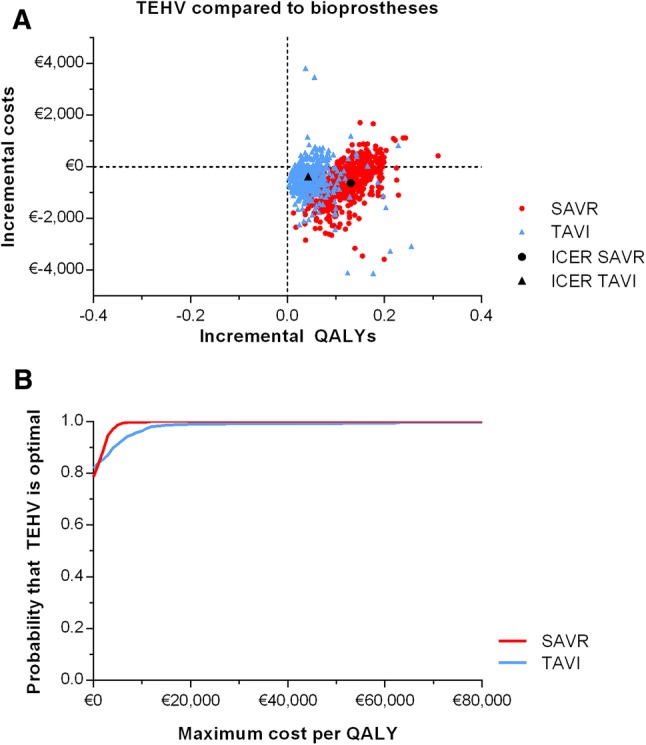
Durability of TEHV had the highest impact on QALY gain and costs, followed by infection resistance. Improved TEHV performance (- 50% prosthetic valve-related events) resulted in lifetime QALY gains of 0.131 and 0.043, lifetime cost reductions of €639 and €368, translating to headrooms of €3255 and €2498 per hypothetical TEHV compared to SAVR and TAVI, respectively. National savings in the first decade after implementation varied between €2.8 and €11.2 million (SAVR) and €3.2-€12.8 million (TAVI) for TEHV substitution rates of 25-100%.
Despite the relatively short life expectancy of elderly patients undergoing SAVR/TAVI, hypothetical TEHV are predicted to be cost-effective compared to bioprostheses, commercially viable and result in national cost savings when biomedical engineers succeed in realising improved durability and/or infection resistance of TEHV.
主动脉瓣疾病是心脏瓣膜置换的最常见指征,在老年人中患病率最高。组织工程心脏瓣膜(TEHV)预计将比目前使用的生物瓣心脏瓣膜替代品具有重要优势,最重要的是减少瓣膜退化,从而减少再次介入。我们对需要手术(SAVR)或经导管主动脉瓣植入术(TAVI)的老年患者(≥70 岁)进行了假设的 TEHV 早期卫生技术评估,以评估 TEHV 的潜力,并为未来的开发决策提供信息。
使用患者水平的仿真模型,从社会角度预测与生物假体相比,TEHV 的潜在成本效益。在方案分析中探讨了目前假设的 TEHV 性能(耐久性、血栓形成和抗感染)的预期改善,以估计质量调整生命年(QALY)的增益、成本降低、空间和预算影响。
TEHV 的耐久性对 QALY 增益和成本的影响最大,其次是抗感染能力。TEHV 性能的改善(减少 50%与假体相关的事件)导致终生 QALY 增益为 0.131 和 0.043,终生成本降低 639 欧元和 368 欧元,相对于 SAVR 和 TAVI,每例假设的 TEHV 分别有 3255 欧元和 2498 欧元的空间。实施后第一个十年的国家节省额在 SAVR(2.8 至 11.2 万欧元)和 TAVI(3.2 至 12.8 万欧元)之间,TEHV 的替代率为 25%至 100%。
尽管接受 SAVR/TAVI 的老年患者的预期寿命相对较短,但与生物假体相比,假设的 TEHV 预计具有成本效益,在生物医学工程师成功实现 TEHV 耐久性和/或抗感染能力的提高时,具有商业可行性并导致国家成本节约。