Diyarbakır University of Health Sciences Turkey, Gazi Yaşargil Training and Research Hospital, Clinic of Paediatrics, Diyarbakır, Turkey
Diyarbakır University of Health Sciences Turkey, Gazi Yaşargil Training and Research Hospital, Clinic of Paediatric Endocrinology, Diyarbakır, Turkey
J Clin Res Pediatr Endocrinol. 2020 Sep 2;12(3):275-280. doi: 10.4274/jcrpe.galenos.2020.2019.0170. Epub 2020 Jan 28.
The tendency to reduce thyroid stimulating hormone (TSH) referral cut-off values in congenital hypothyroidism (CH) neonatal screening programs has resulted in an increase in the incidence of CH, but also the referral of infants with mild transient elevation of TSH. Therefore, there is a need to develop markers for differentiation of transient elevated TSH and permanent CH as early as safely possible to avoid unnecessary treatment. The aim was to evaluate sixth-month L-thyroxine (LT4) dose as a predictive marker for differentiation of transient elevated TSH and permanent CH.
Data of patients who had been followed after referral from the neonatal screening programme between the year 2010 and 2019 in a tertiary pediatric endocrine centre were examined retrospectively.
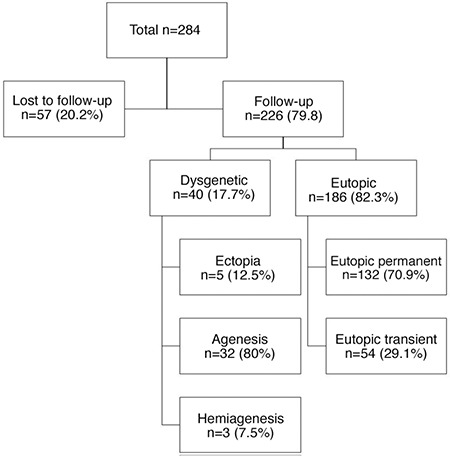
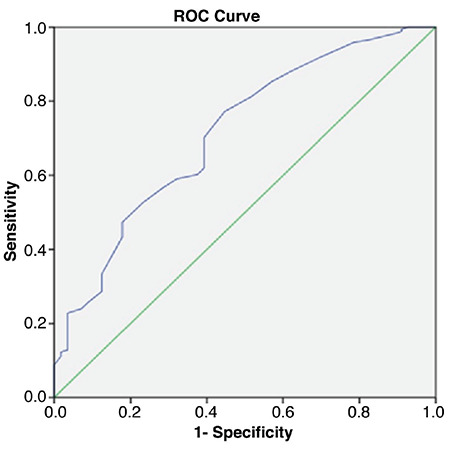
There were 226 cases referred, of whom 186 (82.3%) had eutopic thyroid gland, and 40 (17.7%) had dysgenetic gland. In patients with a dysgentic gland there was a non-significant tendency to have lower diagnostic free thyroxine concentration but significantly higher TSH compared with those with eutopic gland (p=0.44 and p=0.023, respectively). Patients with thyroid dysgenesis required higher initial and six month LT4 doses compared with those with eutopic glands (p=0.001). Receiver operator curve analysis showed the optimum cut-off value for LT4 at six months for transient vs. permanent CH was 2 μg/kg/day (sensitivity 77% and specificity 55%), regardless of etiology. Similarly, in patients with eutopic glands the optimum cut-off value for LT4 dose at six months for permanent vs. transient patients was 2 μg/kg/day (sensitivity 72% and specificity 54%).
Results suggest that LT4 requirement at six months of therapy may be a good marker for predicting transient TSH elevation in patients with eutopic thyroid gland, thus facilitating the decision to halt LT4 therapy.
先天性甲状腺功能减退症(CH)新生儿筛查计划中降低促甲状腺激素(TSH)转诊截止值的趋势导致 CH 的发病率增加,但也导致 TSH 轻度一过性升高的婴儿转诊。因此,需要尽早开发标志物来区分一过性 TSH 升高和永久性 CH,以避免不必要的治疗。目的是评估 6 个月时左旋甲状腺素(LT4)剂量作为区分一过性 TSH 升高和永久性 CH 的预测标志物。
回顾性分析 2010 年至 2019 年期间在一家三级儿科内分泌中心接受新生儿筛查计划转诊后随访的患者数据。
共 226 例患者被转诊,其中 186 例(82.3%)甲状腺位置正常,40 例(17.7%)甲状腺发育不良。在甲状腺发育不良的患者中,诊断游离甲状腺素浓度无显著降低趋势,但 TSH 显著升高(分别为 p=0.44 和 p=0.023)。与甲状腺位置正常的患者相比,甲状腺发育不良的患者需要更高的初始和 6 个月 LT4 剂量(p=0.001)。接受者操作特征曲线分析显示,6 个月时 LT4 对暂时性与永久性 CH 的最佳截断值为 2μg/kg/天(敏感性为 77%,特异性为 55%),与病因无关。同样,在甲状腺位置正常的患者中,6 个月时 LT4 剂量对永久性与暂时性患者的最佳截断值为 2μg/kg/天(敏感性为 72%,特异性为 54%)。
结果表明,治疗 6 个月时的 LT4 需要量可能是预测甲状腺位置正常的患者一过性 TSH 升高的良好标志物,从而有助于决定停止 LT4 治疗。