Department of Biomedical Research, Joan C. Edwards School of Medicine, Huntington, WV 25701, USA.
Neurobiology Research Laboratory, VA Medical Center, Huntington, WV 25704, USA.
Cells. 2020 Jan 26;9(2):297. doi: 10.3390/cells9020297.
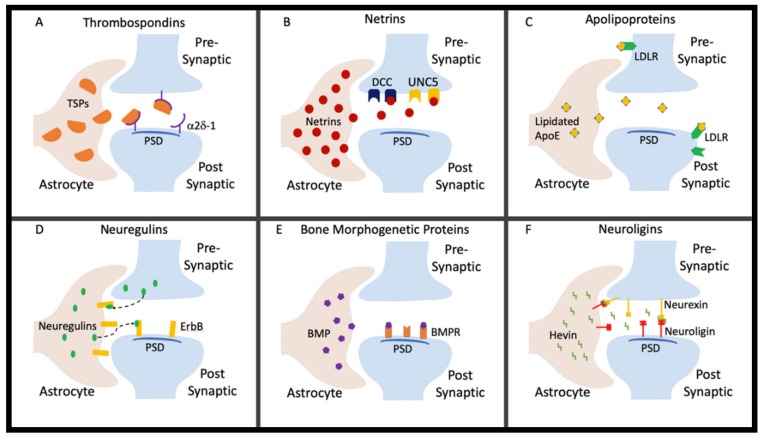
Astrocytes have critical functions throughout the central nervous system (CNS) and have emerged as regulators of synaptic development and function. With their highly complex morphologies, they are able to interact with thousands of synapses via peripheral astrocytic processes (PAPs), ensheathing neuronal axons and dendrites to form the tripartite synapse. In this way, astrocytes engage in crosstalk with neurons to mediate a variety of CNS processes including the regulation of extracellular matrix protein signaling, formation and maintenance of the blood-brain barrier (BBB), axon growth and guidance, homeostasis of the synaptic microenvironment, synaptogenesis, and the promotion of synaptic diversity. In this review, we discuss several key astrocyte signaling factors (thrombospondins, netrins, apolipoproteins, neuregulins, bone morphogenetic proteins, and neuroligins) in the maintenance and regulation of synapse formation. We also explore how these astrocyte signaling factors are impacted by and contribute to substance abuse, particularly alcohol and cocaine use.
星形胶质细胞在中枢神经系统(CNS)中具有关键功能,并且已经成为调节突触发育和功能的关键。它们具有高度复杂的形态,可以通过周围星形胶质细胞突起(PAP)与数千个突触相互作用,包绕神经元轴突和树突,形成三突触。通过这种方式,星形胶质细胞与神经元进行交流,介导包括细胞外基质蛋白信号转导、血脑屏障(BBB)的形成和维持、轴突生长和导向、突触微环境的动态平衡、突触发生以及促进突触多样性在内的多种 CNS 过程。在这篇综述中,我们讨论了几种关键的星形胶质细胞信号因子(血栓素、netrins、载脂蛋白、神经调节蛋白、骨形态发生蛋白和神经连接蛋白)在维持和调节突触形成中的作用。我们还探讨了这些星形胶质细胞信号因子如何受到物质滥用(特别是酒精和可卡因使用)的影响以及对其产生的影响。