Department of Pediatrics and Pharmacology, Mazankowski Alberta Heart Institute, University of Alberta, Edmonton, AB T6G 2S2, Canada.
Faculty of Medicine and Dentistry Cell Imaging Centre, University of Alberta, Edmonton, AB, Canada.
Cardiovasc Res. 2021 Jan 1;117(1):188-200. doi: 10.1093/cvr/cvaa017.
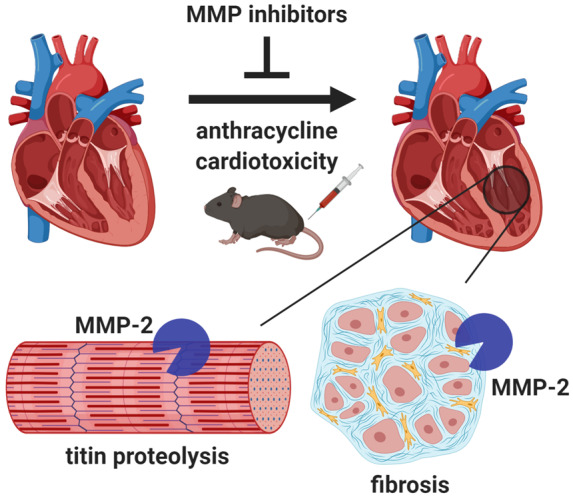
Heart failure is a major complication in cancer treatment due to the cardiotoxic effects of anticancer drugs, especially from the anthracyclines such as doxorubicin (DXR). DXR enhances oxidative stress and stimulates matrix metalloproteinase-2 (MMP-2) in cardiomyocytes. We investigated whether MMP inhibitors protect against DXR cardiotoxicity given the role of MMP-2 in proteolyzing sarcomeric proteins in the heart and remodelling the extracellular matrix.
Eight-week-old male C57BL/6J mice were treated with DXR weekly with or without MMP inhibitors doxycycline or ONO-4817 by daily oral gavage for 4 weeks. Echocardiography was used to determine cardiac function and left ventricular remodelling before and after treatment. MMP inhibitors ameliorated DXR-induced systolic and diastolic dysfunction by reducing the loss in left ventricular ejection fraction, fractional shortening, and E'/A'. MMP inhibitors attenuated adverse left ventricular remodelling, reduced cardiomyocyte dropout, and prevented myocardial fibrosis. DXR increased myocardial MMP-2 activity in part also by upregulating N-terminal truncated MMP-2. Immunogold transmission electron microscopy showed that DXR elevated MMP-2 levels within the sarcomere and mitochondria which were associated with myofilament lysis, mitochondrial degeneration, and T-tubule distention. DXR-induced myofilament lysis was associated with increased titin proteolysis in the heart which was prevented by ONO-4817. DXR also increased the level and activity of MMP-2 in human embryonic stem cell-derived cardiomyocytes, which was reduced by ONO-4817.
MMP-2 activation is an early event in DXR cardiotoxicity and contributes to myofilament lysis by proteolyzing cardiac titin. Two orally available MMP inhibitors ameliorated DXR cardiotoxicity by attenuating intracellular and extracellular matrix remodelling, suggesting their use may be a potential prophylactic strategy to prevent heart injury during chemotherapy.
由于抗癌药物的心脏毒性作用,心力衰竭是癌症治疗的主要并发症,特别是蒽环类药物如多柔比星(DXR)。DXR 增强氧化应激并刺激心肌细胞中的基质金属蛋白酶-2(MMP-2)。鉴于 MMP-2 在心脏中水解肌节蛋白和重塑细胞外基质中的作用,我们研究了 MMP 抑制剂是否可以预防 DXR 心脏毒性。
8 周龄雄性 C57BL/6J 小鼠每周用 DXR 处理,并用或不用 MMP 抑制剂强力霉素或 ONO-4817 通过每日口服灌胃处理 4 周。在治疗前后使用超声心动图来确定心脏功能和左心室重塑。MMP 抑制剂通过降低左心室射血分数、分数缩短和 E'/A'的损失,改善了 DXR 引起的收缩和舒张功能障碍。MMP 抑制剂减轻了不利的左心室重塑,减少了心肌细胞丢失,并防止了心肌纤维化。DXR 通过上调 N 端截断的 MMP-2 部分增加了心肌 MMP-2 活性。免疫金透射电镜显示,DXR 升高了肌节和线粒体中的 MMP-2 水平,这与肌丝溶解、线粒体变性和 T 管扩张有关。DXR 诱导的肌丝溶解与心脏中的 Titin 水解增加有关,ONO-4817 可防止这种水解。DXR 还增加了人胚胎干细胞衍生的心肌细胞中 MMP-2 的水平和活性,ONO-4817 降低了这种活性。
MMP-2 的激活是 DXR 心脏毒性的早期事件,并通过水解心脏 Titin 导致肌丝溶解。两种口服 MMP 抑制剂通过减轻细胞内和细胞外基质重塑改善了 DXR 心脏毒性,表明它们的使用可能是预防化疗期间心脏损伤的潜在策略。