School of Nursing and Midwifery, Guilan University of Medical Sciences, Rasht, Iran.
Department of Medical Ethics and Law, Reproductive Biomedicine Research Center, Royan Institute for Reproductive Biomedicine, ACECR, Tehran, Iran.
BMC Psychol. 2020 Jan 29;8(1):6. doi: 10.1186/s40359-020-0375-z.
Infertility can have a powerful impact on marital quality. The Revised Dyadic Adjustment Scale (RDAS) is a widely used measure of marital quality. This scale has not been validated in infertile patients. Therefore, this study aimed to evaluate the reliability and validity of the RDAS in a sample of infertile patients.
The sample of this methodological study consisted of 254 infertile patients referring to a referral infertility clinic in Tehran, Iran. A battery of questionnaires was administered to the participants, including a demographic/fertility questionnaire, the RDAS, the Relationship Assessment Scale (RAS), the Kansas Marital Satisfaction Scale (KMSS), the Couples Satisfaction Index- 4 Item (CSI-4), the Hospital Anxiety and Depression Scale (HADS), and the Perceived Stress Scale-4 Item (PSS-4). Internal consistency of the scale was assessed with Cronbach's alpha, construct validity was investigated using confirmatory factor analysis (CFA), and convergent validity was examined by correlating the RDAS with RAS, KMSS, CSI-4, HADS, and PSS-4 instruments.
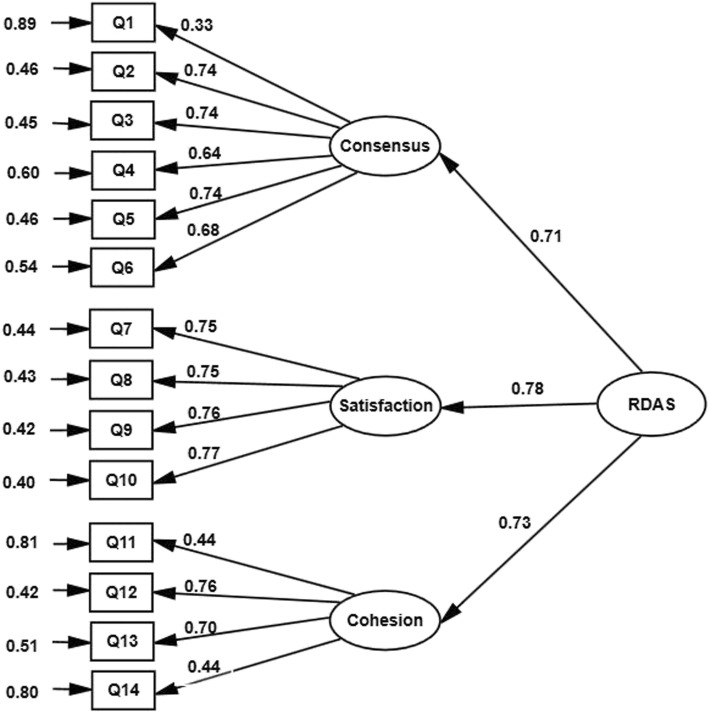
The mean total RDAS score was 49.26 ± 9.34, and 100 patients (39.4%) had marital distress based on the cut-off value of < 48. The second-order three-factor model of the RDAS exhibited an excellent fit to the data, as indicated by χ/df = 2.26; CFI = 0.96; GFI = 0.91; NFI = 0.93; IFI = 0.96; RMSEA = 0.071 and SRMR = 0.050. The RDAS and its subscales revealed satisfactory internal consistency that ranged from 0.664 to 0.847. Convergent validity was confirmed by strong correlations between RDAS scores and scores on the RAS, KMSS, and CSI-4. These correlations also tended to be larger than correlations with measures of HADS-anxiety, HADS-depression, and PSS-4. Among demographic/fertility variables, only infertility duration was found to be correlated to the RDAS.
The RDAS is a reliable and valid inventory for measuring marital quality in infertile patients. Further validation studies are needed to generalize the underlying structure of the scale in various populations.
不孕不育会对婚姻质量产生重大影响。修订后的对偶调整量表(RDAS)是一种广泛用于衡量婚姻质量的量表。该量表尚未在不孕患者中得到验证。因此,本研究旨在评估 RDAS 在不孕患者样本中的信度和效度。
本方法学研究的样本包括 254 名来自伊朗德黑兰一家不孕症转诊诊所的不孕患者。参与者接受了一系列问卷,包括人口统计学/生育问卷、RDAS、关系评估量表(RAS)、堪萨斯婚姻满意度量表(KMSS)、夫妻满意度指数-4 项(CSI-4)、医院焦虑和抑郁量表(HADS)和 4 项感知压力量表(PSS-4)。采用 Cronbach's alpha 评估量表的内部一致性,采用验证性因子分析(CFA)考察结构效度,并通过与 RAS、KMSS、CSI-4、HADS 和 PSS-4 量表相关来检验收敛效度。
RDAS 的平均总分得分为 49.26±9.34,根据<48 的临界值,有 100 名患者(39.4%)存在婚姻困扰。RDAS 的二阶三因素模型与数据拟合良好,χ/df=2.26;CFI=0.96;GFI=0.91;NFI=0.93;IFI=0.96;RMSEA=0.071 和 SRMR=0.050。RDAS 及其分量表的内部一致性令人满意,范围为 0.664 至 0.847。RDAS 评分与 RAS、KMSS 和 CSI-4 评分之间的强相关性证实了收敛效度。这些相关性也倾向于大于与 HADS-焦虑、HADS-抑郁和 PSS-4 测量值的相关性。在人口统计学/生育变量中,只有不孕持续时间与 RDAS 相关。
RDAS 是一种可靠有效的量表,可用于衡量不孕患者的婚姻质量。需要进一步的验证研究来推广该量表在不同人群中的潜在结构。