Institute of Applied Synthetic Chemistry and Institute of Chemical Technologies and Analytics, Faculty of Technical Chemistry, Vienna University of Technology, Getreidemarkt 9/163-164, 1060, Vienna, Austria.
Austrian Cluster for Tissue Regeneration, Vienna, Austria.
Sci Rep. 2020 Jan 29;10(1):1400. doi: 10.1038/s41598-020-58373-0.
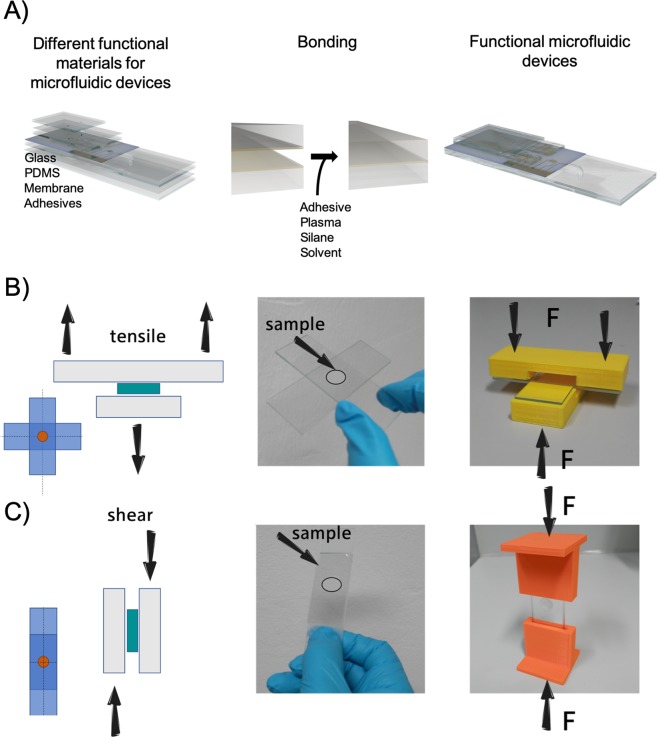
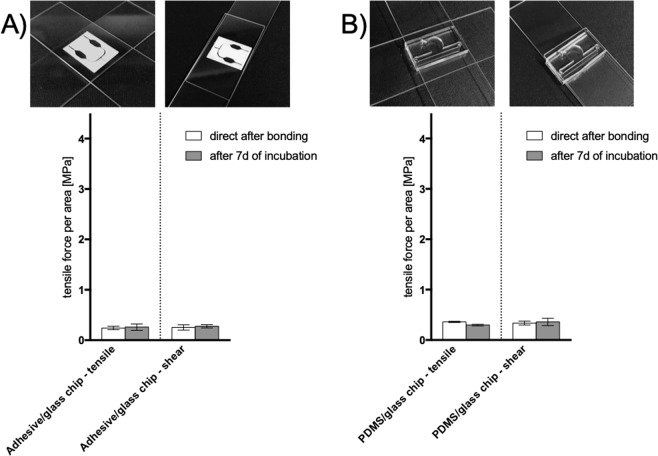
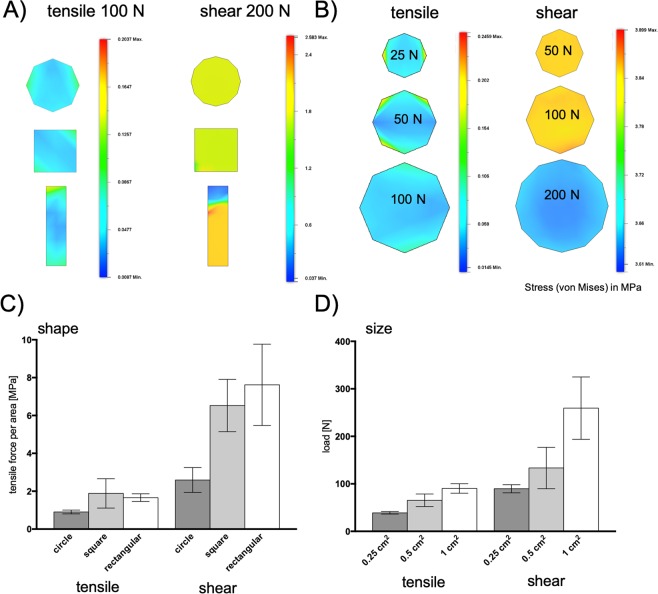
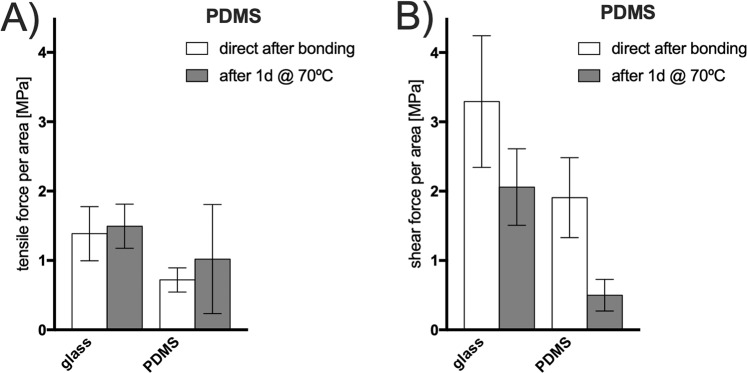
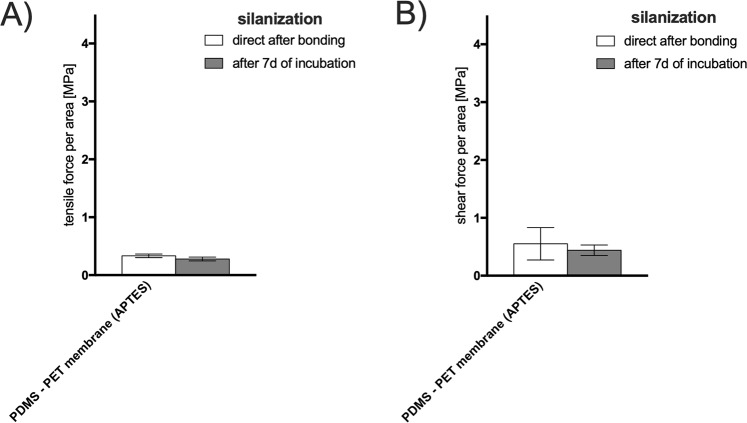
Bonding of a variety of inorganic and organic polymers as multi-layered structures is one of the main challenges for biochip production even to date, since the chemical nature of these materials often does not allow easy and straight forward bonding and proper sealing. After selection of an appropriate method to bond the chosen materials to form a complex biochip, function and stability of bonding either requires qualitative burst tests or expensive mechanical multi-test stations, that often do not have the right adaptors to clamp biochip slides without destruction. Therefore, we have developed a simple and inexpensive bonding test based on 3D printed transmission elements that translate compressive forces via manual compression, hand press or hydraulic press compression into shear and tensile force. Mechanical stress simulations showed that design of the bonding geometry and size must be considered for bonding tests since the stress distribution thus bonding strength heavily varies with size but also with geometry. We demonstrate the broad applicability of our 3D printed bonding test system by testing the most frequent bonding strategies in combination with the respective most frequently used biochip material in a force-to-failure study. All evaluated materials are biocompatible and used in cell-based biochip devices. This study is evaluating state-of-the-art bonding approaches used for sealing of microfluidic biochips including adhesive bonding, plasma bonding, solvent bonding as well as bonding mediated by amino-silane monolayers or even functional thiol-ene epoxy biochip materials that obviate intermediate adhesive layers.
将各种无机和有机聚合物结合为多层结构是生物芯片生产至今面临的主要挑战之一,因为这些材料的化学性质通常不允许简单直接的结合和适当的密封。在选择将选定的材料结合形成复杂生物芯片的适当方法之后,结合的功能和稳定性需要定性的突发测试或昂贵的机械多测试站,这些测试站通常没有合适的适配器来在不破坏的情况下夹住生物芯片载玻片。因此,我们开发了一种基于 3D 打印传输元件的简单且廉价的结合测试,该测试通过手动压缩、手压或液压机压缩将压缩力转化为剪切力和拉力。机械应力模拟表明,必须考虑结合几何形状和尺寸的设计,因为因此结合强度的应力分布会随着尺寸而有很大变化,但也会随着几何形状而变化。我们通过在失效力研究中结合最常用的生物芯片材料来测试最常见的结合策略,展示了我们 3D 打印结合测试系统的广泛适用性。所有评估的材料都是生物相容性的,并且用于基于细胞的生物芯片设备中。本研究评估了用于微流控生物芯片密封的最新结合方法,包括粘合剂结合、等离子体结合、溶剂结合以及通过氨基硅烷单层甚至功能硫醇-烯环氧生物芯片材料进行的结合,这些方法省去了中间的粘合剂层。