Du Tingting, Meng Ping, Huang Jianliang, Peng Shaobing, Xiong Dongliang
National Key Laboratory of Crop Genetic Improvement, MOA Key Laboratory of Crop Ecophysiology and Farming System in the Middle Reaches of the Yangtze River, Huazhong Agricultural University, Wuhan, 430070 Hubei China.
Plant Methods. 2020 Jan 24;16:6. doi: 10.1186/s13007-020-0553-2. eCollection 2020.
Over the past decades, the structural and functional genomics of rice have been deeply studied, and high density of molecular genetic markers have been developed. However, the genetic variation in leaf photosynthesis, the most important trait for rice yield improvement, was rarely studied. The lack of photosynthesis phenotyping tools is one of the bottlenecks, as traditional direct photosynthesis measurements are very low-throughput, and recently developed high-throughput methods are indirect measurements. Hence, there is an urgent need for a fast, accurate and direct measurement approach.
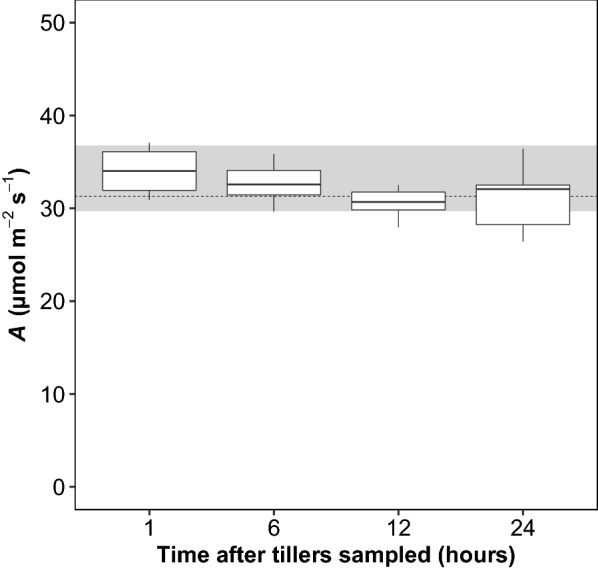
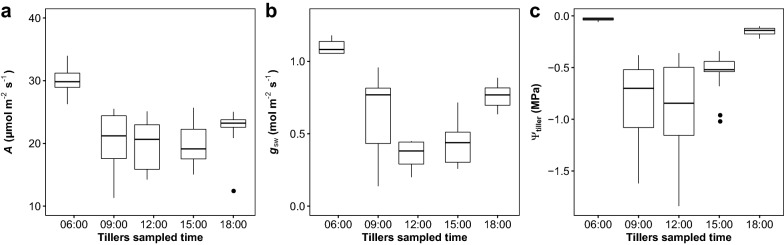
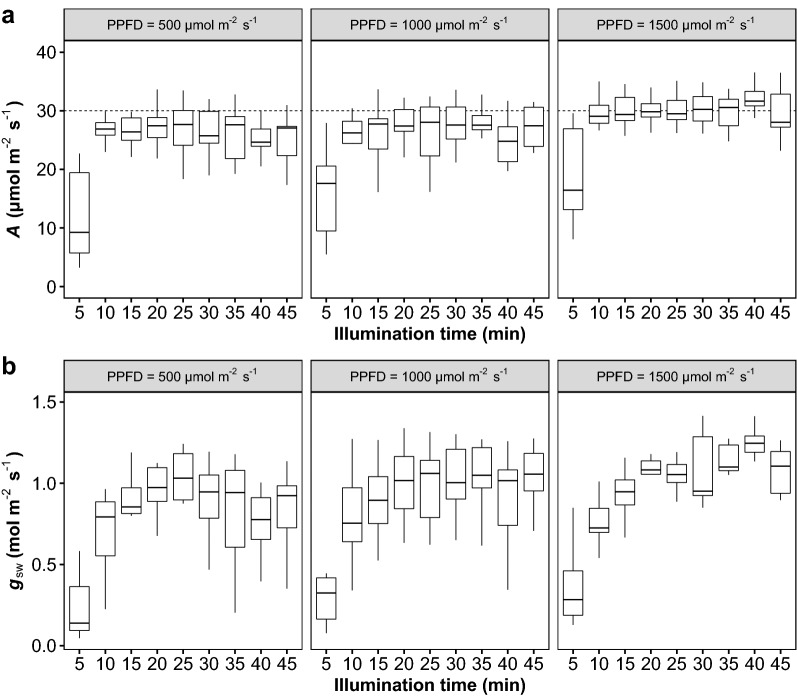
We reported a fast photosynthesis measurement (FPM) method for phenotyping photosynthetic capacity of rice, which measures photosynthesis of excised tillers in environment-controlled lab conditions. The light response curves measured using FPM approach coped well with that the curves measured using traditional gas exchange approach. Importantly, the FPM technique achieved an average throughput of 5.4 light response curves per hour, which was 3 times faster than the 1.8 light response curves per hour using the traditional method. Tillers sampled at early morning had the highest photosynthesis, stomatal conductance and the lowest variability. In addition, even 12 h after sampling, there was no significant difference of photosynthesis rate between excised tillers and in situ. We finally investigated the genetic variations of photosynthetic traits across 568 F2 lines using the FPM technique and discussed the logistics of screening several hundred samples per day per instrumental unit using FPM to generate a wealth of photosynthetic phenotypic data, which might help to improve the selection power in large populations of rice with the ultimate aim of improving yield through improved photosynthesis.
Here we developed a high-throughput method that can measure the rice leaf photosynthetic capacity approximately 10 times faster than traditional gas exchange approaches. Importantly, this method can overcome measurement errors caused by environmental heterogeneity under field conditions, and it is possible to measure 12 or more hours per day under lab conditions.
在过去几十年里,水稻的结构和功能基因组学得到了深入研究,并且开发出了高密度的分子遗传标记。然而,对于水稻产量提高最重要的性状——叶片光合作用的遗传变异却鲜有研究。缺乏光合作用表型分析工具是瓶颈之一,因为传统的直接光合作用测量通量非常低,而最近开发的高通量方法是间接测量。因此,迫切需要一种快速、准确且直接的测量方法。
我们报道了一种用于水稻光合能力表型分析的快速光合作用测量(FPM)方法,该方法在环境可控的实验室条件下测量离体分蘖的光合作用。使用FPM方法测得的光响应曲线与使用传统气体交换方法测得的曲线拟合良好。重要的是,FPM技术实现了每小时平均5.4条光响应曲线的通量,这比传统方法每小时1.8条光响应曲线快3倍。清晨采集的分蘖光合作用、气孔导度最高且变异性最低。此外,即使在采样12小时后,离体分蘖与原位分蘖之间的光合速率也没有显著差异。我们最终使用FPM技术研究了568个F2品系光合性状的遗传变异,并讨论了每个仪器单元每天使用FPM筛选数百个样本以生成大量光合表型数据的可行性,这可能有助于提高在大量水稻群体中的选择能力,最终目标是通过改善光合作用来提高产量。
我们在此开发了一种高通量方法,其测量水稻叶片光合能力的速度比传统气体交换方法快约10倍。重要的是,该方法可以克服田间条件下环境异质性引起的测量误差,并且在实验室条件下每天有可能测量12小时或更长时间。