Yang Wen, Qi Yu-Bin, Si Meng, Hou Yong, Nie Lin
Department of Orthopaedics, Qilu Hospital of Shandong University, Jinan, Shandong Province, China.
Department of Spinal Surgery, Heze Municipal Hospital, Heze, Shandong Province, China.
PeerJ. 2020 Jan 20;8:e8389. doi: 10.7717/peerj.8389. eCollection 2020.
Osteosarcoma (OS) is the most common malignant primary bone tumor occurring in children and young adults, which occupies the second important cause of tumor-associated deaths among children and young adults. Recent studies have demonstrated that many microRNAs (miRNAs) have abnormal expression in OS, and can function as prognostic factors of OS patients. However, no previous studies have comprehensively analyzed the relationship between multiple miRNAs and prognosis of OS patients.
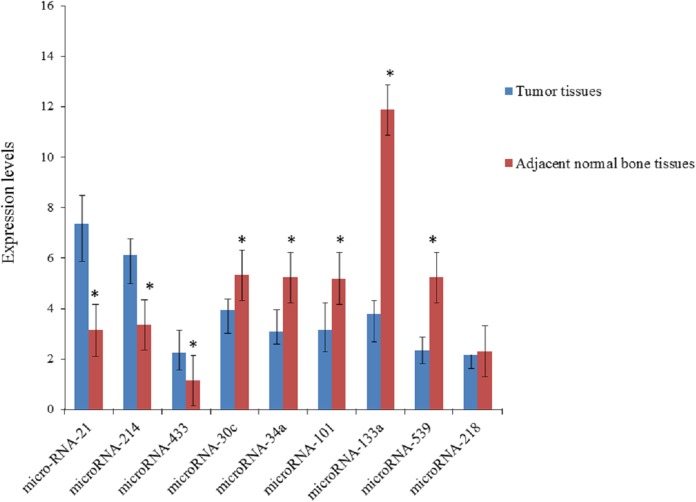
A total of 63 OS patients were retrospectively enrolled. The clinical characteristics were collected, and the expression levels of miRNA-21, miRNA-30c, miRNA-34a, miRNA-101, miRNA-133a, miRNA-214, miRNA-218, miRNA-433 and miRNA-539 in tumor tissues were measured through quantitative real-time polymerasechain reaction. Kaplan-Meier analysis was used to perform univariate survival analysis, and Cox regression model was used to perform multivariate survival analysis which included the variables with < 0.1 in univariate survival analysis.
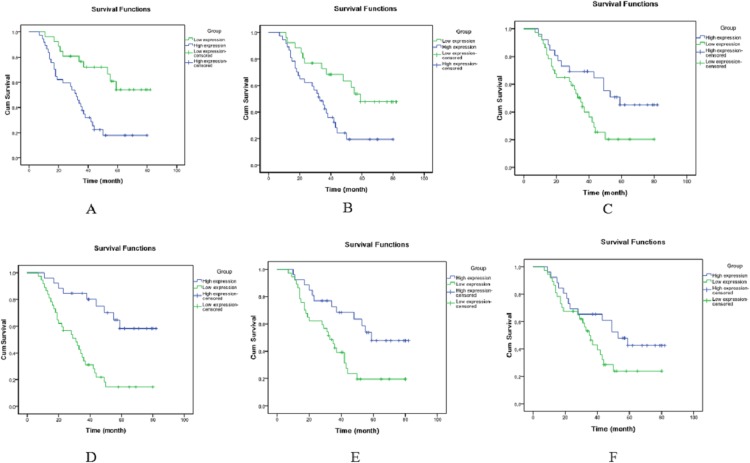
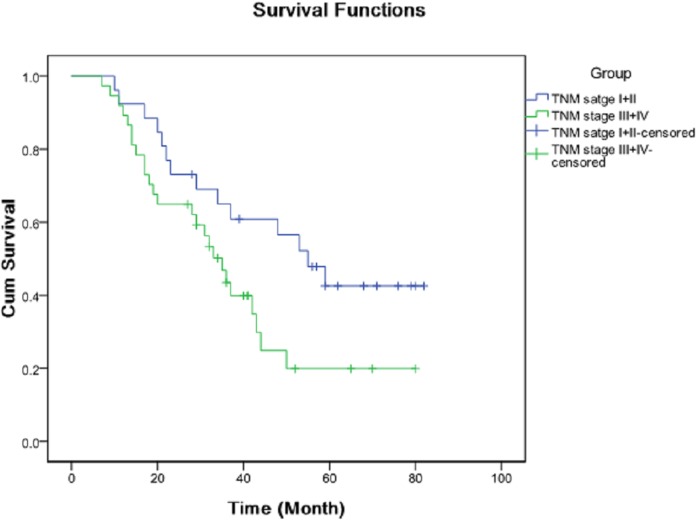
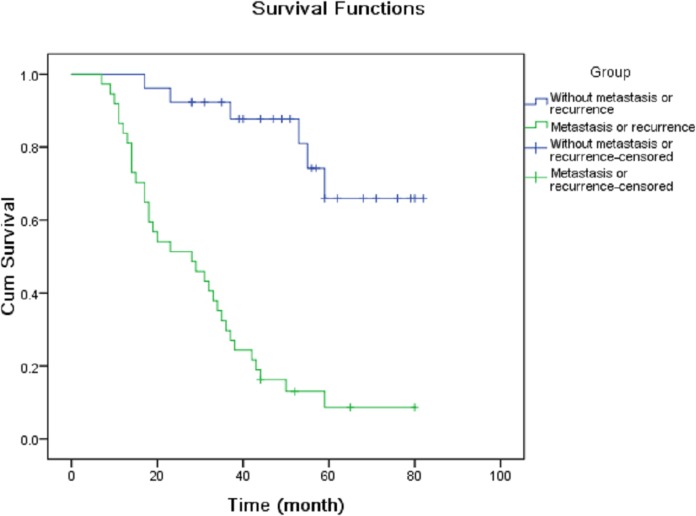
The cumulative survival for 1, 2 and 5 years was 90.48%, 68.25% and 38.10%, respectively, and mean survival time was (45.39 ± 3.60) months (95% CI [38.34-52.45]). Kaplan-Meier analysis demonstrated that TNM stage, metastasis or recurrence, miRNA-21, miRNA-214, miRNA-34a, miRNA-133a and miRNA-539 were correlated with cum survival, but gender, age, tumor diameter, differentiation, miRNA-30c, miRNA-433, miRNA-101 and miRNA-218 were not. Multivariate survival analysis demonstrated that miRNA-21 (hazard ratio (HR): 3.457, 95% CI [2.165-11.518]), miRNA (HR: 3.138, 95% CI [2.014-10.259]), miRNA-34a (HR: 0.452, 95% CI [0.202-0.915]), miRNA-133a (HR: 0.307, 95% CI [0.113-0.874]) and miRNA-539 (HR: 0.358, 95% CI [0.155-0.896]) were independent prognostic markers of OS patients after adjusting for TNM stage (HR: 2.893, 95% CI [1.496-8.125]), metastasis or recurrence (HR: 3.628, 95% CI [2.217-12.316]) and miRNA-30c (HR: 0.689, 95% CI [0.445-1.828]).
High expression of miRNA-21 and miRNA-214 and low expression of miRNA-34a, miRNA-133a and miRNA-539 were associated with poor prognosis of OS patients after adjusting for TNM stage, metastasis or recurrence and miRNA-30c.
骨肉瘤(OS)是儿童和青少年中最常见的原发性恶性骨肿瘤,是儿童和青少年肿瘤相关死亡的第二大重要原因。最近的研究表明,许多微小RNA(miRNA)在骨肉瘤中表达异常,并可作为骨肉瘤患者的预后因素。然而,此前尚无研究全面分析多种miRNA与骨肉瘤患者预后之间的关系。
回顾性纳入63例骨肉瘤患者。收集临床特征,并通过定量实时聚合酶链反应检测肿瘤组织中miRNA-21、miRNA-30c、miRNA-34a、miRNA-101、miRNA-133a、miRNA-214、miRNA-218、miRNA-433和miRNA-539的表达水平。采用Kaplan-Meier分析进行单因素生存分析,采用Cox回归模型进行多因素生存分析,多因素生存分析纳入单因素生存分析中P<0.1的变量。
1年、2年和5年的累积生存率分别为90.48%、68.25%和38.10%,平均生存时间为(45.39±3.60)个月(95%CI[38.34-52.45])。Kaplan-Meier分析表明,TNM分期、转移或复发、miRNA-21、miRNA-214、miRNA-34a、miRNA-133a和miRNA-539与累积生存率相关,但性别、年龄、肿瘤直径、分化程度、miRNA-30c、miRNA-433、miRNA-101和miRNA-218与累积生存率无关。多因素生存分析表明,在校正TNM分期(风险比(HR):2.893,95%CI[1.496-8.125])、转移或复发(HR:3.628,95%CI[2.217-12.316])和miRNA-30c(HR:0.689,95%CI[0.445-1.828])后,miRNA-21(HR:3.457,95%CI[2.165-11.518])、miRNA(HR:3.138,95%CI[2.014-10.259])、miRNA-34a(HR:0.452,95%CI[0.202-0.915])、miRNA-133a(HR:0.307,95%CI[0.113-0.874])和miRNA-539(HR:0.358,95%CI[0.155-0.896])是骨肉瘤患者的独立预后标志物。
在校正TNM分期、转移或复发以及miRNA-30c后,miRNA-21和miRNA-214的高表达以及miRNA-34a、miRNA-133a和miRNA-539的低表达与骨肉瘤患者的不良预后相关。