Gugjoo Mudasir B, Hussain Shahid, Shah Riaz A, Dhama Kuldeep
Division of Veterinary Clinical Complex, Faculty of Veterinary Sciences and Animal Husbandry, SKUAST, Shuhama, Srinagar-190006, Jammu and Kashmir, India.
Division of Surgery, ICAR-Indian Veterinary Research Institute, Izatnagar, Bareilly, 243 122, Uttar Pradesh, India.
Recent Pat Inflamm Allergy Drug Discov. 2020;14(1):3-14. doi: 10.2174/1872213X14666200130100236.
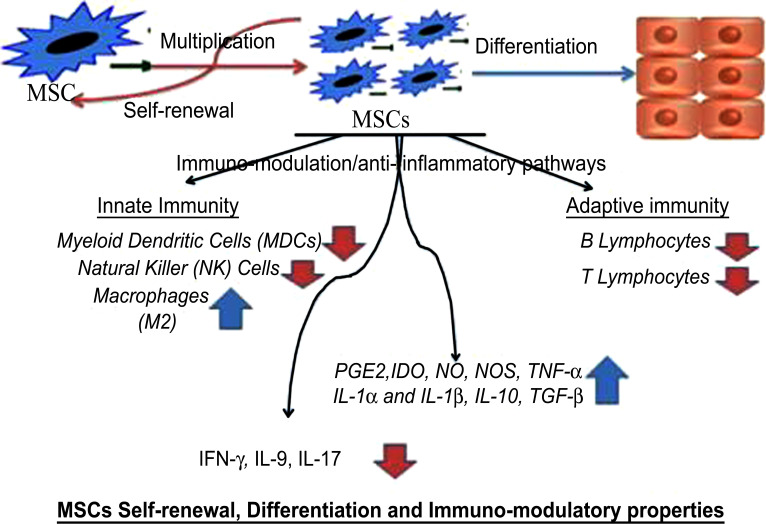
Mesenchymal Stem Cells (MSCs) are present in almost all the tissues of the body and act as the backbone of the internal tissue homeostasis. Among their various characteristic features, immuno-modulatory and/ anti-inflammatory properties play an important role in therapeutics.
The current topic focuses on the characterization and immuno-modulatory and/ antiinflammatory properties of MSCs. To present and discuss the current status of MSCs immunomodulatory properties.
Available literature on MSCs properties and patents have been detailed, critically interpreted, and discussed based upon available literature. The main focus has been on their characteristic immunomodulatory and anti-inflammatory properties though some of the basic characterization markers have also been detailed. The databases searched for the literature include PubMed, Med Line, PubMed Central, Science Direct and a few other scientific databases.
MSCs are present in a very limited concentration in the tissues, and as such their culture expansion becomes imperative. MSCs immuno-modulatory and anti-inflammatory roles are achieved through direct cell-cell contact and / by the release of certain factors. Such properties are controlled by micro-environment upon which currently very limited control can be exerted. Besides, further insights in the xeno-protein free culture media as against the fetal bovine serum is required.
MSCs have been well-isolated, cultured and characterized from numerous tissues of the body. The majority of the studies have shown MSCs as immuno-compromised with immunomodulatory and / or anti-inflammatory properties except some of the latest studies that have failed to achieve the desired results and thus, demand further research. Further research is required in the area to translate the results into clinical application.
间充质干细胞(MSCs)存在于人体几乎所有组织中,是体内组织稳态的支柱。在其各种特征中,免疫调节和/抗炎特性在治疗中发挥着重要作用。
当前主题聚焦于MSCs的特性以及免疫调节和/抗炎特性。呈现并讨论MSCs免疫调节特性的现状。
已根据现有文献详细阐述、批判性解读并讨论了关于MSCs特性的可用文献和专利。主要关注其特征性的免疫调节和抗炎特性,不过也详细介绍了一些基本的特征性标志物。搜索文献的数据库包括PubMed、Med Line、PubMed Central、Science Direct以及其他一些科学数据库。
MSCs在组织中的浓度非常有限,因此其培养扩增变得至关重要。MSCs的免疫调节和抗炎作用是通过直接的细胞间接触和/或释放某些因子来实现的。这些特性受微环境控制,而目前对微环境的控制非常有限。此外,相对于胎牛血清,需要对无异种蛋白的培养基有更深入的了解。
已从人体众多组织中成功分离、培养并鉴定出MSCs。大多数研究表明MSCs具有免疫调节和/或抗炎特性,免疫功能较弱,但一些最新研究未能取得预期结果,因此需要进一步研究。该领域需要进一步研究以将结果转化为临床应用。