Department of Pathology, Shanghai Pulmonary Hospital, Tongji University School of Medicine, 200433, Shanghai, People's Republic of China.
Diagn Pathol. 2020 Jan 31;15(1):9. doi: 10.1186/s13000-019-0910-5.
Non-surgical cytological specimens are adequate not only for accurate histological subtyping but also for molecular profiling. A modified amplification refractory mutation system polymerase chain reaction (ARMS PCR), known as SuperARMS PCR, was improved by optimizing the primers designation, which provides a higher sensitivity and specificity approach for free plasma DNA detection. It is unclear whether SuperARMS PCR detects epidermal growth factor receptor (EGFR) mutations in cytology samples. The aim of this study was to compare the EGFR mutations detected by ARMS PCR and SuperARMS PCR in cytology samples derived from advanced non-small cell lung cancer (NSCLC) patients.
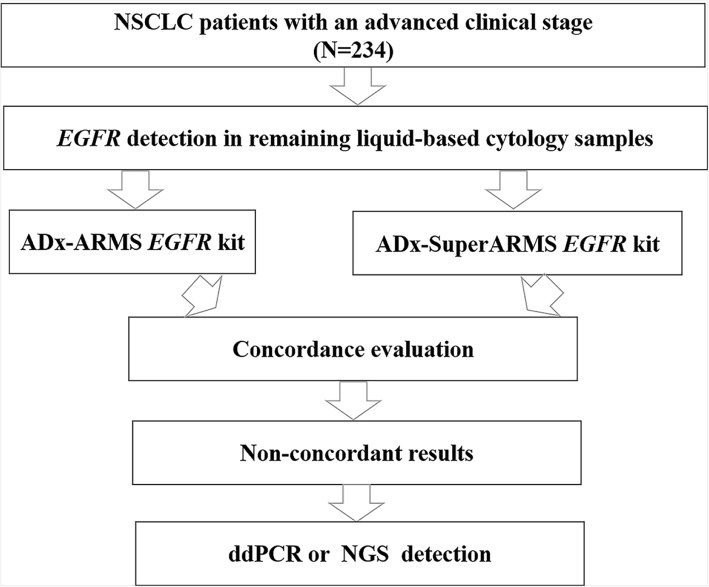
From March 2016 to March 2018, a total of 234 cytological samples were obtained from primary or metastatic lesions of NSCLC, including 144 fine-needle aspirations (FNAs), 36 endobroncheal ultrasonography (EBUS) FNAs, 36 transbronchial needle aspirations (TBNAs) and 18 pleural effusion (PLEs). EGFR mutations were simultaneously detected using an ADx-ARMS EGFR kit (Amoy Diagnostics CO., ltd., Xiamen, China) and an ADx-SuperARMS EGFR kit (Amoy Diagnostics CO., ltd., Xiamen, China). Digital droplet PCR (ddPCR) and next-generation sequencing (NGS) were further used to verify the EGFR mutant inconsistent samples.
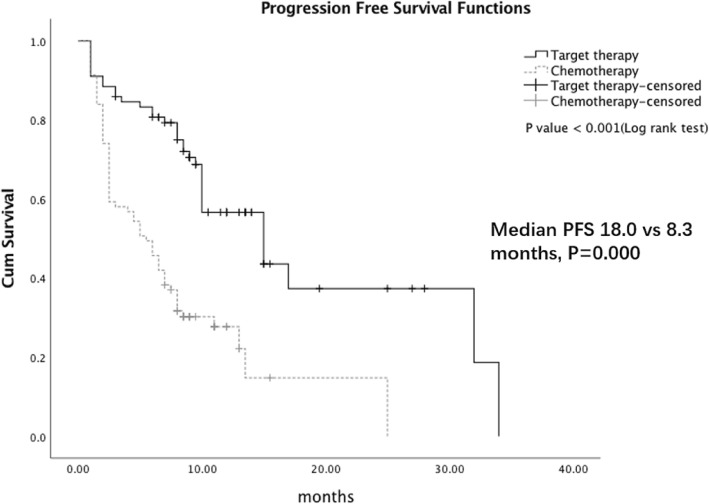
All of the 234 patients with advanced or recurrent NSCLC were diagnosed and assessed by two cytopathologists, and their EGFR mutation statuses were successfully detected by ARMS and SuperARMS. Importantly, the SuperARMS and ARMS methods showed a highly concordant result of 94.0% (220/234) (95%CI: 85.0, 95.0%). The positive rate of the SuperARMS was higher than the ARMS in the cytology samples for EGFR detection (46.2% vs. 40.2%). The specific EGFR mutation sites in 16 samples (6.8%) were not completely consistent between the SuperARMS and ARMS. A total of 14 patients showed EGFR mutations when detected by SuperARMS, but by ARMS there were EGFR wild-type. Two patients were detected as having one more EGFR mutation site by SuperARMS than by ARMS. ddPCR and NGS were used to further confirm the EGFR mutations in these inconsistent samples. Eight samples had the same mutation results as the SuperARMS, and 6 samples were not verified because the remaining DNA was insufficient. A total of 78 EGFR mutation patients received Tyrosine Kinase Inhibitor (TKI) treatment. The overall objective response rate (ORR) was 88.5% (69/78) for EGFR TKI treatment.
SuperARMS showed a high sensitivity and specificity for EGFR detection and thus, is expected to become a routine test in the clinic to be used as a widely available, easy-to-operate and sensitive method for EGFR mutation detection in liquid-based cytology samples.
非手术细胞学标本不仅足以进行准确的组织学分型,而且还可以进行分子分析。一种改良的扩增不可抑制突变系统聚合酶链反应(ARMS PCR),称为 SuperARMS PCR,通过优化引物设计得到了改进,为游离血浆 DNA 检测提供了更高的灵敏度和特异性。目前尚不清楚 SuperARMS PCR 是否可检测细胞学样本中的表皮生长因子受体(EGFR)突变。本研究旨在比较 ARMS PCR 和 SuperARMS PCR 在晚期非小细胞肺癌(NSCLC)患者的细胞学样本中检测 EGFR 突变的情况。
2016 年 3 月至 2018 年 3 月,共从 NSCLC 的原发性或转移性病变中获得了 234 个细胞学样本,包括 144 个细针抽吸(FNA),36 个支气管内超声(EBUS)FNA,36 个经支气管针吸活检(TBNAs)和 18 个胸腔积液(PLE)。使用 ADx-ARMS EGFR 试剂盒(Amoy Diagnostics CO.,Ltd.,厦门,中国)和 ADx-SuperARMS EGFR 试剂盒(Amoy Diagnostics CO.,Ltd.,厦门,中国)同时检测 EGFR 突变。进一步使用数字液滴 PCR(ddPCR)和下一代测序(NGS)来验证 EGFR 突变不一致的样本。
所有 234 名晚期或复发性 NSCLC 患者均由两名细胞病理学家进行诊断和评估,并成功通过 ARMS 和 SuperARMS 检测到其 EGFR 突变状态。重要的是,SuperARMS 和 ARMS 方法的一致性结果非常高,为 94.0%(220/234)(95%CI:85.0,95.0%)。SuperARMS 方法用于 EGFR 检测的细胞学样本中的阳性率高于 ARMS(46.2%比 40.2%)。在 SuperARMS 和 ARMS 之间,16 个样本(6.8%)的特定 EGFR 突变部位不完全一致。共有 14 名患者经 SuperARMS 检测出 EGFR 突变,但 ARMS 检测出 EGFR 野生型。两名患者经 SuperARMS 检测到的 EGFR 突变部位比 ARMS 多一个。进一步使用 ddPCR 和 NGS 来进一步确认这些不一致样本中的 EGFR 突变。8 个样本的突变结果与 SuperARMS 相同,6 个样本由于剩余 DNA 不足而无法验证。共有 78 名 EGFR 突变患者接受了酪氨酸激酶抑制剂(TKI)治疗。EGFR TKI 治疗的总体客观缓解率(ORR)为 88.5%(69/78)。
SuperARMS 对 EGFR 检测具有较高的灵敏度和特异性,有望成为临床常规检测手段,成为液体细胞学样本中 EGFR 突变检测的一种广泛可用,易于操作和敏感的方法。