Zhang Qing-Wei, Gao Yun-Jie, Zhang Ran-Ying, Zhou Xiao-Xuan, Chen Shuang-Li, Zhang Yan, Liu Qiang, Xu Jian-Rong, Ge Zhi-Zheng
Division of Gastroenterology and Hepatology, Key Laboratory of Gastroenterology and Hepatology, Ministry of Health, Renji Hospital, School of Medicine, Shanghai Jiao Tong University, Shanghai Institute of Digestive Disease, Shanghai, China.
Department of Radiology, Zhongshan Hospital, Fudan University and Shanghai Institute of Medical Imaging, Shanghai, China.
Clin Transl Med. 2020 Jan 31;9(1):12. doi: 10.1186/s40169-020-0263-4.
To develop and validate radiomic prediction models using contrast-enhanced computed tomography (CE-CT) to preoperatively predict Ki-67 expression in gastrointestinal stromal tumors (GISTs).
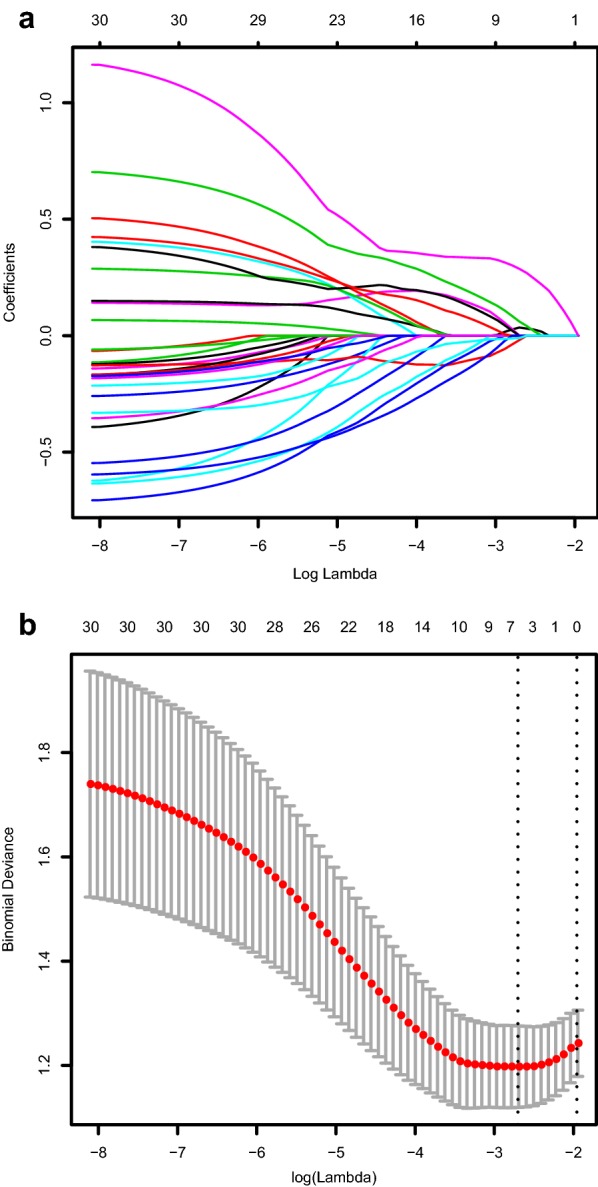
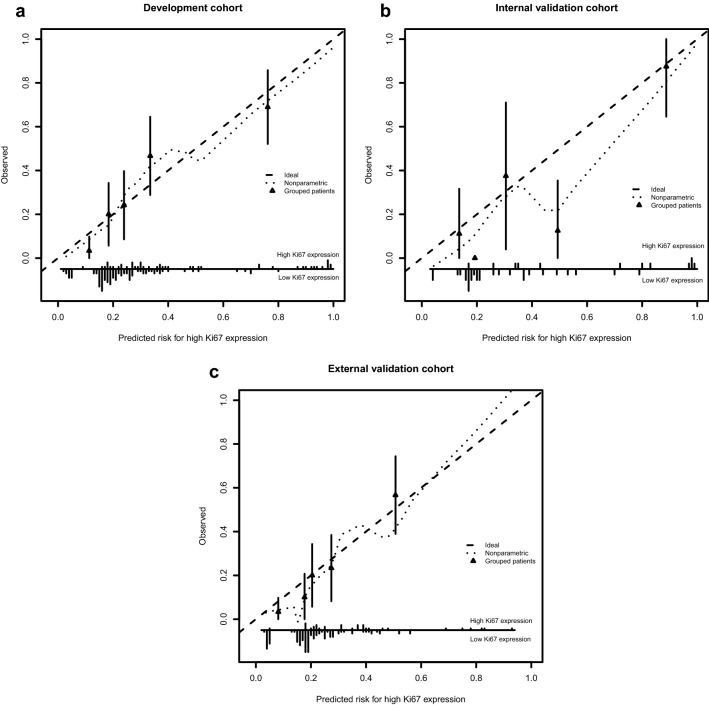
A total of 339 GIST patients from four centers were categorized into the training, internal validation, and external validation cohort. By filtering unstable features, minimum redundancy, maximum relevance, Least Absolute Shrinkage and Selection Operator (LASSO) algorithm, a radiomic signature was built to predict the malignant potential of GISTs. Individual nomograms of Ki-67 expression incorporating the radiomic signature or clinical factors were developed using the multivariate logistic model and evaluated regarding its calibration, discrimination, and clinical usefulness.
The radiomic signature, consisting of 6 radiomic features had AUC of 0.787 [95% confidence interval (CI) 0.632-0.801], 0.765 (95% CI 0.683-0.847), and 0.754 (95% CI 0.666-0.842) in the prediction of high Ki-67 expression in the training, internal validation and external validation cohort, respectively. The radiomic nomogram including the radiomic signature and tumor size demonstrated significant calibration, and discrimination with AUC of 0.801 (95% CI 0.726-0.876), 0.828 (95% CI 0.681-0.974), and 0.784 (95% CI 0.701-0.868) in the training, internal validation and external validation cohort respectively. Based on the Decision curve analysis, the radiomics nomogram was found to be clinically significant and useful.
The radiomic signature from CE-CT was significantly associated with Ki-67 expression in GISTs. A nomogram consisted of radiomic signature, and tumor size had maximum accuracy in the prediction of Ki-67 expression in GISTs. Results from our study provide vital insight to make important preoperative clinical decisions.
利用对比增强计算机断层扫描(CE-CT)开发并验证放射组学预测模型,以术前预测胃肠道间质瘤(GIST)中Ki-67的表达。
将来自四个中心的339例GIST患者分为训练组、内部验证组和外部验证组。通过过滤不稳定特征、最小冗余最大相关性、最小绝对收缩和选择算子(LASSO)算法,构建放射组学特征以预测GIST的恶性潜能。使用多变量逻辑模型开发包含放射组学特征或临床因素的Ki-67表达个体列线图,并对其校准、区分度和临床实用性进行评估。
由6个放射组学特征组成的放射组学特征在训练组、内部验证组和外部验证组中预测高Ki-67表达时的曲线下面积(AUC)分别为0.787[95%置信区间(CI)0.632-0.801]、0.765(95%CI 0.683-0.847)和0.754(95%CI 0.666-0.842)。包含放射组学特征和肿瘤大小的放射组学列线图显示出显著的校准,在训练组、内部验证组和外部验证组中的区分度AUC分别为0.801(95%CI 0.726-0.876)、0.828(95%CI 0.681-0.974)和0.784(95%CI 0.701-0.868)。基于决策曲线分析,发现放射组学列线图具有临床意义且有用。
CE-CT的放射组学特征与GIST中Ki-67的表达显著相关。由放射组学特征和肿瘤大小组成的列线图在预测GIST中Ki-67表达时具有最高的准确性。我们的研究结果为术前重要临床决策提供了重要见解。