Zhang Kaiqiang, Lee Tae Hyung, Khalilzadeh Mohammad A, Varma Rajender S, Choi Ji-Won, Jang Ho Won, Shokouhimehr Mohammadreza
Department of Materials Science and Engineering, Research Institute of Advanced Materials, Seoul National University, Seoul 08826, Republic of Korea.
Electronic Materials Center, Korea Institute of Science and Technology (KIST), Seoul 136-791, Republic of Korea.
ACS Omega. 2020 Jan 15;5(3):1634-1639. doi: 10.1021/acsomega.9b03699. eCollection 2020 Jan 28.
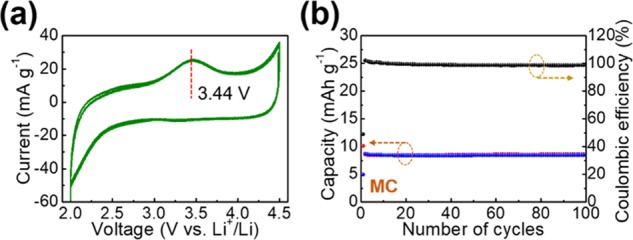
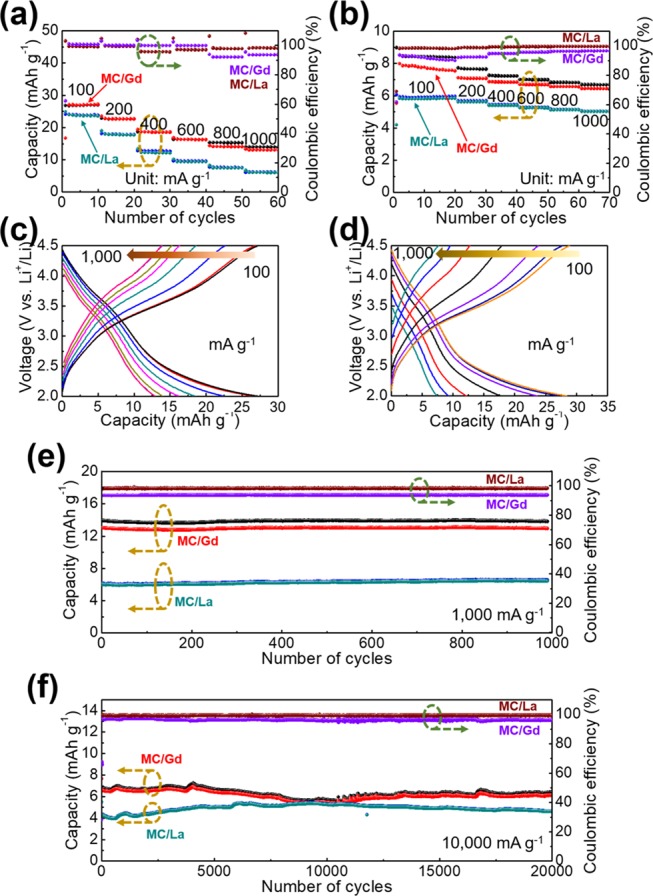
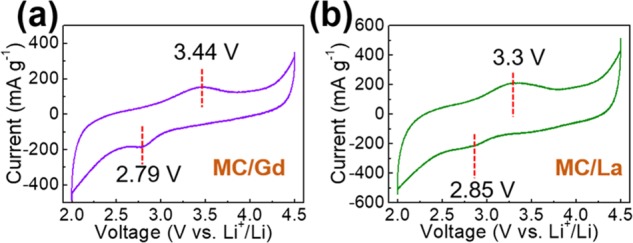
Capacitors allow extremely fast charge and discharge operations, which is a challenge faced by recent metal-ion batteries despite having highly improved energy densities. Thus, combined type electric energy storage devices that can integrate high energy density and high power density with high potentials, can overcome the shortcomings of the current metal-ion batteries and capacitors. However, the limited capacities of cathode materials owing to the barren redox reactions are regarded as an obstacle for the development of future high-performance hybrid metal-ion capacitors. In this study, we demonstrate the redox-reaction-rendering effect of the much overlooked lanthanide elements when used as the cathode of lithium-ion capacitors using the mesoporous carbon (MC) as a matrix material. Consequently, these lanthanide elements can effectively enrich the redox reaction, thus improving the capacity of the matrix materials by more than two times. Typically, the Gd-elemental decoration of MC surprisingly enhances the capacity by almost two times as compared with the underacted MC. Furthermore, the La nanoparticles (NPs) decoration depicts the same behavior. Evident redox peaks were formed on the original rectangular cyclic voltammetry (CV) curves. This study provides the first example of embedding lanthanide elements on matrix materials to enrich the desired redox reactions for improving the electrochemical performances.
电容器允许进行极快速的充电和放电操作,这是近期金属离子电池面临的一项挑战,尽管其能量密度已得到大幅提高。因此,能够将高能量密度和高功率密度与高电位相结合的复合型电能存储装置,可以克服当前金属离子电池和电容器的缺点。然而,由于氧化还原反应匮乏,阴极材料的容量有限,这被视为未来高性能混合金属离子电容器发展的一个障碍。在本研究中,我们展示了在以介孔碳(MC)作为基体材料的锂离子电容器阴极中使用时,长期被忽视的镧系元素的氧化还原反应呈现效应。因此,这些镧系元素能够有效地丰富氧化还原反应,从而使基体材料的容量提高两倍多。通常,与未充分发挥作用的MC相比,MC的钆元素修饰令人惊讶地使容量提高了近两倍。此外,镧纳米颗粒(NPs)修饰也呈现出相同的行为。在原始的矩形循环伏安(CV)曲线上形成了明显的氧化还原峰。本研究提供了将镧系元素嵌入基体材料以丰富所需氧化还原反应从而改善电化学性能的首个实例。