Curtis Ethan R, Hannigan Matthew D, Vitek Andrew K, Zimmerman Paul M
Department of Chemistry , University of Michigan , 930 N. University Ave , Ann Arbor , Michigan 48109 , United States.
J Phys Chem A. 2020 Feb 27;124(8):1480-1488. doi: 10.1021/acs.jpca.9b09985. Epub 2020 Feb 18.
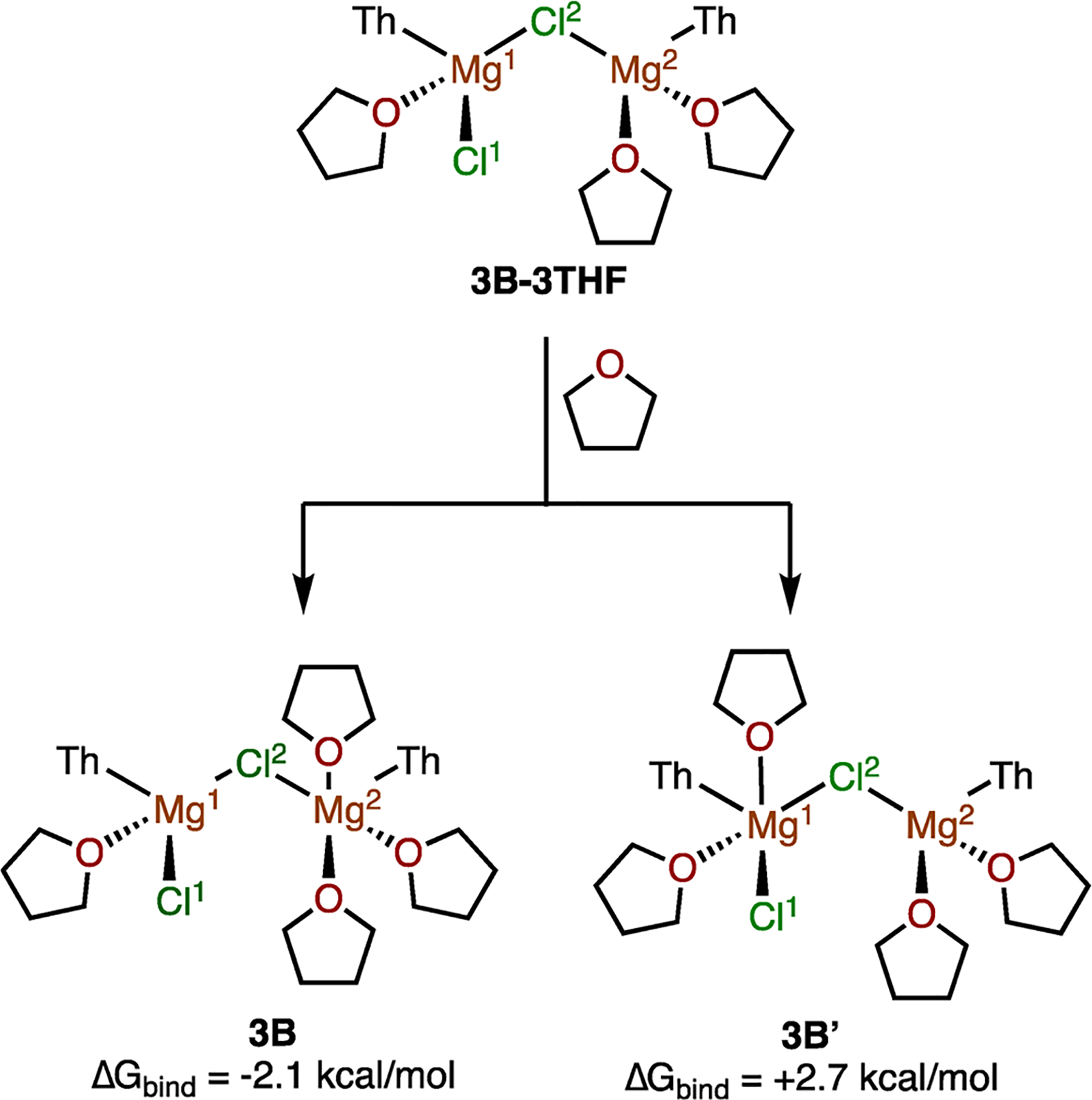
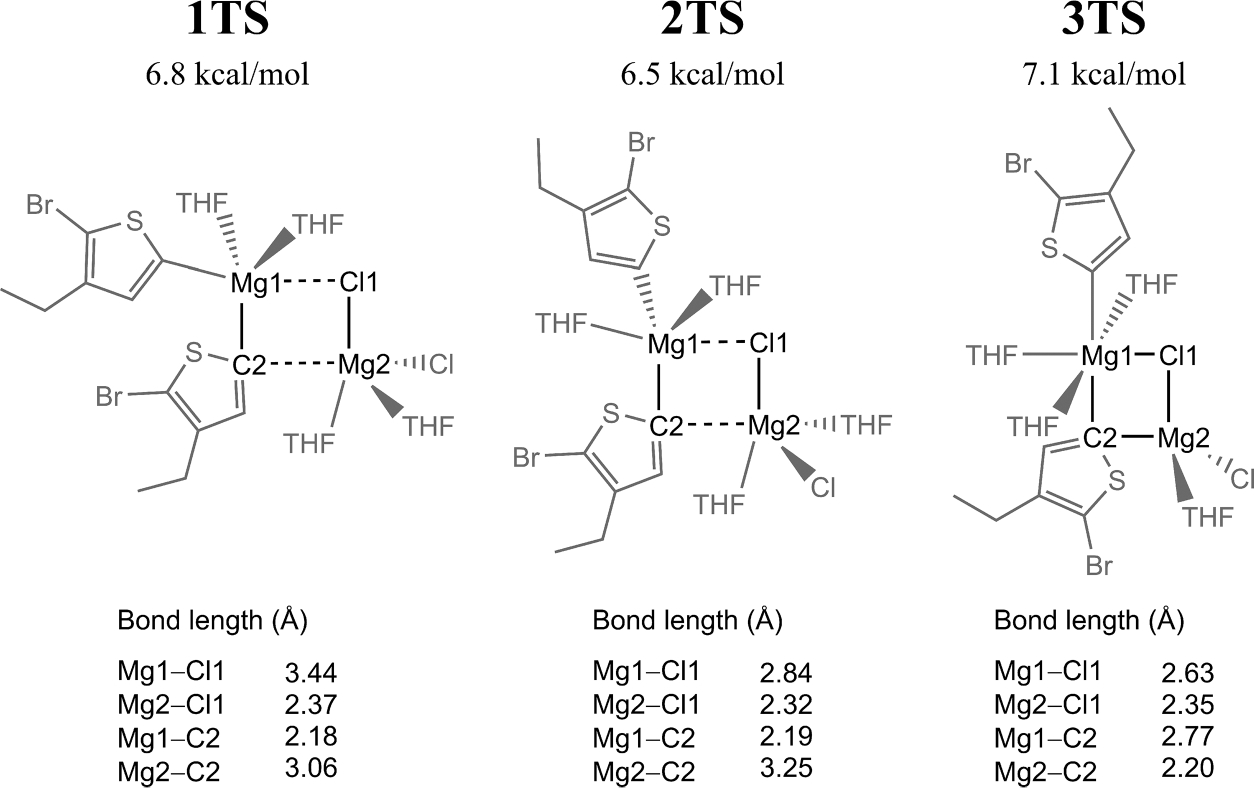
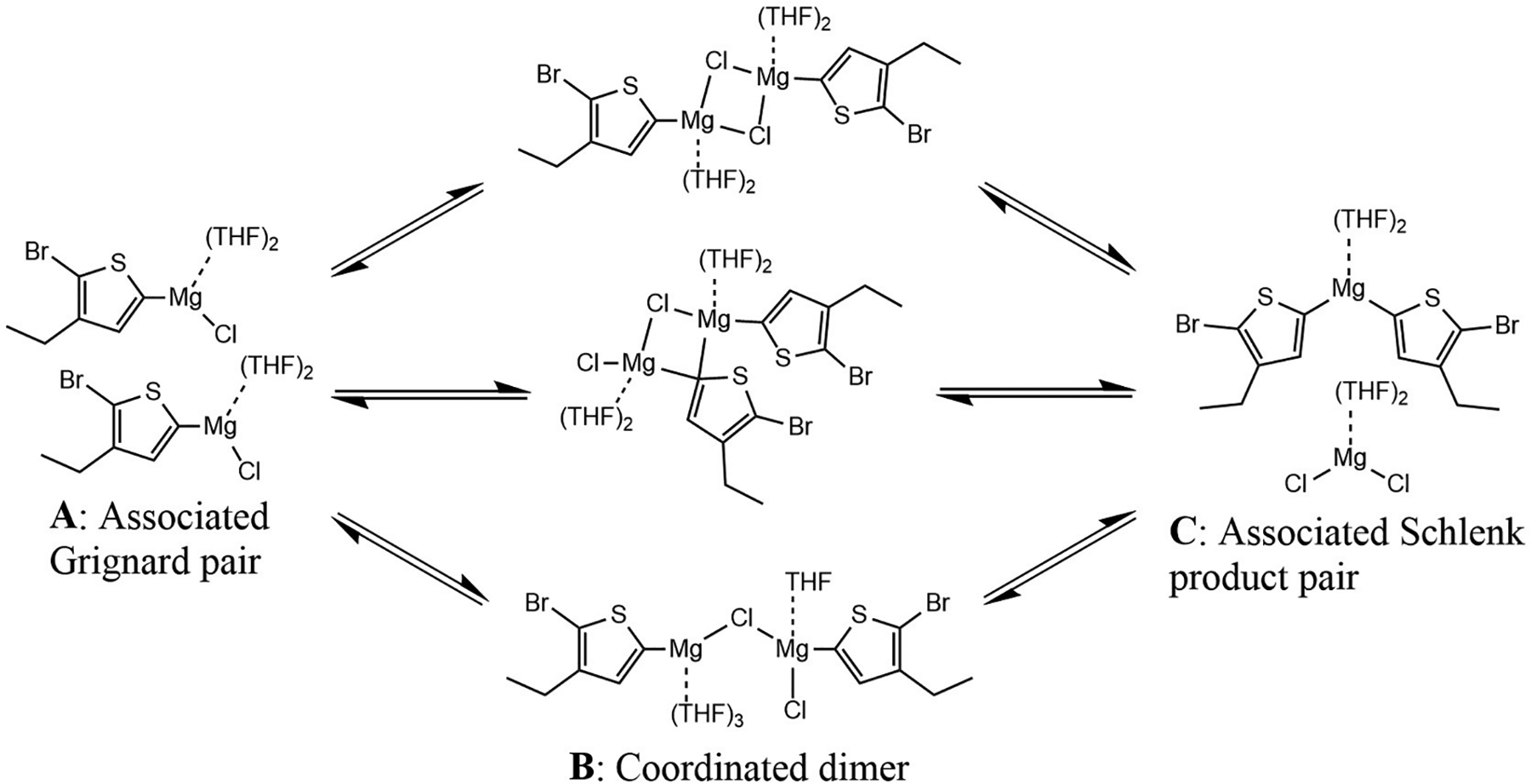
The Schlenk equilibrium of Grignard reagents describes the intricate relationships between monomers, aggregates, and exchange products. The core step of the Schlenk equilibrium, formally 2RMgX ⇌ RMg + MgX, has been subject to computational studies of simple methyl Grignards and NMR determination of thermodynamics. These studies neglect the effect the R group may have on the accessibility of intermediates in the Schlenk equilibrium. In this study, computational reaction discovery tools were employed to thoroughly search the chemical space for feasible dimerizations and pathways to ligand exchange for thiophene Grignards. Three bridged dimers, μ-(Cl, C), μ-(Cl, Cl), and μ-Cl, were found to be vital intermediates, which are stabilized by π-interactions involving the thiophene group. These dimers are approximately as thermodynamically stable as the Grignard monomers and its ligand exchange products, and therefore, their reactivity should be considered when examining mechanisms for aryl Grignard or cross-coupling reactions.
格氏试剂的施伦克平衡描述了单体、聚集体和交换产物之间的复杂关系。施伦克平衡的核心步骤,形式上为2RMgX ⇌ RMg + MgX,已经受到简单甲基格氏试剂的计算研究以及热力学的核磁共振测定。这些研究忽略了R基团可能对施伦克平衡中中间体可及性产生的影响。在本研究中,使用计算反应发现工具全面搜索化学空间,以寻找噻吩格氏试剂可行的二聚化反应和配体交换途径。发现三种桥联二聚体,μ-(Cl, C)、μ-(Cl, Cl)和μ-Cl,是重要的中间体,它们通过涉及噻吩基团的π相互作用得以稳定。这些二聚体的热力学稳定性与格氏单体及其配体交换产物大致相当,因此,在研究芳基格氏试剂或交叉偶联反应的机理时,应考虑它们的反应活性。