Environmental Science, Policy, and Management, University of California, Berkeley, CA, USA.
Department of Animal Science, University of California, Davis, CA, USA.
Mol Ecol. 2020 Mar;29(5):870-885. doi: 10.1111/mec.15367. Epub 2020 Feb 17.
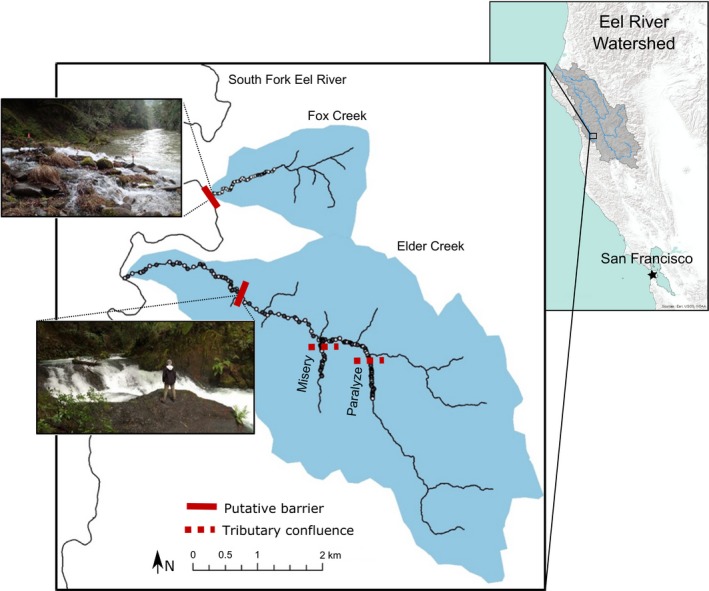
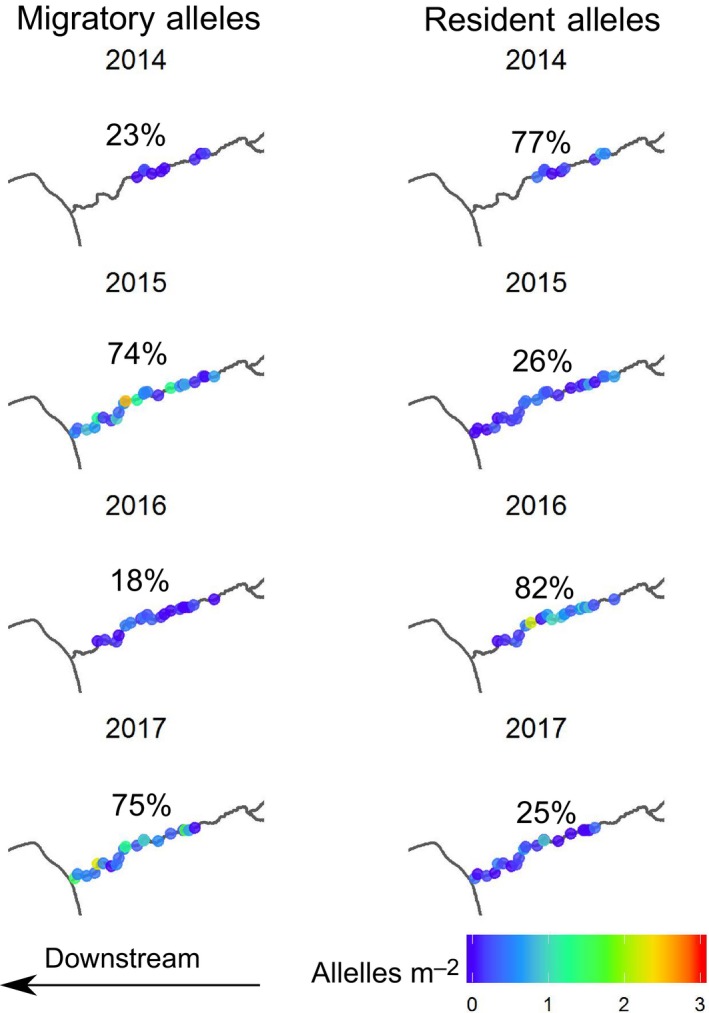
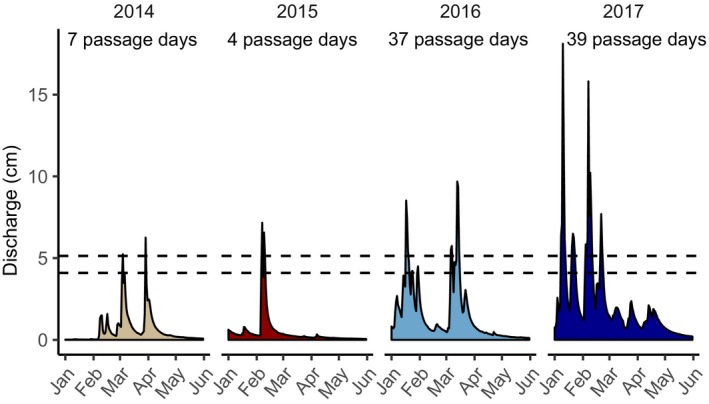
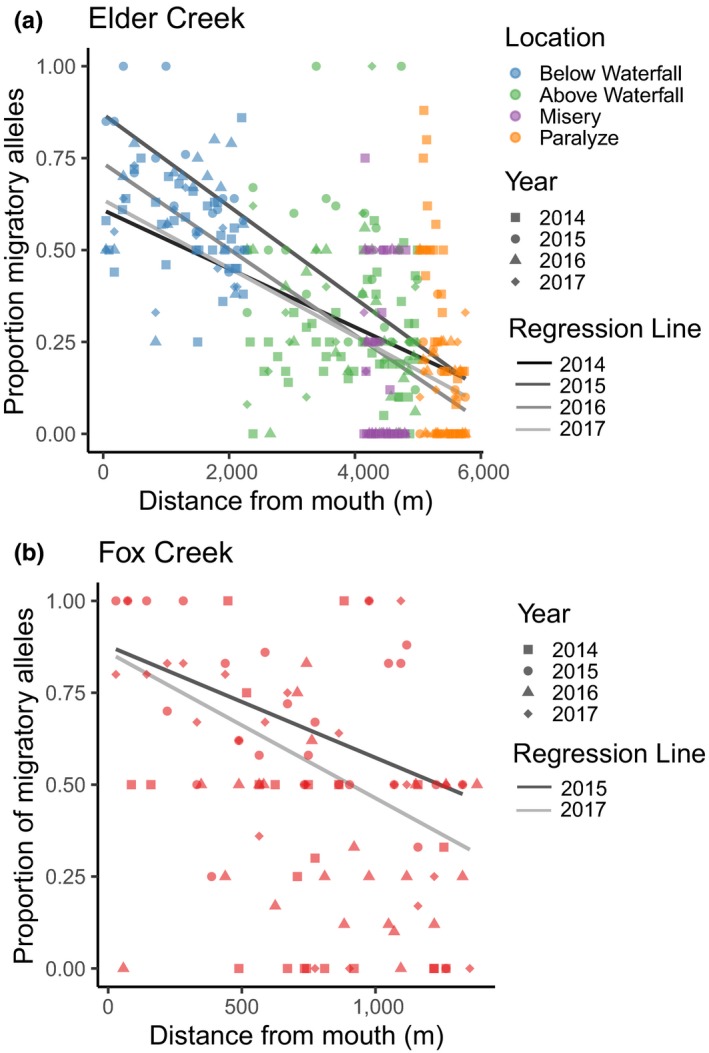
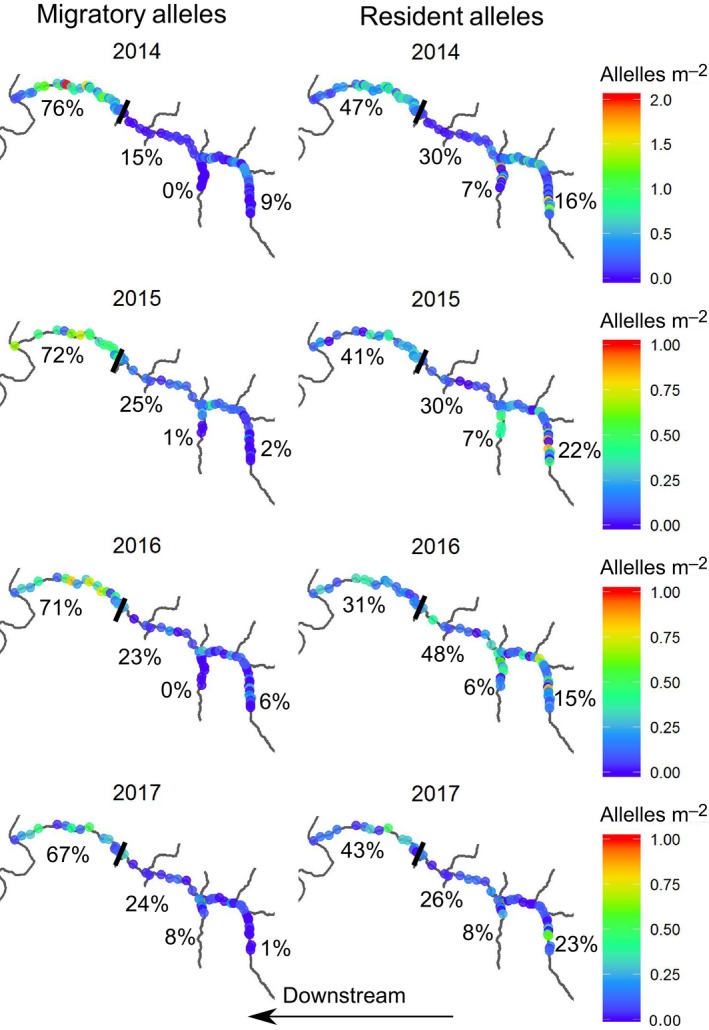
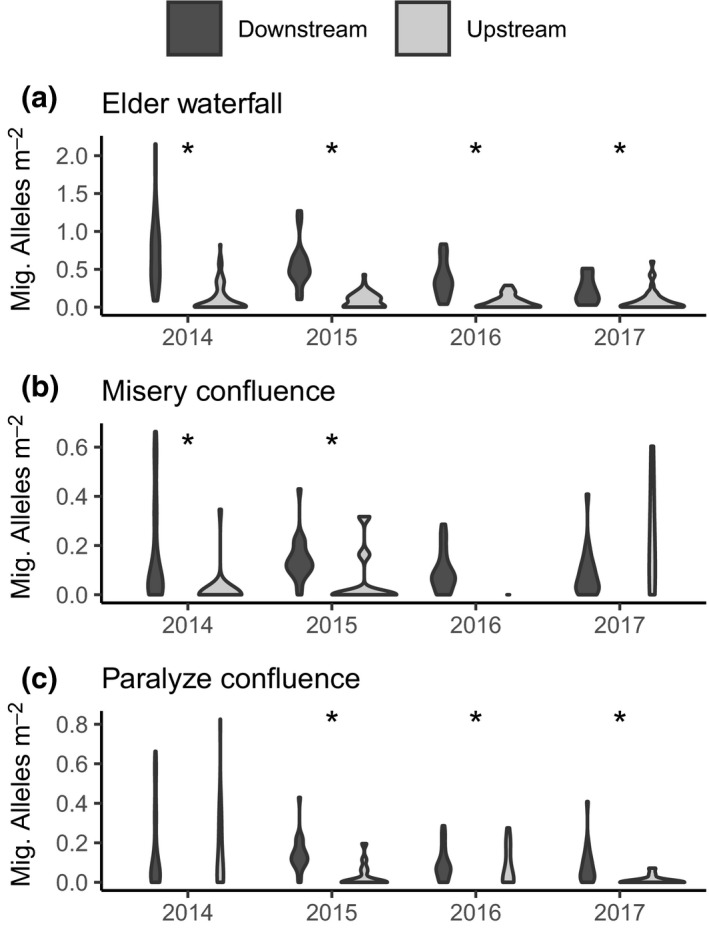
Landscape permeability is often explored spatially, but may also vary temporally. Landscape permeability, including partial barriers, influences migratory animals that move across the landscape. Partial barriers are common in rivers where barrier passage varies with streamflow. We explore the influence of partial barriers on the spatial and temporal distribution of migration-linked genotypes of Oncorhynchus mykiss, a salmonid fish with co-occurring resident and migratory forms, in tributaries to the South Fork Eel River, California, USA, Elder and Fox Creeks. We genotyped >4,000 individuals using RAD-capture and classified individuals as resident, heterozygous or migratory genotypes using life history-associated loci. Across four years of study (2014-2017), the permeability of partial barriers varied across dry and wet years. In Elder Creek, the largest waterfall was passable for adults migrating up-river 4-39 days each year. In this stream, the overall spatial pattern, with fewer migratory genotypes above the waterfall, remained true across dry and wet years (67%-76% of migratory alleles were downstream of the waterfall). We also observed a strong relationship between distance upstream and proportion of migratory alleles. In Fox Creek, the primary barrier is at the mouth, and we found that the migratory allele frequency varied with the annual timing of high flow events. In years when rain events occurred during the peak breeding season, migratory allele frequency was high (60%-68%), but otherwise it was low (30% in two years). We highlight that partial barriers and landscape permeability can be temporally dynamic, and this effect can be observed through changing genotype frequencies in migratory animals.
景观渗透性通常在空间上进行探索,但也可能随时间变化。景观渗透性,包括部分障碍物,会影响跨越景观的迁徙动物。部分障碍物在河流中很常见,其中障碍物的通过性随水流而变化。我们探索了部分障碍物对 Oncorhynchus mykiss (一种具有共存的居留和洄游形式的鲑鱼)在加利福尼亚州埃尔德溪和福克斯溪等美国南福克河支流中与洄游相关的基因型的空间和时间分布的影响。我们使用 RAD 捕获对 >4000 个个体进行了基因分型,并使用与生活史相关的基因座将个体分类为居留、杂合或洄游基因型。在四年的研究(2014-2017 年)中,部分障碍物的渗透性在旱年和湿年之间有所不同。在埃尔德溪,最大的瀑布每年有 4-39 天可供成年鱼向上游洄游通过。在这条溪流中,瀑布上方的洄游基因型较少的整体空间格局在旱年和湿年都保持不变(瀑布下游有 67%-76%的洄游等位基因)。我们还观察到距离上游和洄游等位基因比例之间的强烈关系。在福克斯溪,主要的障碍物是在河口,我们发现洄游等位基因频率随每年高水位事件的时间而变化。在雨水事件发生在繁殖高峰期的年份,洄游等位基因频率较高(60%-68%),否则频率较低(两年中为 30%)。我们强调,部分障碍物和景观渗透性可能随时间而动态变化,这种效应可以通过观察迁徙动物中基因型频率的变化来观察到。