Department of Epidemiology, University of Florida, Gainesville, FL, 32608, USA.
Department of Epidemiology and Health Statistics School of Health Sciences, Wuhan University, Wuhan, 430071, China.
BMC Public Health. 2020 Feb 4;20(1):156. doi: 10.1186/s12889-020-8253-4.
Marijuana is the most commonly used illicit drug in the United States. More and more states legalized medical and recreational marijuana use. Adolescents and emerging adults are at high risk for marijuana use. This ecological study aims to examine historical trends in marijuana use among youth along with marijuana legalization.
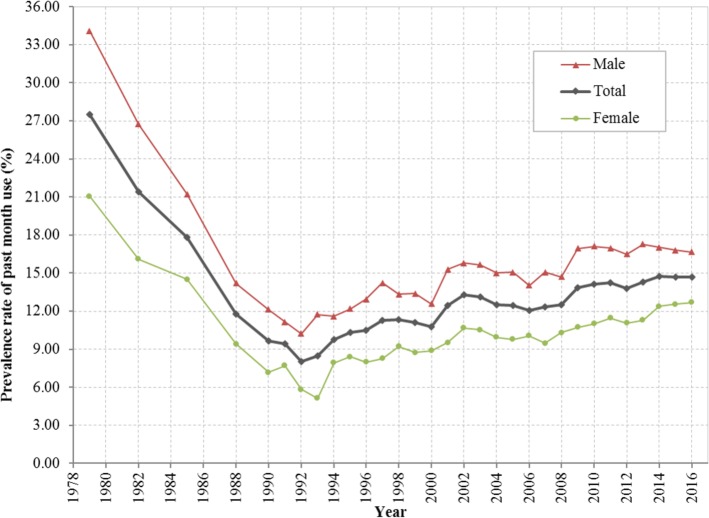
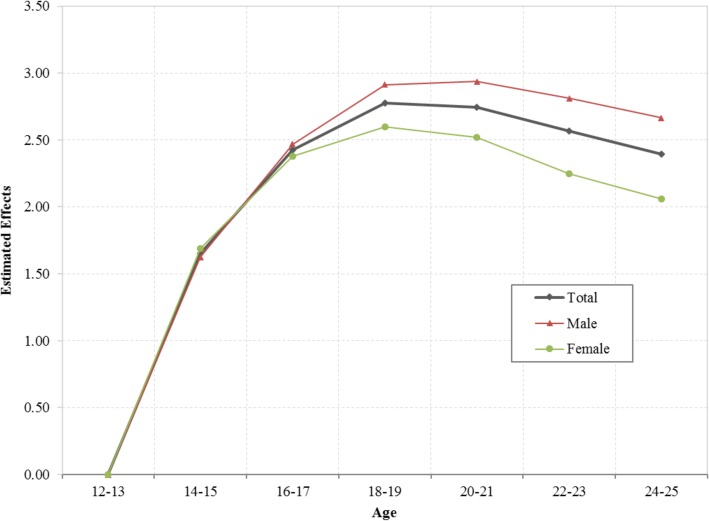
Data (n = 749,152) were from the 31-wave National Survey on Drug Use and Health (NSDUH), 1979-2016. Current marijuana use, if use marijuana in the past 30 days, was used as outcome variable. Age was measured as the chronological age self-reported by the participants, period was the year when the survey was conducted, and cohort was estimated as period subtracted age. Rate of current marijuana use was decomposed into independent age, period and cohort effects using the hierarchical age-period-cohort (HAPC) model.
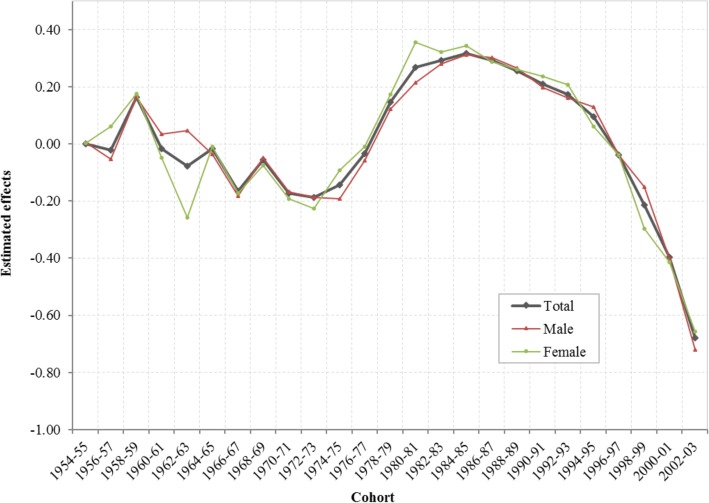
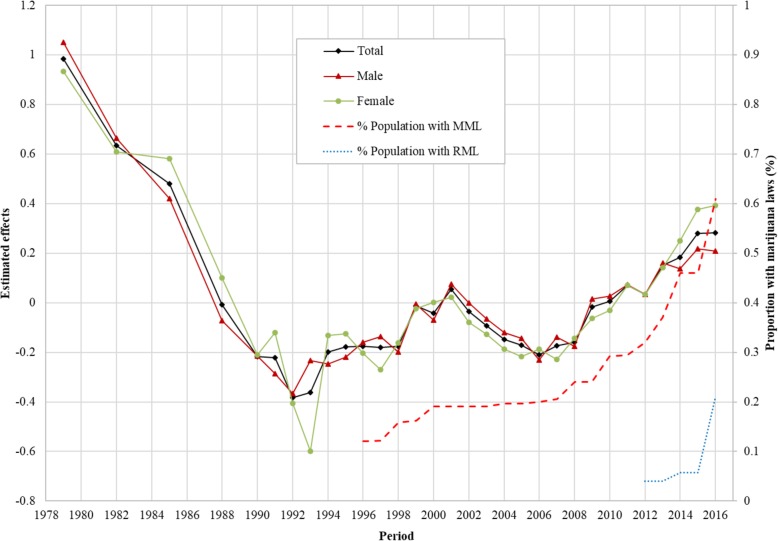
After controlling for age, cohort and other covariates, the estimated period effect indicated declines in marijuana use in 1979-1992 and 2001-2006, and increases in 1992-2001 and 2006-2016. The period effect was positively and significantly associated with the proportion of people covered by Medical Marijuana Laws (MML) (correlation coefficients: 0.89 for total sample, 0.81 for males and 0.93 for females, all three p values < 0.01), but was not significantly associated with the Recreational Marijuana Laws (RML). The estimated cohort effect showed a historical decline in marijuana use in those who were born in 1954-1972, a sudden increase in 1972-1984, followed by a decline in 1984-2003.
The model derived trends in marijuana use were coincident with the laws and regulations on marijuana and other drugs in the United States since the 1950s. With more states legalizing marijuana use in the United States, emphasizing responsible use would be essential to protect youth from using marijuana.
大麻是美国最常用的非法药物。越来越多的州将医用和娱乐用大麻合法化。青少年和刚成年的人使用大麻的风险很高。本生态研究旨在检查大麻在年轻人中的历史使用趋势以及大麻合法化。
数据(n=749152)来自 1979 年至 2016 年的 31 波全国药物使用和健康调查(NSDUH)。当前大麻使用情况,即过去 30 天内是否使用过大麻,作为结果变量。年龄由参与者自我报告的实际年龄测量,时期为调查进行的年份,队列由时期减去年龄估计。使用分层年龄-时期-队列(HAPC)模型将当前大麻使用率分解为独立的年龄、时期和队列效应。
在控制年龄、队列和其他协变量后,估计的时期效应表明 1979-1992 年和 2001-2006 年大麻使用率下降,1992-2001 年和 2006-2016 年上升。时期效应与医用大麻法(MML)覆盖人群的比例呈正相关(总样本的相关系数:0.89,男性:0.81,女性:0.93,所有三个 p 值均<0.01),但与娱乐用大麻法(RML)无关。估计的队列效应显示,1954-1972 年出生的人的大麻使用呈历史下降趋势,1972-1984 年突然上升,随后在 1984-2003 年下降。
该模型得出的大麻使用趋势与 20 世纪 50 年代以来美国关于大麻和其他药物的法律法规相吻合。随着美国越来越多的州将大麻使用合法化,强调负责任地使用大麻对于保护年轻人免受大麻的影响至关重要。