From the Institute of Pharmacology (K.F.B., S.v.G.), University of Bern, Switzerland; Neurologic Clinic and Policlinic (J.O., L.K., J.K.), Departments of Medicine, Clinical Research, Biomedicine and Biomedical Engineering, University Hospital Basel, University of Basel, Switzerland; Department of Neurology with Institute of Translational Neurology (C.W.K., J.D.L.), University Hospital Münster, University of Münster, Germany; Laboratory of Neuroinflammation (C.W.K., B.P., J.D.L.), Institute of Experimental Immunology, University of Zurich, Switzerland; Department for BioMedical Research (DBMR) (R.R.), University of Bern, Switzerland; Shemyakin-Ovchinnikov Institute of Bioorganic Chemistry Russian Academy of Science (N.B.), Moscow, Russia; Auckland University of Technology (N.B.), New Zealand; and Department of Surgery (R.D.C.), Beth Israel Deaconess Medical Center, Harvard Medical School, Boston, MA.
Neurol Neuroimmunol Neuroinflamm. 2020 Feb 3;7(2). doi: 10.1212/NXI.0000000000000676. Print 2020 Mar.
To explore the repertoire of glycan-specific immunoglobulin G (IgG) antibodies in treatment-naive patients with relapsing-remitting multiple sclerosis (RRMS).
A systems-level approach combined with glycan array technologies was used to determine specificities and binding reactivities of glycan-specific IgGs in treatment-naive patients with RRMS compared with patients with noninflammatory and other inflammatory neurologic diseases.
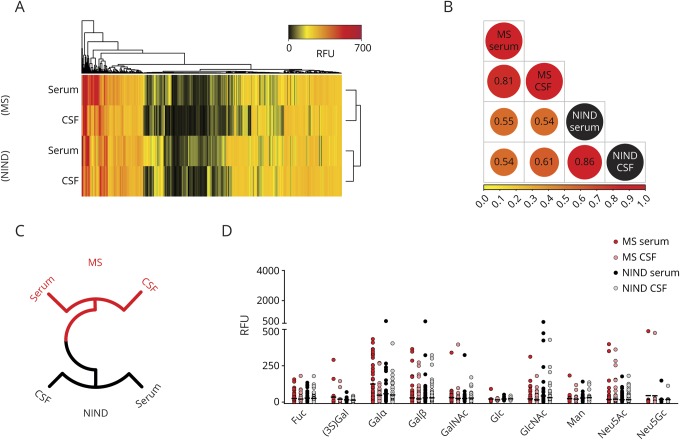
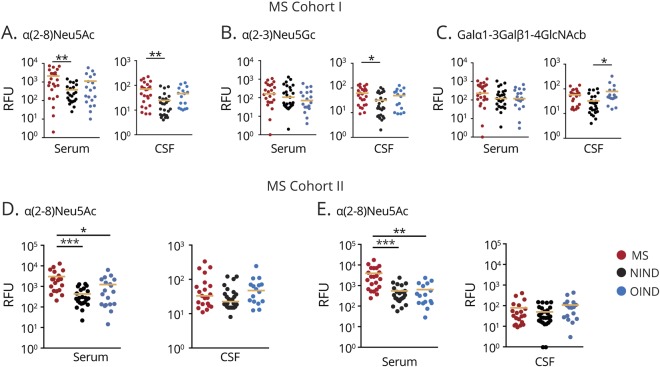
We identified a unique signature of glycan-binding IgG in MS with high reactivities to the dietary xenoglycan N-glycolylneuraminic acid (Neu5Gc) and the self-glycan N-acetylneuraminic acid (Neu5Ac). Increased reactivities of serum IgG toward Neu5Gc and Neu5Ac were additionally observed in an independent, treatment-naive cohort of patients with RRMS.
Patients with MS show increased IgG reactivities to structurally related xenogeneic and human neuraminic acids. The discovery of these glycan-specific epitopes as immune targets and potential biomarkers in MS merits further investigation.
探索初治复发缓解型多发性硬化症(RRMS)患者中糖特异性免疫球蛋白 G(IgG)抗体的 repertoire。
采用系统级方法结合聚糖阵列技术,比较初治 RRMS 患者与非炎症性和其他炎症性神经疾病患者,确定糖特异性 IgG 的特异性和结合反应性。
我们在 MS 中鉴定出一种独特的聚糖结合 IgG 特征,对饮食性异种糖 N-糖基神经氨酸(Neu5Gc)和自身糖 N-乙酰神经氨酸(Neu5Ac)具有高反应性。在另一个独立的、初治 RRMS 患者队列中,还观察到血清 IgG 对 Neu5Gc 和 Neu5Ac 的反应性增加。
MS 患者对结构上相关的异种和人类神经氨酸的 IgG 反应性增加。这些糖特异性表位作为 MS 中的免疫靶标和潜在生物标志物的发现值得进一步研究。