Laboratório de Ecologia Bentônica, Programa de Pós-Graduação em Ecologia: Teoria, Aplicação e Valores, Instituto de Biologia & CIENAM, Universidade Federal da Bahia, Rua Barão de Geremoabo s/n., Campus Ondina, CEP 40170-115, Salvador, BA, Brazil.
Núcleo de Pesquisas em Limnologia, Ictiologia e Aquicultura (Nupelia), Programa de Pós-Graduação em Ecologia de Ambientes Aquáticos Continentais (PEA), Universidade Estadual de Maringá, Av. Colombo 5790, CEP 87020-900, Maringá, PR, Brazil.
Sci Rep. 2020 Feb 3;10(1):1739. doi: 10.1038/s41598-020-58631-1.
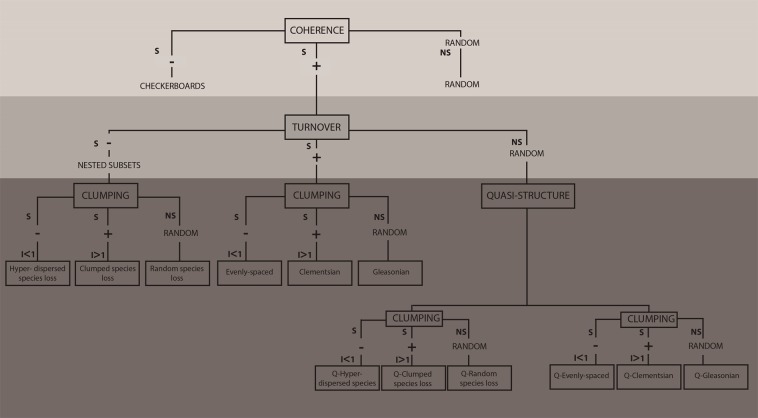
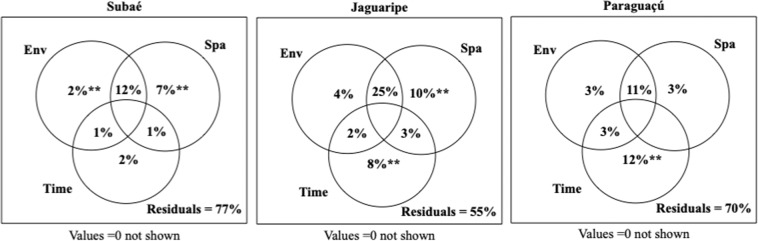
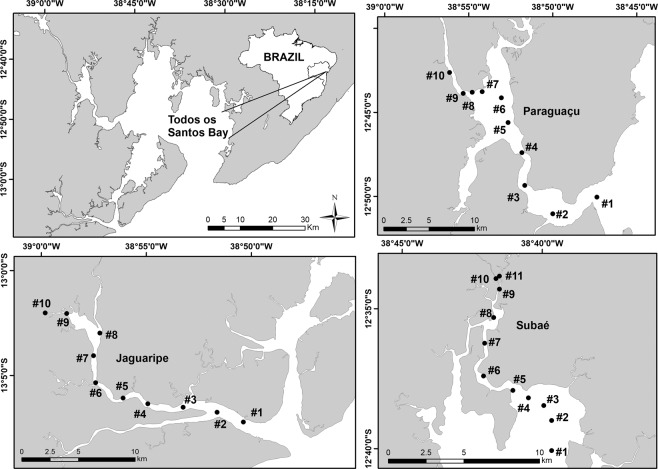
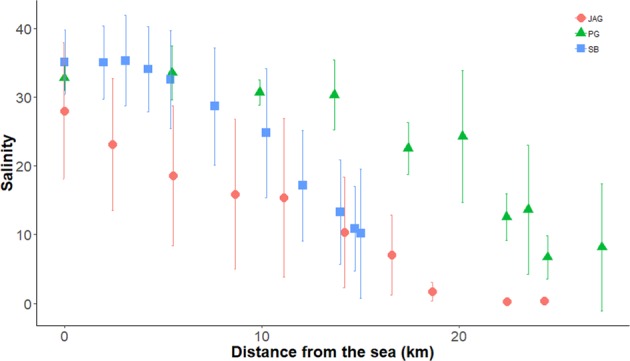
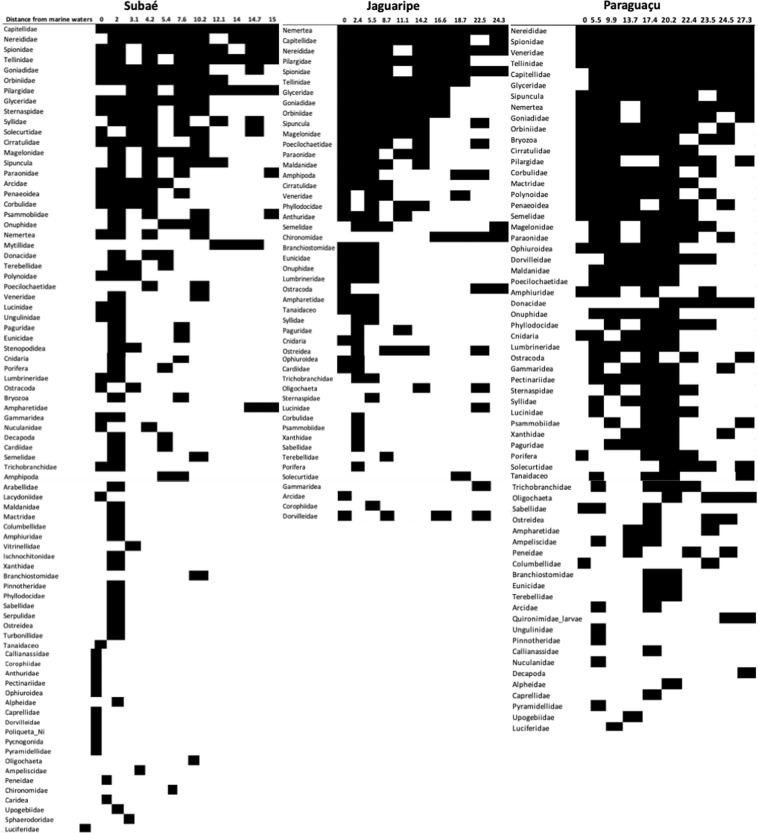
Community structure of many systems changes across space in many different ways (e.g., gradual, random or clumpiness). Accessing patterns of species spatial variation in ecosystems characterized by strong environmental gradients, such as estuaries, is essential to provide information on how species respond to them and for identification of potential underlying mechanisms. We investigated how environmental filters (i.e., strong environmental gradients that can include or exclude species in local communities), spatial predictors (i.e., geographical distance between communities) and temporal variations (e.g., different sampling periods) influence benthic macroinfaunal metacommunity structure along salinity gradients in tropical estuaries. We expected environmental filters to explain the highest proportion of total variation due to strong salinity and sediment gradients, and the main structure indicating species displaying individualistic response that yield a continuum of gradually changing composition (i.e., Gleasonian structure). First we identified benthic community structures in three estuaries at Todos os Santos Bay in Bahia, Brazil. Then we used variation partitioning to quantify the influences of environmental, spatial and temporal predictors on the structures identified. More frequently, the benthic metacommunity fitted a quasi-nested pattern with total variation explained by the shared influence of environmental and spatial predictors, probably because of ecological gradients (i.e., salinity decreases from sea to river). Estuarine benthic assemblages were quasi-nested likely for two reasons: first, nested subsets are common in communities subjected to disturbances such as one of our estuarine systems; second, because most of the estuarine species were of marine origin, and consequently sites closer to the sea would be richer while those more distant from the sea would be poorer subsets.
许多系统的群落结构在空间上以多种不同的方式发生变化(例如,逐渐的、随机的或块状的)。在以强烈环境梯度为特征的生态系统中,如河口,获取物种空间变异模式对于提供有关物种如何对其做出反应的信息以及识别潜在的潜在机制至关重要。我们研究了环境过滤器(即强烈的环境梯度,包括或排除当地群落中的物种)、空间预测因子(即群落之间的地理距离)和时间变化(例如,不同的采样期)如何影响热带河口盐度梯度的底栖大型无脊椎动物元群落结构。我们预计环境过滤器会由于强烈的盐度和沉积物梯度而解释总变异的最高比例,并且主要结构表明物种表现出个体反应,从而产生逐渐变化组成的连续体(即格里森结构)。首先,我们在巴西巴伊亚州托多斯桑托斯湾的三个河口确定了底栖群落结构。然后,我们使用变异分割来量化环境、空间和时间预测因子对确定结构的影响。更频繁的是,底栖元群落适合准嵌套模式,总变异由环境和空间预测因子的共同影响来解释,这可能是由于生态梯度(即从海到河的盐度降低)。河口底栖组合之所以准嵌套,可能有两个原因:首先,嵌套子集在受干扰的群落中很常见,例如我们的一个河口系统;其次,因为大多数河口物种都来自海洋,因此靠近海洋的地点会更丰富,而远离海洋的地点则会更贫穷。