Institute for Molecular Bioscience, The University of Queensland, 306 Carmody Road, Brisbane, Queensland, 4072, Australia.
The Peter Doherty Institute for Infection and Immunity, The University of Melbourne, 792 Elizabeth Street, Melbourne, Victoria, 3000, Australia.
Gigascience. 2020 Feb 1;9(2). doi: 10.1093/gigascience/giaa002.
Klebsiella pneumoniae frequently harbours multidrug resistance, and current diagnostics struggle to rapidly identify appropriate antibiotics to treat these bacterial infections. The MinION device can sequence native DNA and RNA in real time, providing an opportunity to compare the utility of DNA and RNA for prediction of antibiotic susceptibility. However, the effectiveness of bacterial direct RNA sequencing and base-calling has not previously been investigated. This study interrogated the genome and transcriptome of 4 extensively drug-resistant (XDR) K. pneumoniae clinical isolates; however, further antimicrobial susceptibility testing identified 3 isolates as pandrug-resistant (PDR).
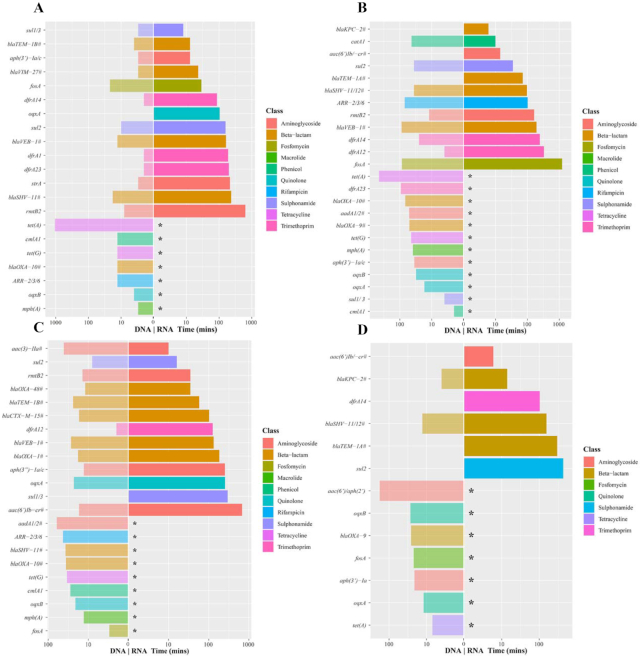
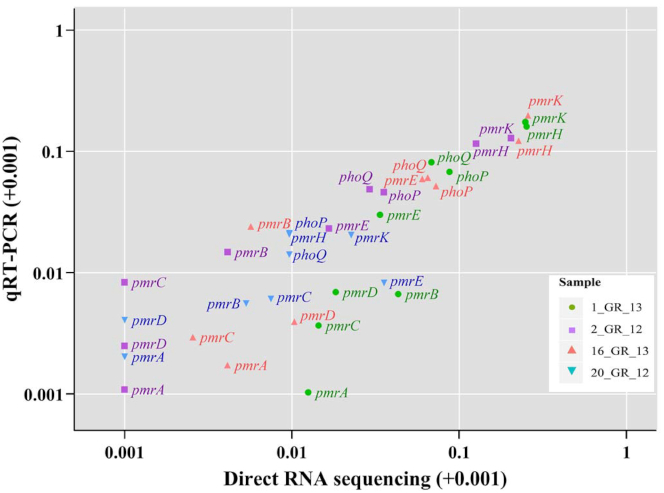
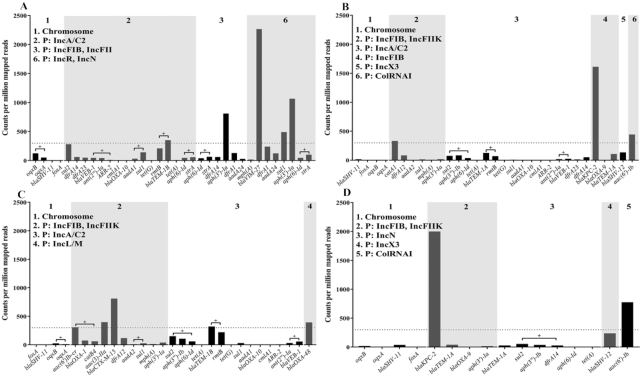
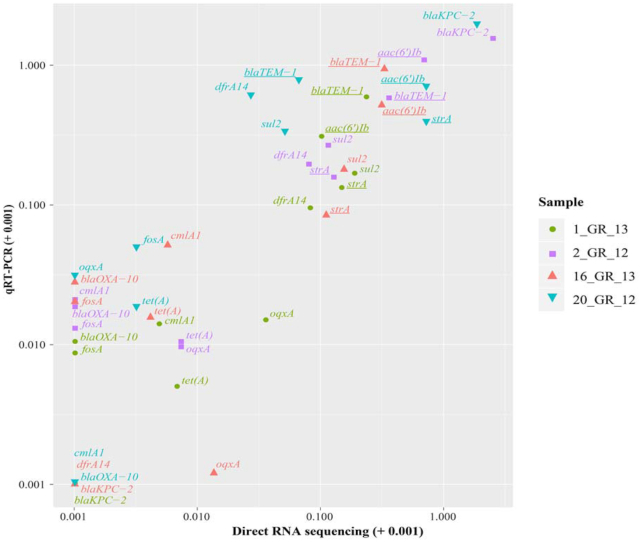
The majority of acquired resistance (≥75%) resided on plasmids including several megaplasmids (≥100 kb). DNA sequencing detected most resistance genes (≥70%) within 2 hours of sequencing. Neural network-based base-calling of direct RNA achieved up to 86% identity rate, although ≤23% of reads could be aligned. Direct RNA sequencing (with ∼6 times slower pore translocation) was able to identify (within 10 hours) ≥35% of resistance genes, including those associated with resistance to aminoglycosides, β-lactams, trimethoprim, and sulphonamide and also quinolones, rifampicin, fosfomycin, and phenicol in some isolates. Direct RNA sequencing also identified the presence of operons containing up to 3 resistance genes. Polymyxin-resistant isolates showed a heightened transcription of phoPQ (≥2-fold) and the pmrHFIJKLM operon (≥8-fold). Expression levels estimated from direct RNA sequencing displayed strong correlation (Pearson: 0.86) compared to quantitative real-time PCR across 11 resistance genes.
Overall, MinION sequencing rapidly detected the XDR/PDR K. pneumoniae resistome, and direct RNA sequencing provided accurate estimation of expression levels of these genes.
肺炎克雷伯菌常携带多种耐药性,目前的诊断方法难以快速确定合适的抗生素来治疗这些细菌感染。MinION 设备可以实时对天然 DNA 和 RNA 进行测序,为比较 DNA 和 RNA 预测抗生素敏感性提供了机会。然而,细菌直接 RNA 测序和碱基调用的有效性尚未得到研究。本研究检测了 4 株广泛耐药(XDR)肺炎克雷伯菌临床分离株的基因组和转录组;然而,进一步的抗菌药物敏感性测试发现 3 株为泛耐药(PDR)。
获得的耐药性(≥75%)主要位于质粒上,包括几个大型质粒(≥100 kb)。DNA 测序在测序后 2 小时内检测到大多数耐药基因(≥70%)。基于神经网络的直接 RNA 碱基调用实现了高达 86%的身份识别率,尽管≤23%的读取可以对齐。直接 RNA 测序(孔转运速度约慢 6 倍)能够在 10 小时内识别(≥35%)≥35%的耐药基因,包括与氨基糖苷类、β-内酰胺类、磺胺类和喹诺酮类、利福平、磷霉素和氯霉素耐药相关的基因,在某些分离株中也能识别。直接 RNA 测序还鉴定了包含多达 3 个耐药基因的操纵子。多粘菌素耐药分离株的 phoPQ(≥2 倍)和 pmrHFIJKLM 操纵子(≥8 倍)转录水平升高。通过直接 RNA 测序估计的表达水平与定量实时 PCR 相比,在 11 个耐药基因中显示出强烈的相关性(Pearson:0.86)。
总体而言,MinION 测序快速检测了 XDR/PDR 肺炎克雷伯菌的耐药组,直接 RNA 测序准确估计了这些基因的表达水平。