Department of Reproductive Health and Population Studies, College of Medicine and Health Sciences, Bahir Dar University, Bahir Dar, Ethiopia.
Department of Epidemiology and Biostatistics, College of Medicine and Health Sciences, Bahir Dar University, Bahir Dar, Ethiopia.
PLoS One. 2020 Feb 4;15(2):e0228678. doi: 10.1371/journal.pone.0228678. eCollection 2020.
The first year after birth is an ideal time to offer contraception services, as many women have many opportunities to be in contact with the health care system. Nevertheless, a large number of postpartum women in developing countries do not use the service owing to the interplay of factors operating at various stages. Therefore, this study aimed to assess predictors of modern contraceptive use in the extended postpartum period.
A community based retrospective cross-sectional study was done among 1281 women who gave birth within 12 months preceding the survey. Kaplan-Meier plots and log rank tests were used to explore the rate of modern contraceptive use. The Weibull regression survival model with multivariate frailty was employed to identify the predictors of time to contraception.
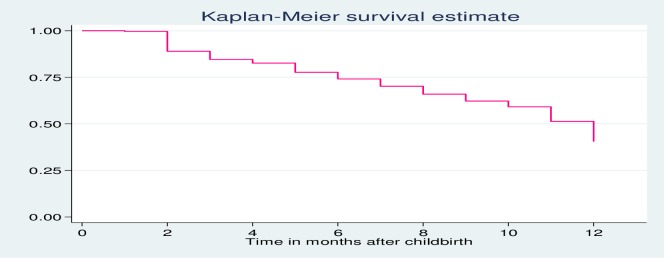
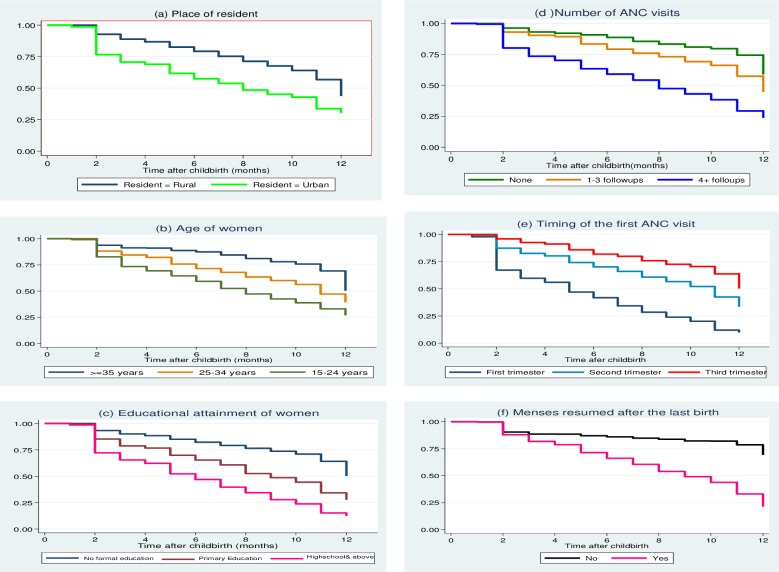
Of the respondents, 59.1% (95% CI: 56.8%-62.2%) had started using modern contraceptive methods within 12 months after birth. By the second month after birth, only 11.1 percent of the women surveyed started to use a contraceptive method, which increased steadily to 25.9%, 37.7%, and 59.5% at 6, 9, and 12 months, respectively. The most preferred contraceptive method was injectable (71.5%), followed by implants (21.5%). Women's education (aHR = 1.29; 95%CI: 1.02, 1.66), four or more antenatal care (aHR = 1.59; 95% CI: 1.22, 2.06), early initiation of antenatal care (aHR = 2.03; 95% CI: 1.28, 3.21), and early postnatal checkup (aHR = 1.39; 95% CI: 1.12, 1.73) were statistically significant predictors of earlier initiation of modern contraceptive methods.
A substantial proportion of women did not use modern contraceptive methods in the first year after birth. Maternal services were found to be the sole predictors in postpartum contraceptive use. Findings suggest the importance of linking postpartum family planning along the continuum of care. The observed heterogeneity at cluster level also urges the need of disaggregating data for decision-making.
婴儿出生后的第一年是提供避孕服务的理想时期,因为许多妇女有很多机会接触医疗保健系统。然而,由于各种因素在不同阶段相互作用,发展中国家的许多产后妇女并没有使用这项服务。因此,本研究旨在评估延长产后期间现代避孕方法使用的预测因素。
对 1281 名在调查前 12 个月内分娩的妇女进行了基于社区的回顾性横断面研究。使用 Kaplan-Meier 图和对数秩检验来探索现代避孕方法使用的比率。采用具有多元脆弱性的威布尔回归生存模型来确定避孕时间的预测因素。
在受访者中,59.1%(95%CI:56.8%-62.2%)在分娩后 12 个月内开始使用现代避孕方法。在产后第二个月,只有 11.1%的调查妇女开始使用避孕方法,此后逐渐增加,分别在 6、9 和 12 个月时达到 25.9%、37.7%和 59.5%。最受欢迎的避孕方法是注射(71.5%),其次是植入物(21.5%)。妇女的教育(aHR=1.29;95%CI:1.02,1.66)、四次或更多次产前护理(aHR=1.59;95%CI:1.22,2.06)、早期开始产前护理(aHR=2.03;95%CI:1.28,3.21)和早期产后检查(aHR=1.39;95%CI:1.12,1.73)是现代避孕方法更早开始的统计学显著预测因素。
相当一部分妇女在产后第一年没有使用现代避孕方法。产妇服务被发现是产后避孕使用的唯一预测因素。研究结果表明,将产后计划生育纳入护理连续体的重要性。在聚类水平上观察到的异质性也迫切需要对数据进行分解,以做出决策。