Department of Pharmacology, Creighton University School of Medicine, 2500 California Plaza, Omaha, NE, 68178, USA; Department of Pharmacology, Midwestern University, 555 31St., Downers Grove, IL, 60515, USA.
Department of Psychology, University of Nebraska Omaha, 6001 Dodge St., Omaha, NE, 68182, USA.
Biomed Pharmacother. 2020 May;125:109832. doi: 10.1016/j.biopha.2020.109832. Epub 2020 Feb 1.
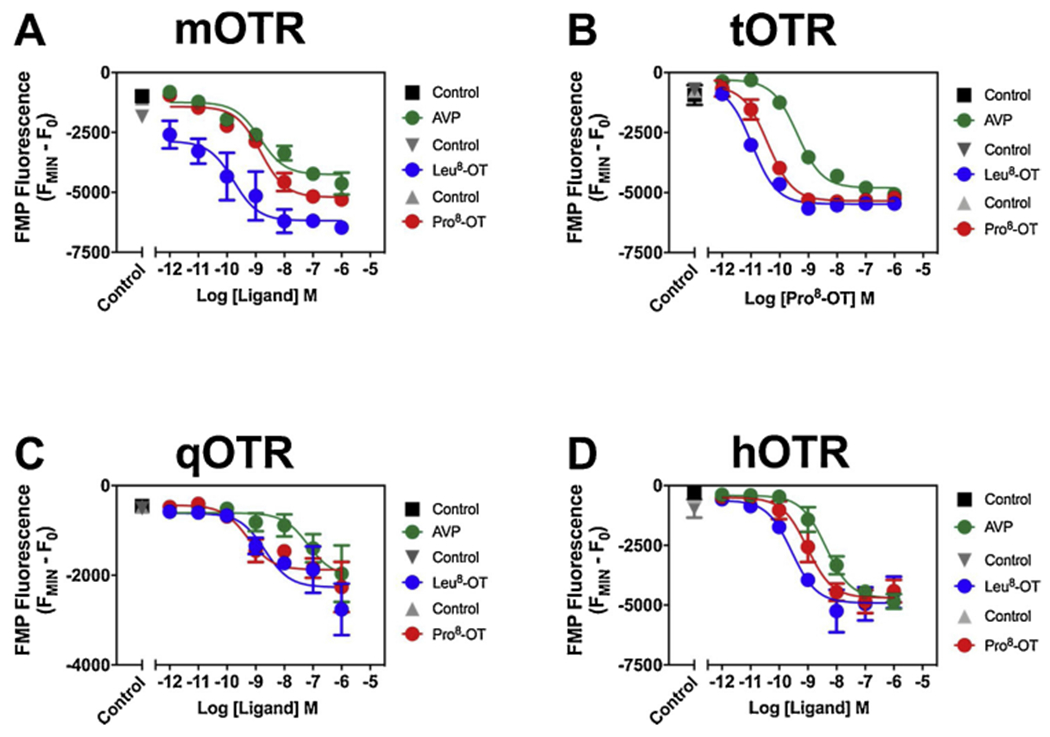
The oxytocin-arginine vasopressin (OT-AVP) ligand-receptor family influences a variety of physiological, behavioral, and social behavioral processes in the brain and periphery. The OT-AVP family is highly conserved in mammals, but recent discoveries have revealed remarkable diversity in OT ligands and receptors in New World Monkeys (NWMs) providing a unique opportunity to assess the effects of genetic variation on pharmacological signatures of peptide ligands. The consensus mammalian OT sequence has leucine in the 8 position (Leu-OT), whereas a number of NWMs, including the marmoset, have proline in the 8 position (Pro-OT) resulting in a more rigid tail structure. OT and AVP bind to OT's cognate G-protein coupled receptor (OTR), which couples to various G-proteins (G, G, G) to stimulate diverse signaling pathways. CHO cells expressing marmoset (mOTR), titi monkey (tOTR), macaque (qOTR), or human (hOTR) OT receptors were used to compare AVP and OT analog-induced signaling. Assessment of G-mediated increase in intracellular calcium (Ca) demonstrated that AVP was less potent than OT analogs at OTRs from species whose endogenous ligand is Leu-OT (tOTR, qOTR, hOTR), relative to Pro-OT. Likewise, AVP-induced membrane hyperpolarization was less potent at these same OTRs. Evaluation of (Ca)-activated potassium (K) channels using the inhibitors apamin, paxilline, and TRAM-34 demonstrated that both intermediate and large conductance Ca-activated K channels contributed to membrane hyperpolarization, with different pharmacological profiles identified for distinct ligand-receptor combinations. Understanding more fully the contributions of structure activity relationships for these peptide ligands at vasopressin and OT receptors will help guide the development of OT-mediated therapeutics.
缩宫素-精氨酸加压素(OT-AVP)配体-受体家族影响大脑和外周的多种生理、行为和社会行为过程。OT-AVP 家族在哺乳动物中高度保守,但最近的发现揭示了新世界猴(NWMs)中 OT 配体和受体的显著多样性,为评估遗传变异对肽配体药理学特征的影响提供了独特的机会。保守的哺乳动物 OT 序列在第 8 位具有亮氨酸(Leu-OT),而许多 NWMs,包括狨猴,在第 8 位具有脯氨酸(Pro-OT),导致尾部结构更僵硬。OT 和 AVP 结合到 OT 的同源 G 蛋白偶联受体(OTR),其与各种 G 蛋白(G、G、G)偶联,刺激不同的信号通路。表达狨猴(mOTR)、塔伊猴(tOTR)、猕猴(qOTR)或人(hOTR)OT 受体的 CHO 细胞用于比较 AVP 和 OT 类似物诱导的信号。评估 G 介导的细胞内钙(Ca)增加表明,与 Leu-OT(tOTR、qOTR、hOTR)的内源性配体相比,AVP 在 OT 受体上的效力低于 OT 类似物。同样,AVP 诱导的膜超极化在这些相同的 OTR 上的效力也较低。使用抑制剂 apamin、paxilline 和 TRAM-34 评估(Ca)激活的钾(K)通道表明,中等和大电导 Ca 激活的 K 通道都有助于膜超极化,并且不同的配体-受体组合具有不同的药理学特征。更充分地了解这些肽配体在加压素和 OT 受体上的结构活性关系的贡献将有助于指导 OT 介导的治疗药物的开发。