Topographic and clinical Anatomy, Institute of Anatomy, University of Bern, 3012 Bern, Switzerland.
Developmental Biology and Regeneration, Institute of Anatomy, University of Bern, 3012 Bern, Switzerland.
PLoS One. 2020 Feb 5;15(2):e0228333. doi: 10.1371/journal.pone.0228333. eCollection 2020.
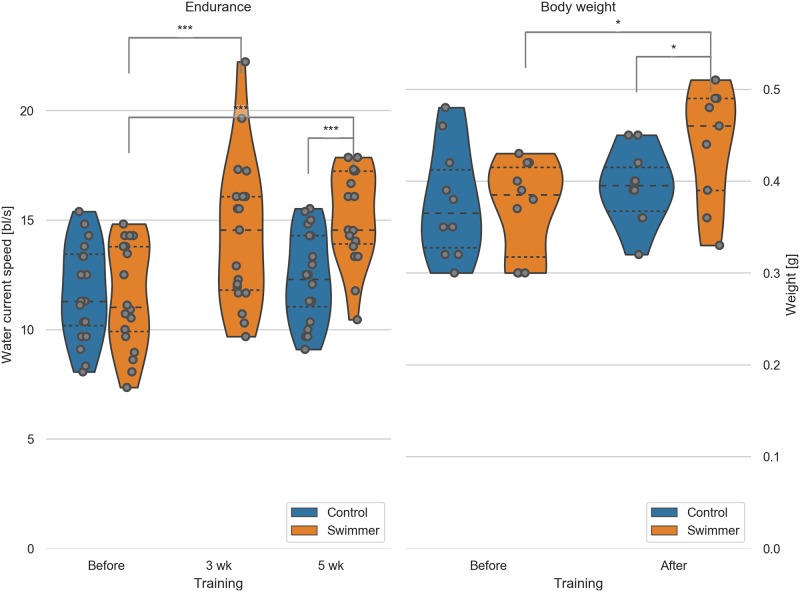
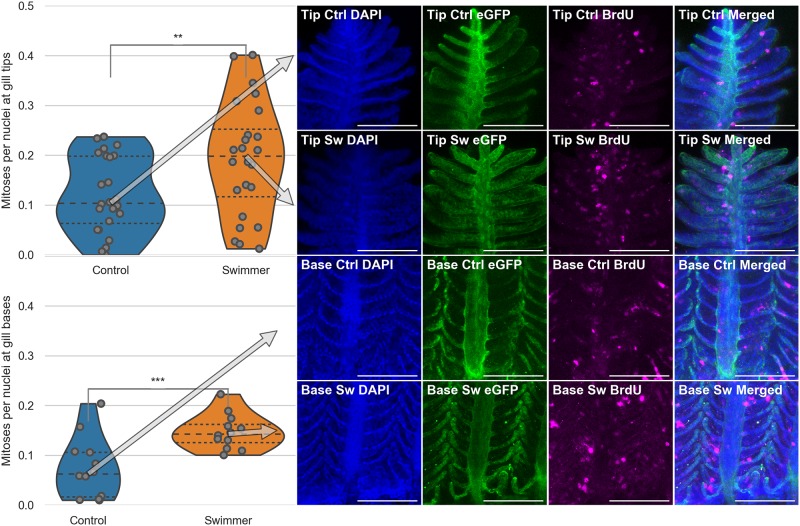
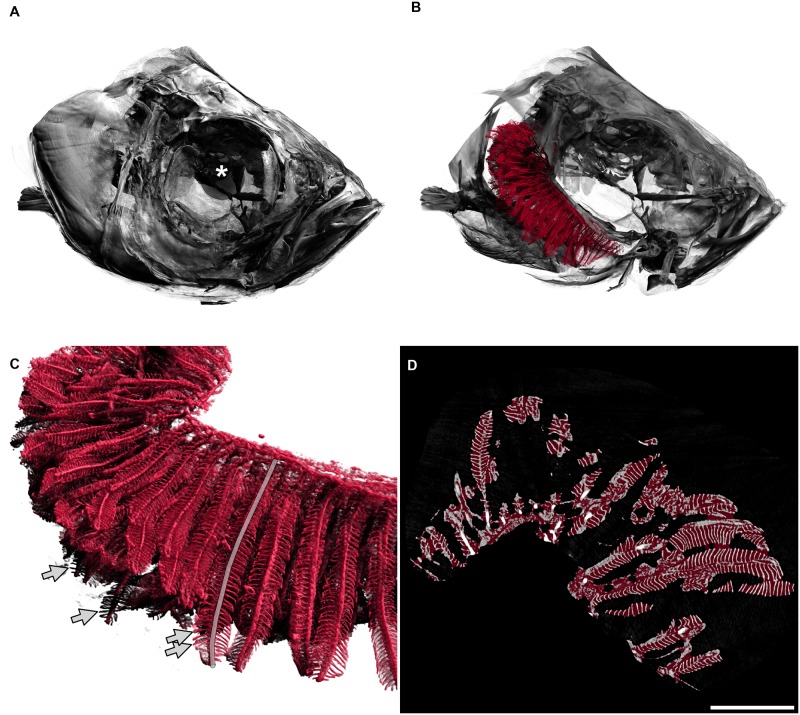
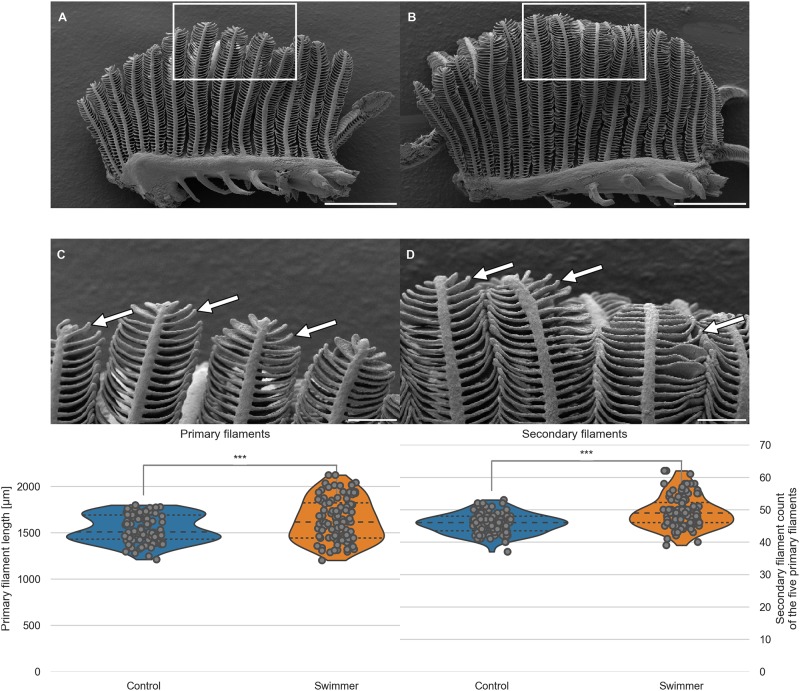
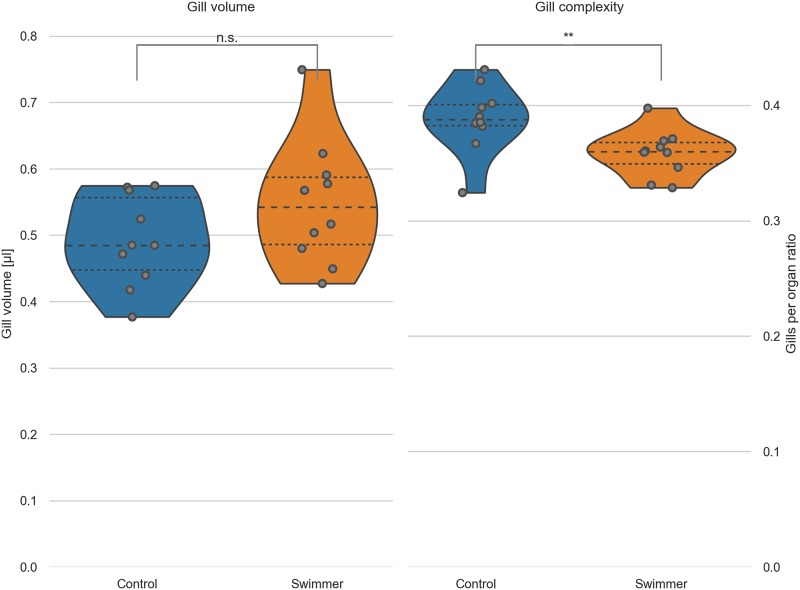
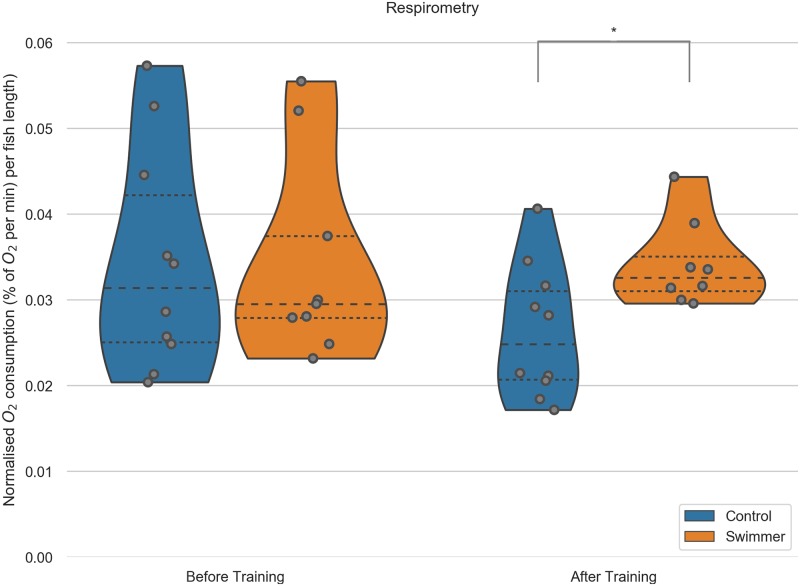
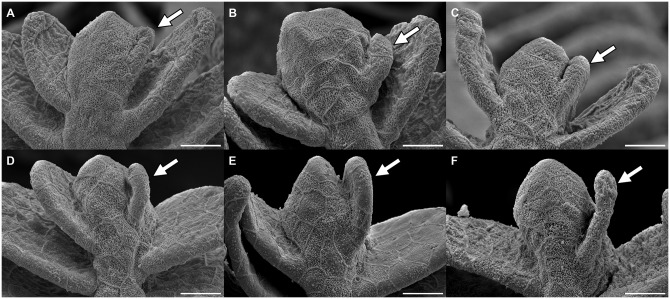
In order to study the adaptation scope of the fish respiratory organ and the O2 metabolism due to endurance training, we subjected adult zebrafish (Danio rerio) to endurance exercise for 5 weeks. After the training period, the swimmer group showed a significant increase in swimming performance, body weight and length. In scanning electron microscopy of the gills, the average length of centrally located primary filaments appeared significantly longer in the swimmer than in the non-trained control group (+6.1%, 1639 μm vs. 1545 μm, p = 0.00043) and the average number of secondary filaments increased significantly (+7.7%, 49.27 vs. 45.73, p = 9e-09). Micro-computed tomography indicated a significant increase in the gill volume (p = 0.048) by 11.8% from 0.490 mm3 to 0.549 mm3. The space-filling complexity dropped significantly (p = 0.0088) by 8.2% from 38.8% to 35.9%., i.e. making the gills of the swimmers less compact. Respirometry after 5 weeks showed a significantly higher oxygen consumption (+30.4%, p = 0.0081) of trained fish during exercise compared to controls. Scanning electron microscopy revealed different stages of new secondary filament budding, which happened at the tip of the primary lamellae. Using BrdU we could confirm that the growth of the secondary filaments took place mainly in the distal half and the tip and for primary filaments mainly at the tip. We conclude that the zebrafish respiratory organ-unlike the mammalian lung-has a high plasticity, and after endurance training increases its volume and changes its structure in order to facilitate O2 uptake.
为了研究鱼类呼吸器官对耐力训练的适应范围和 O2 代谢,我们对成年斑马鱼(Danio rerio)进行了 5 周的耐力训练。在训练期结束后,游泳组的游泳性能、体重和体长均显著提高。在鳃的扫描电子显微镜下,游泳组中央主鳃丝的平均长度比未经训练的对照组显著增加(+6.1%,1639μm 比 1545μm,p=0.00043),次级鳃丝的平均数量也显著增加(+7.7%,49.27 比 45.73,p=9e-09)。微计算机断层扫描显示,鳃体积显著增加(p=0.048),从 0.490mm3 增加到 0.549mm3,增加了 11.8%。鳃的空间填充复杂性显著下降(p=0.0088),从 38.8%下降到 35.9%,即游泳者的鳃变得不那么紧凑。5 周后的呼吸测量显示,与对照组相比,训练后的鱼在运动期间的耗氧量显著增加(+30.4%,p=0.0081)。扫描电子显微镜显示了新的次级鳃丝芽生的不同阶段,这些芽生发生在主鳃丝的尖端。使用 BrdU,我们可以证实次级鳃丝的生长主要发生在远端的一半和尖端,而主鳃丝的生长主要发生在尖端。我们得出结论,与哺乳动物的肺不同,斑马鱼的呼吸器官具有很高的可塑性,在耐力训练后,它会增加体积并改变结构,以促进 O2 的摄取。