Nature. 2020 Feb;578(7793):53-59. doi: 10.1038/s41586-020-1958-9. Epub 2020 Feb 5.
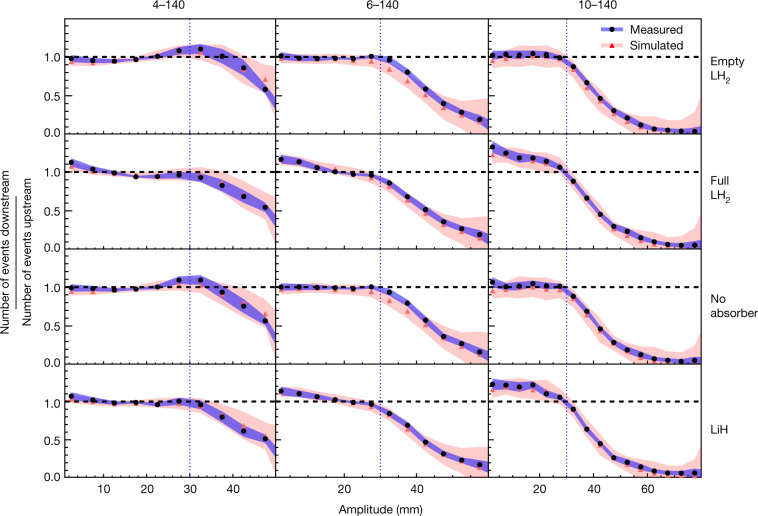
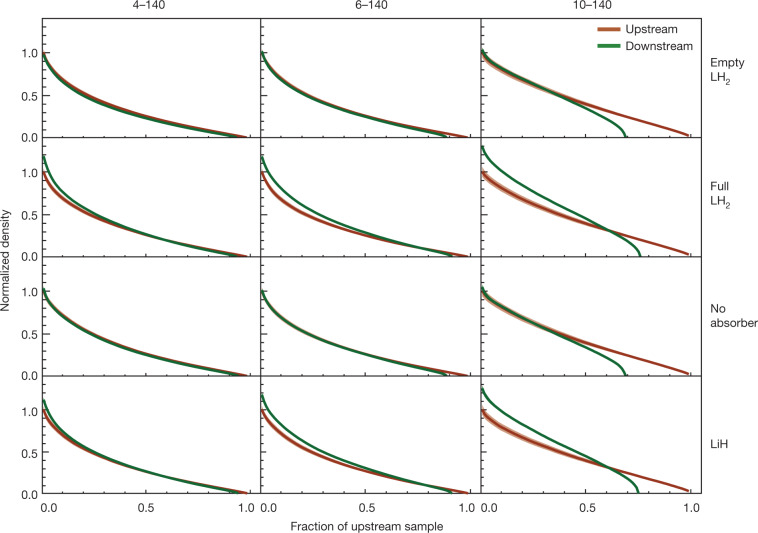
The use of accelerated beams of electrons, protons or ions has furthered the development of nearly every scientific discipline. However, high-energy muon beams of equivalent quality have not yet been delivered. Muon beams can be created through the decay of pions produced by the interaction of a proton beam with a target. Such 'tertiary' beams have much lower brightness than those created by accelerating electrons, protons or ions. High-brightness muon beams comparable to those produced by state-of-the-art electron, proton and ion accelerators could facilitate the study of lepton-antilepton collisions at extremely high energies and provide well characterized neutrino beams. Such muon beams could be realized using ionization cooling, which has been proposed to increase muon-beam brightness. Here we report the realization of ionization cooling, which was confirmed by the observation of an increased number of low-amplitude muons after passage of the muon beam through an absorber, as well as an increase in the corresponding phase-space density. The simulated performance of the ionization cooling system is consistent with the measured data, validating designs of the ionization cooling channel in which the cooling process is repeated to produce a substantial cooling effect. The results presented here are an important step towards achieving the muon-beam quality required to search for phenomena at energy scales beyond the reach of the Large Hadron Collider at a facility of equivalent or reduced footprint.
使用加速的电子、质子或离子束进一步推动了几乎每一个科学学科的发展。然而,尚未提供具有同等质量的高能缪子束。缪子束可以通过质子束与靶相互作用产生的介子衰变而产生。这种“三级”束的亮度比通过加速电子、质子或离子产生的束低得多。与最先进的电子、质子和离子加速器产生的亮度相当的高亮度缪子束可以促进在极高能量下研究轻子-反轻子碰撞,并提供具有良好特征的中微子束。这种缪子束可以通过离化冷却来实现,已经提出离化冷却可以提高缪子束的亮度。在这里,我们报告了离化冷却的实现,通过观察缪子束穿过吸收体后低幅度缪子数量的增加以及相应相空间密度的增加来证实。离化冷却系统的模拟性能与测量数据一致,验证了离化冷却通道的设计,其中冷却过程被重复以产生显著的冷却效果。这里介绍的结果是朝着在与大型强子对撞机等效或更小占地面积的设施中寻找超出其能量范围的现象的所需的缪子束质量迈出的重要一步。