Alvim Cecília M, Mansinho André, Paiva Rita S, Brás Raquel, Semedo Patrícia M, Lobo-Martins Soraia, da Ponte Carolina B, Macedo Daniela, Ribeiro Leonor, Dos Reis José P, Fernandes Isabel, Costa Luís
Medical Oncology Department, Hospital de Santa Maria, Centro Hospitalar Universitário Lisboa Norte, Lisbon, 1649-035, Portugal.
Luís Costa Lab, Instituto de Medicina Molecular, Faculdade de Medicina, Universidade de Lisboa, 1649-028 Lisbon, Portugal.
Future Sci OA. 2019 Dec 12;6(2):FSO436. doi: 10.2144/fsoa-2019-0079.
To evaluate prostate-specific antigen response (PSAr) defined as a ≥50% decrease in PSA concentration from the pretreatment value, as a prognostic factor in patients with metastatic castration-resistant prostate cancer (mCRPC) treated with abiraterone acetate (AA).
Retrospective evaluation of patients with mCRPC treated with AA.
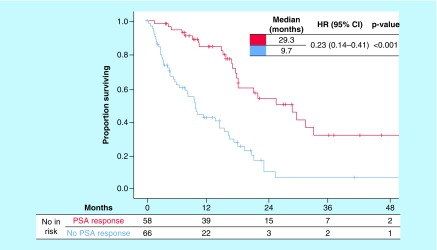
124 patients were identified. Median overall survival and progression-free survival for patients achieving PSAr versus patients without PSAr were 29.3 versus 9.7 months and 17.0 versus 5.2 months, respectively. Multivariate analysis confirmed that PSAr correlated with better overall survival (hazard ratio: 0.19; 95% CI: 0.10-0.38; p < 0.001) and progression-free survival (hazard ratio: 0.24; 95% CI: 0.14-0.41; p < 0.001).
PSAr can be utilized as prognostic and predictive factors in mCRPC patients treated with AA.
评估前列腺特异性抗原反应(PSAr),即前列腺特异性抗原(PSA)浓度较治疗前值降低≥50%,作为醋酸阿比特龙(AA)治疗的转移性去势抵抗性前列腺癌(mCRPC)患者的预后因素。
对接受AA治疗的mCRPC患者进行回顾性评估。
共纳入124例患者。达到PSAr的患者与未达到PSAr的患者的中位总生存期和无进展生存期分别为29.3个月对9.7个月和17.0个月对5.2个月。多因素分析证实,PSAr与更好的总生存期(风险比:0.19;95%置信区间:0.10 - 0.38;p < 0.001)和无进展生存期(风险比:0.24;95%置信区间:0.14 - 0.41;p < 0.001)相关。
PSAr可作为接受AA治疗的mCRPC患者的预后和预测因素。