Research Service, Birmingham VA Medical Center, Birmingham, AL, USA.
Department of Cell, Developmental and Integrative Biology, University of Alabama-Birmingham, Birmingham, AL, USA.
Physiol Rep. 2020 Feb;8(3):e14357. doi: 10.14814/phy2.14357.
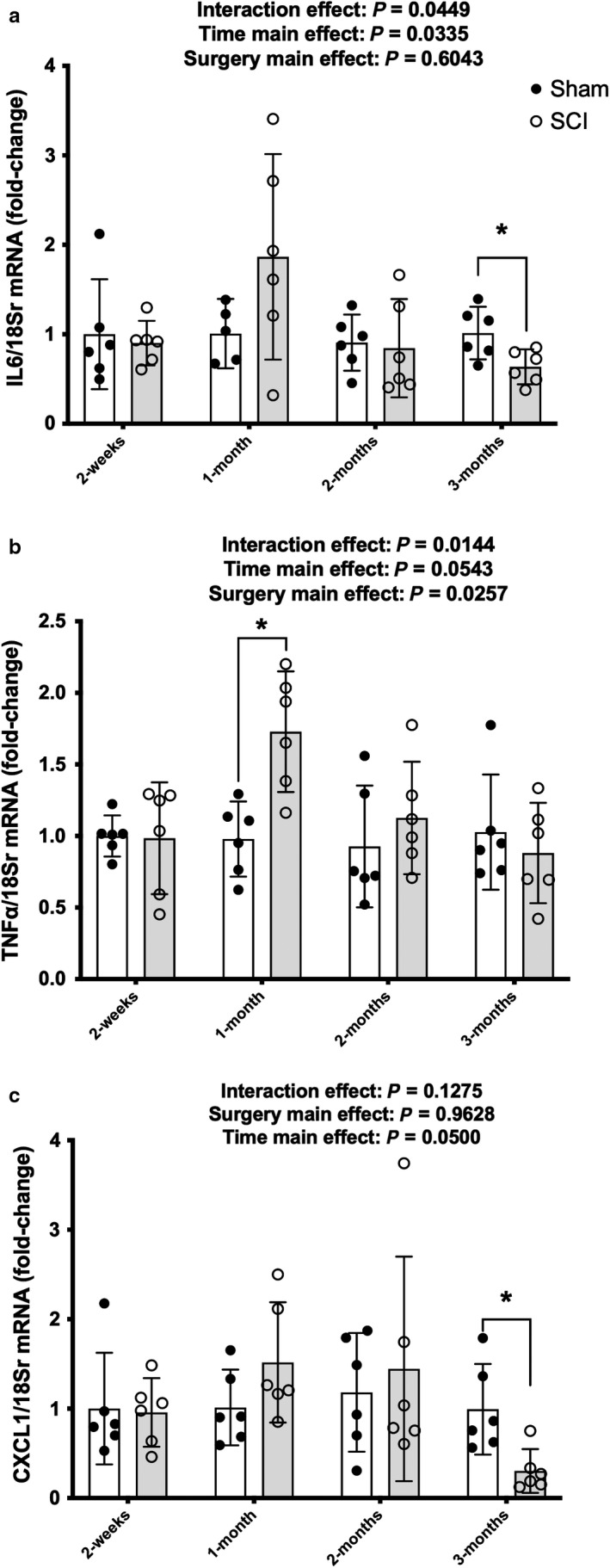
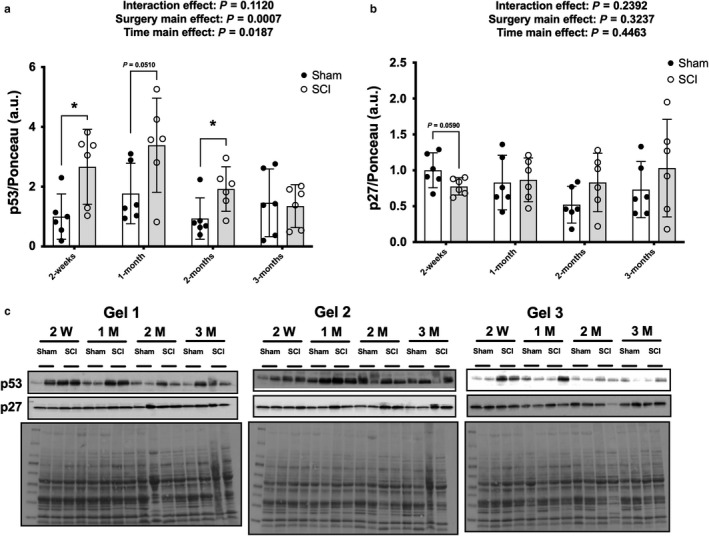
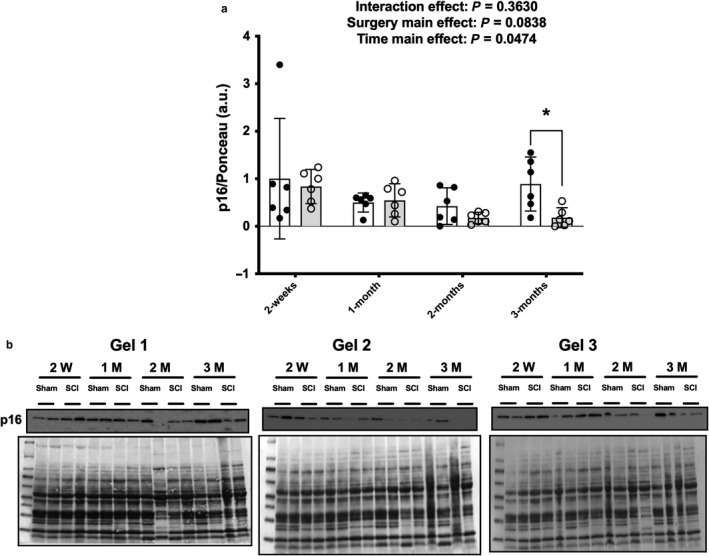
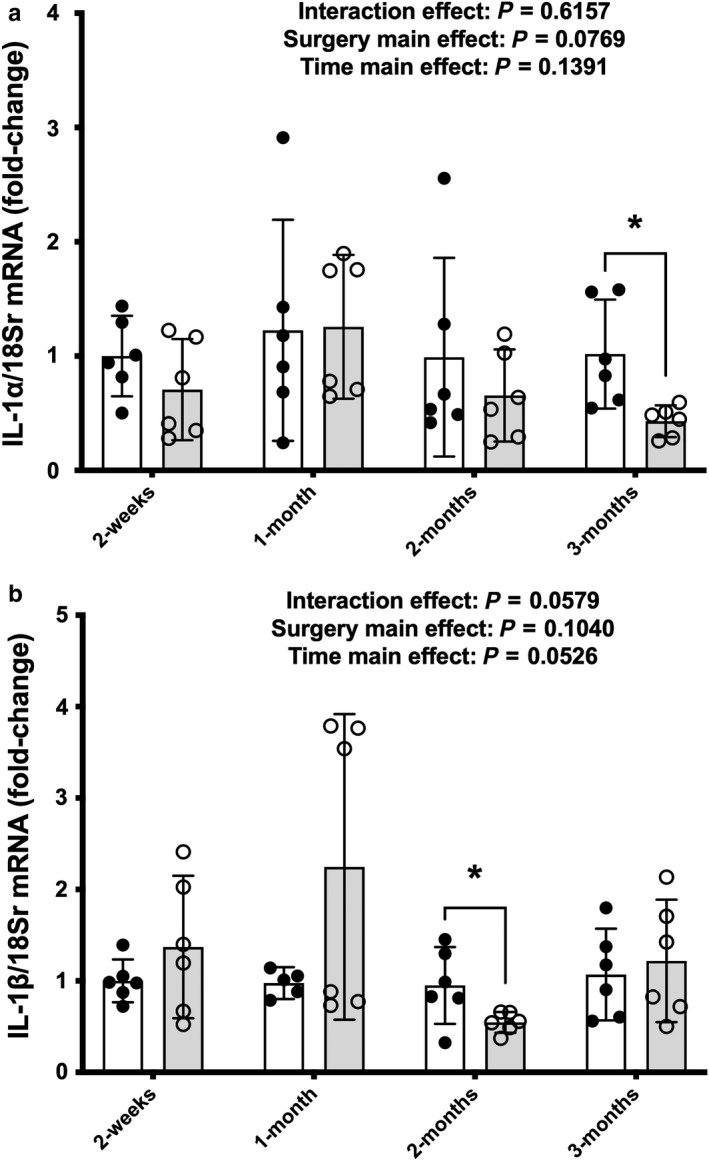
To determine whether muscle disuse after a spinal cord injury (SCI) produces elevated markers of cellular senescence and induces markers of the senescence-associated secretory phenotypes (SASPs) in paralyzed skeletal muscle. Four-month-old male Sprague-Dawley rats received a moderate-severe (250 kiloDyne) T-9 contusion SCI or Sham surgery and were monitored over 2 weeks, and 1-, 2-, or 3 months. Animals were sacrificed via isoflurane overdose and terminal exsanguination and the soleus was carefully excised and snap frozen. Protein expression of senescence markers p53, p27, and p16 was determined from whole soleus lysates using Western immunoblotting and RT-qPCR was used to determine the soleus gene expression of IL-1α, IL-1β, IL-6, CXCL1, and TNFα. SCI soleus muscle displayed 2- to 3-fold higher total p53 protein expression at 2 weeks, and at 1 and 2 months when compared with Sham. p27 expression was stable across all groups and timepoints. p16 protein expression was lower at 3 months in SCI versus Sham, but not earlier timepoints. Gene expression was relatively stable between groups at 2 weeks. There were Surgery x Time interaction effects for IL-6 and TNFα mRNA expression but not for IL-1α, IL-1β, or CXCL1. There were no main effects for time or surgery for IL-1α, IL-1β, or CXCL1, but targeted t tests showed reductions in IL-1α and CXCL1 in SCI animals compared to Sham at 3 months and IL-1β was reduced in SCI animals compared to Sham animals at the 2-month timepoint. The elevation in p53 does not appear consistent with the induction of SASP because mRNA expression of cytokines associated with senescence was not uniformly upregulated and, in some instances, was downregulated in the early chronic phase of SCI.
为了确定脊髓损伤(SCI)后肌肉废用是否会导致细胞衰老标志物升高,并在瘫痪骨骼肌中诱导衰老相关分泌表型(SASP)标志物。将四个月大的雄性 Sprague-Dawley 大鼠接受中度严重(250 千牛顿)T-9 挫伤 SCI 或假手术,并在 2 周、1 个月、2 个月或 3 个月进行监测。动物通过异氟烷过量和终末期放血处死,小心地切除比目鱼肌并立即冷冻。使用 Western 免疫印迹法从整个比目鱼肌裂解物中测定衰老标志物 p53、p27 和 p16 的蛋白表达,并用 RT-qPCR 测定 IL-1α、IL-1β、IL-6、CXCL1 和 TNFα 的比目鱼肌基因表达。与 Sham 相比,SCI 比目鱼肌在 2 周时总 p53 蛋白表达增加了 2-3 倍,在 1 个月和 2 个月时也是如此。p27 表达在所有组和时间点均保持稳定。与 Sham 相比,SCI 组在 3 个月时 p16 蛋白表达较低,但在更早的时间点并非如此。在 2 周时,两组之间的基因表达相对稳定。IL-6 和 TNFα mRNA 表达存在手术 x 时间的交互作用,但 IL-1α、IL-1β 或 CXCL1 则没有。时间或手术对 IL-1α、IL-1β 或 CXCL1 均无主要影响,但靶向 t 检验显示与 Sham 相比,SCI 动物在 3 个月时 IL-1α 和 CXCL1 减少,而在 2 个月时 IL-1β 减少。p53 的升高似乎与 SASP 的诱导不一致,因为与衰老相关的细胞因子的 mRNA 表达并没有普遍上调,在 SCI 的早期慢性阶段,某些情况下甚至下调。