Byeon Seonggyu, Cho Jang Ho, Jung Hyun Ae, Sun Jong-Mu, Lee Se-Hoon, Ahn Jin Seok, Park Keunchil, Ahn Myung-Ju
Division of Hematology-Oncology, Department of Medicine, Samsung Medical Center, Sungkyunkwan University School of Medicine, Seoul, Korea.
Division of Hematology-Oncology, Department of Medicine, Incheon St. Mary's Hospital, Incheon, Korea.
Cancer Med. 2020 Apr;9(7):2352-2362. doi: 10.1002/cam4.2868. Epub 2020 Feb 6.
Immune checkpoint inhibitors (ICIs) have provided new therapeutic options for non-small cell lung cancer(NSCLC) patients. However, due to concerning increases in immune-related adverse events, clinical trials usually exclude patients with special issues such as viral hepatitis, tuberculosis (Tbc), interstitial lung disease (ILD) and autoimmune disease.
We retrospectively reviewed the medical records of NSCLC patients who received ICIs, and analyzed the clinical outcomes of patients with special issues.
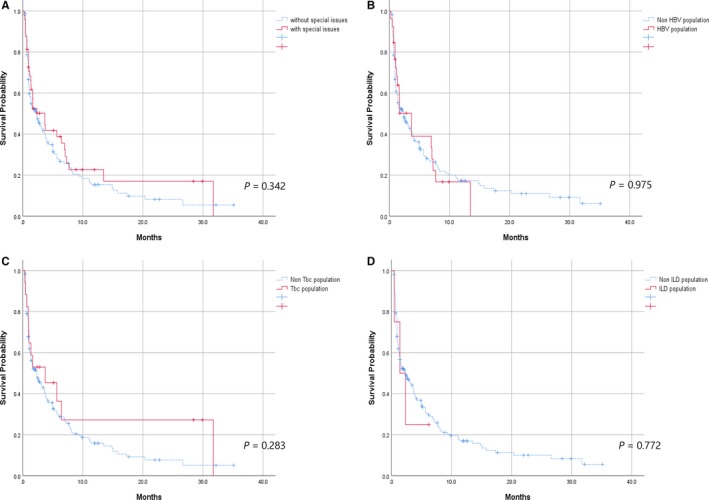
Between January 2015 and October 2018, 237 patients received ICIs. Of these patients, 26% (61/237) had special issues: 32 had hepatitis B viral (HBV) infections, 20 Tbc, six ILD, one HIV infection, one Behçet's disease and a past HBV infection, and one rheumatoid arthritis. The incidence of hepatitis tended to be higher in patients with HBV infections than in those without (18.8% vs 8.91%, P = .082). Severe hepatitis (grade 3 or higher) was more common in HBV-infected patients (12.5% vs 1.9%, P = .0021), but the AEs were well-managed. During ICI treatment, three of the 20 patients with a history of pulmonary Tbc developed active pulmonary Tbc, considered reactivations. No aggravation of ILD was noted. One RA patient experienced a disease flare and was treated with a low-dose steroid. There was no significant difference in the overall response rate or progression-free survival between patients with and without special issues.
Given the relatively low incidence of immune-related AEs and the comparability of clinical outcomes, ICIs can be treatment option of NSCLC patients with special issues.
免疫检查点抑制剂(ICI)为非小细胞肺癌(NSCLC)患者提供了新的治疗选择。然而,由于免疫相关不良事件的发生率令人担忧,临床试验通常会排除患有特殊疾病的患者,如病毒性肝炎、肺结核(Tbc)、间质性肺病(ILD)和自身免疫性疾病。
我们回顾性分析了接受ICI治疗的NSCLC患者的病历,并分析了有特殊疾病患者的临床结局。
2015年1月至2018年10月期间,237例患者接受了ICI治疗。其中,26%(61/237)的患者有特殊疾病:32例为乙型肝炎病毒(HBV)感染,20例为肺结核,6例为ILD,1例为HIV感染,1例为白塞病且既往有HBV感染,1例为类风湿关节炎。HBV感染患者的肝炎发生率往往高于未感染患者(18.8%对8.91%,P = 0.082)。严重肝炎(3级或更高)在HBV感染患者中更为常见(12.5%对1.9%,P = 0.0021),但不良事件得到了良好管理。在ICI治疗期间,20例有肺结核病史的患者中有3例发生了活动性肺结核,被认为是复发。未观察到ILD加重。1例类风湿关节炎患者病情发作,接受了低剂量类固醇治疗。有特殊疾病和无特殊疾病患者的总体缓解率或无进展生存期无显著差异。
鉴于免疫相关不良事件的发生率相对较低且临床结局具有可比性,ICI可作为有特殊疾病的NSCLC患者的治疗选择。