Lee Jae Hwan, Kim Min Uk, Kim Eung Tae, Shim Dong Jae, Kim Il Jung, Byeon Jong Hyun, Kim Hyun Beom
Department of Radiology, Seoul National University Bundang Hospital, Seongnam-si, Gyeonggi-do.
Department of Radiology, Seoul Metropolitan Government-Seoul National University Boramae Medical Center, Seoul.
Medicine (Baltimore). 2020 Feb;99(6):e19056. doi: 10.1097/MD.0000000000019056.
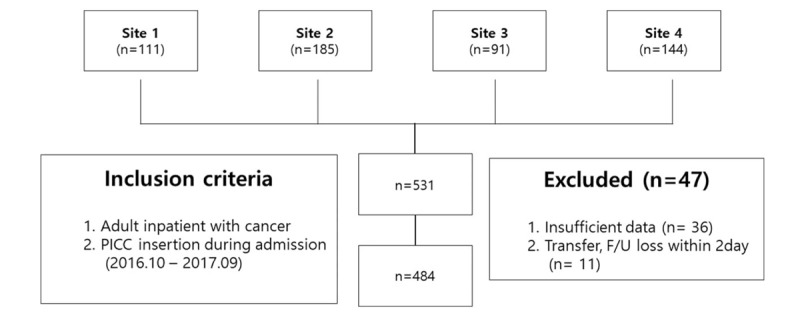
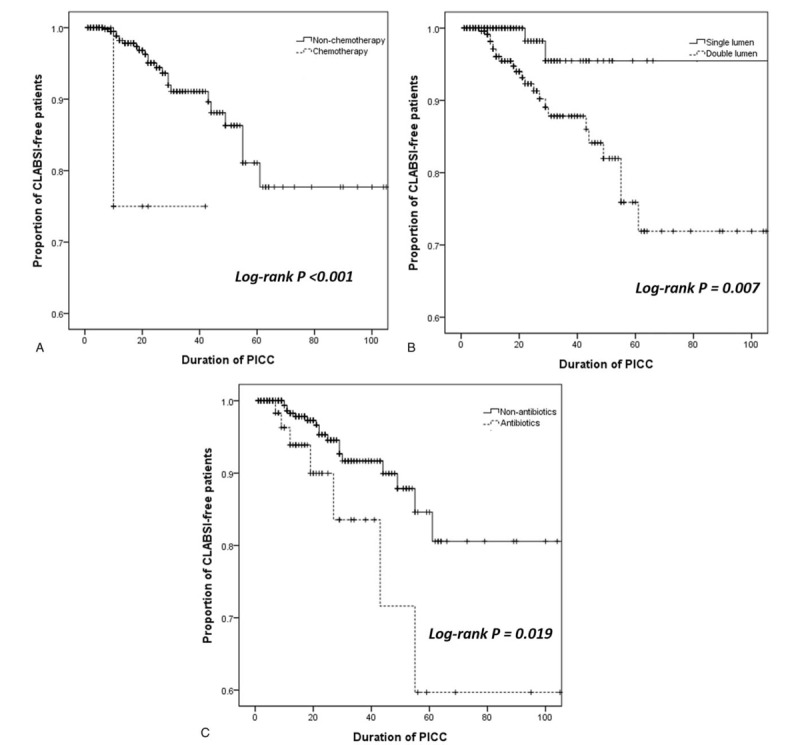
Despite increasing use, the exact prevalence and predictors of peripherally inserted central catheter-associated bloodstream infection (PICC-CLABSI) in hospitalized patients with cancer are not elucidated.This retrospective cohort study included consecutive patients who underwent peripherally inserted central catheter (PICC) placement in 4 institutions (during 12 months in 3 hospitals and 10 months in 1 hospital). The prevalence of PICC-CLABSI was evaluated. The association between predictors and PICC-CLABSI were analyzed using Cox proportional hazards regression models and Kaplan-Meier survival analysis with log-rank tests.During the study period, 539 PICCs were inserted in 484 patients for a total of 10,841 catheter days. PICC-CLABSI occurred in 25 (5.2%) patients, with an infection rate of 2.31 per 1000 catheter days. PICC for chemotherapy (hazards ratio [HR] 11.421; 95% confidence interval (CI), 2.434-53.594; P = .019), double lumen catheter [HR 5.466; 95% CI, 1.257-23.773; P = .007], and PICC for antibiotic therapy [HR 2.854; 95% CI, 1.082-7.530; P = .019] were associated with PICC-CLABSI.PICC for chemotherapy or antibiotics, and number of catheter lumens are associated with increased risk of PICC-CLABSI in cancer patients. Careful assessment of these factors might help prevent PICC-CLABSI and improve cancer patients care.
尽管外周静脉穿刺中心静脉导管(PICC)的使用日益增多,但住院癌症患者中PICC相关血流感染(PICC-CLABSI)的确切患病率及预测因素仍未明确。这项回顾性队列研究纳入了在4家机构接受PICC置管的连续患者(3家医院为12个月,1家医院为10个月)。评估了PICC-CLABSI的患病率。使用Cox比例风险回归模型以及带有对数秩检验的Kaplan-Meier生存分析来分析预测因素与PICC-CLABSI之间的关联。在研究期间,484例患者共置入539根PICC,累计导管留置天数达10841天。25例(5.2%)患者发生了PICC-CLABSI,感染率为每1000导管日2.31例。化疗用PICC(风险比[HR]11.421;95%置信区间[CI],2.434 - 53.594;P = 0.019)、双腔导管[HR 5.466;95% CI,1.257 - 23.773;P = 0.007]以及抗生素治疗用PICC[HR 2.854;95% CI,1.082 - 7.530;P = 0.019]与PICC-CLABSI相关。化疗或抗生素治疗用PICC以及导管腔数与癌症患者发生PICC-CLABSI的风险增加相关。仔细评估这些因素可能有助于预防PICC-CLABSI并改善癌症患者的护理。