Department of Chemistry, University of Surrey, Guildford, GU2 7XH, UK.
Ion Beam Centre, University of Surrey, Guildford, GU2 7XH, UK.
Sci Rep. 2020 Feb 6;10(1):1974. doi: 10.1038/s41598-020-58856-0.
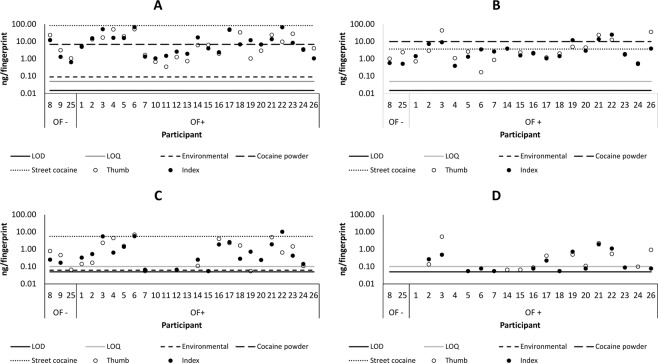
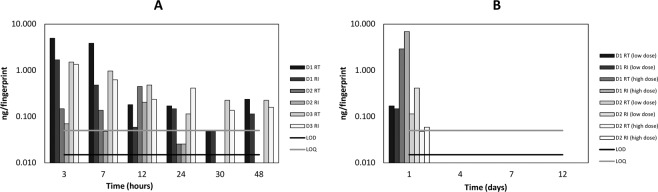
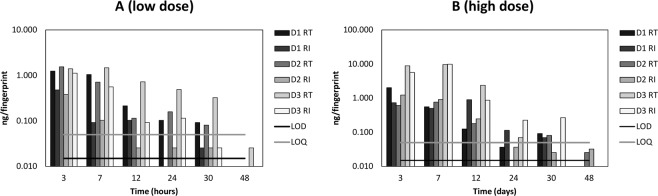
The finding that drugs and metabolites can be detected from fingerprints is of potential relevance to forensic science and as well as toxicology and clinical testing. However, discriminating between dermal contact and ingestion of drugs has never been verified experimentally. The inability to interpret the result of finding a drug or metabolite in a fingerprint has prevented widespread adoption of fingerprints in drug testing and limits the probative value of detecting drugs in fingermarks. A commonly held belief is that the detection of metabolites of drugs of abuse in fingerprints can be used to confirm a drug has been ingested. However, we show here that cocaine and its primary metabolite, benzoylecgonine, can be detected in fingerprints of non-drug users after contact with cocaine. Additionally, cocaine was found to persist above environmental levels for up to 48 hours after contact. Therefore the detection of cocaine and benzoylecgonine (BZE) in fingermarks can be forensically significant, but do not demonstrate that a person has ingested the substance. In contrast, the data here shows that a drug test from a fingerprint (where hands can be washed prior to donating a sample) CAN distinguish between contact and ingestion of cocaine. If hands were washed prior to giving a fingerprint, BZE was detected only after the administration of cocaine. Therefore BZE can be used to distinguish cocaine contact from cocaine ingestion, provided donors wash their hands prior to sampling. A test based on the detection of BZE in at least one of two donated fingerprint samples has accuracy 95%, sensitivity 90% and specificity of 100% (n = 86).
指纹中可以检测到药物及其代谢物,这一发现与法医学以及毒理学和临床检测都密切相关。然而,人们从未通过实验验证过区分皮肤接触和摄入药物的能力。由于无法解释在指纹中发现药物或其代谢物的结果,因此指纹在药物检测中的广泛应用受到阻碍,也限制了在指纹中检测药物的证据价值。人们普遍认为,在指纹中检测到滥用药物的代谢物可以用于确认摄入了药物。然而,我们在这里表明,接触可卡因后,即使是非药物使用者的指纹中也可以检测到可卡因及其主要代谢物苯甲酰爱康宁。此外,接触后可卡因在指纹中的存在时间长达 48 小时以上,仍可检测到。因此,在指纹中检测到可卡因和苯甲酰爱康宁(BZE)可能具有法医学意义,但并不能证明一个人摄入了该物质。相比之下,这里的数据表明,指纹药物检测(在此情况下,在提供样本前可以清洗双手)可以区分可卡因的接触和摄入。如果在提供指纹前先清洗双手,则只有在摄入可卡因后才会检测到 BZE。因此,如果捐赠者在采样前洗手,BZE 可用于区分可卡因接触和可卡因摄入。基于在至少两个捐赠的指纹样本中的一个样本中检测到 BZE 的测试,其准确率为 95%,灵敏度为 90%,特异性为 100%(n=86)。