Khamtuikrua Chaowanan, Suksompong Sirilak
Department of Anesthesiology, Faculty of Medicine Siriraj Hospital, Mahidol University, Bangkok, Thailand.
SAGE Open Med. 2020 Jan 22;8:2050312120901733. doi: 10.1177/2050312120901733. eCollection 2020.
The use of medical radiation in diagnosis and procedural and surgical treatment is increasing. Therefore, healthcare personnel should be adequately aware and knowledgeable about radiation hazards to protect themselves and their patients from its adverse effects. The objective of this study was to examine awareness about radiation hazards and knowledge about protection methods among the anesthesia personnel and surgical subspecialists of a quaternary care academic center.
A validated questionnaire was completed by anesthetic personnel and surgical subspecialists. It consisted of questions that required demographic information and assessed awareness about radiation hazards. In addition, 15 multiple-choice questions assessed knowledge about radiation across the following domains: the main principle of radiation protection, personal annual radiation dose, personal protection equipment, safe distance from an X-ray machine, and susceptible organs.
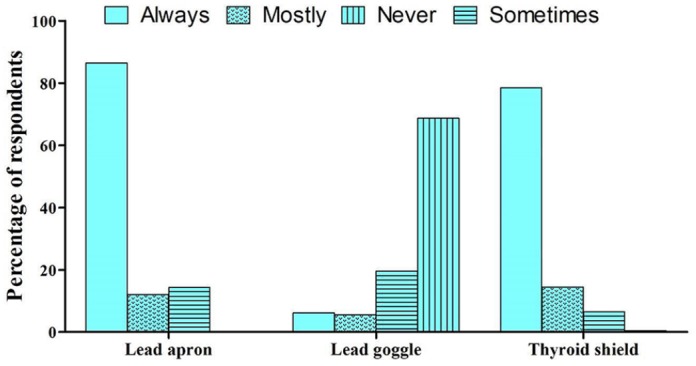
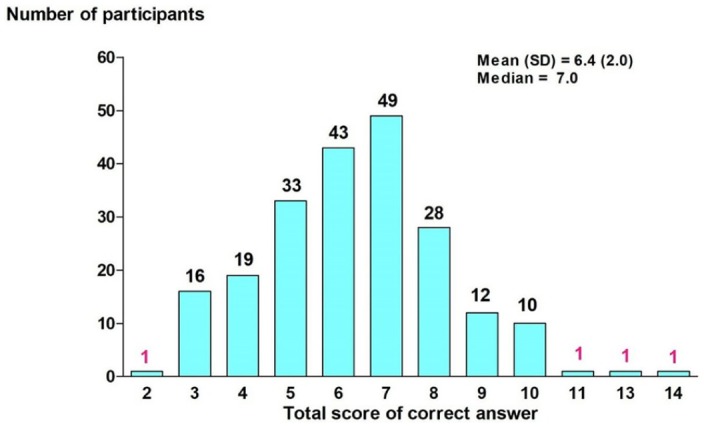
A total of 270 potential participants were emailed and invited to respond to an online questionnaire, and the response rate was 79.3%. Of the 214 participants, 69.2% were women; the mean age of the sample was 34.8 years. Most of the participants (63.1%) considered radiation exposure that occurs as a part of daily work to be very harmful; 86.4% and 78.5% reported that they always wore a lead apron and a thyroid shield when working in an environment that entails radiation exposure, respectively. The mean score for knowledge about radiation hazards and protection was 6.4 ± 2.0 (maximum possible score = 15) Therefore, there is a need to improve anesthetic personnel and surgical subspecialists' knowledge about radiation protection, especially with regard to the use of lead goggles and harmful doses of radiation.
The present findings suggest that there is a reasonable level of awareness but a relative lack of knowledge about radiation hazards and protection among anesthesia personnel and surgical subspecialists. Therefore, continuing medical education on radiation hazards and protection must be mandated.
医学辐射在诊断以及程序和手术治疗中的应用正在增加。因此,医护人员应充分了解辐射危害并具备相关知识,以保护自己和患者免受其不良影响。本研究的目的是调查一家四级医疗学术中心的麻醉人员和外科专科医生对辐射危害的认识以及对防护方法的了解。
麻醉人员和外科专科医生填写一份经过验证的问卷。问卷包括需要人口统计学信息的问题,并评估对辐射危害的认识。此外,15道多项选择题评估了在以下领域的辐射知识:辐射防护的主要原则、个人年度辐射剂量、个人防护设备、与X光机的安全距离以及易受影响的器官。
总共向270名潜在参与者发送电子邮件邀请他们回答在线问卷,回复率为79.3%。在214名参与者中,69.2%为女性;样本的平均年龄为34.8岁。大多数参与者(63.1%)认为日常工作中发生的辐射暴露非常有害;分别有86.4%和78.5%的参与者报告说,他们在有辐射暴露的环境中工作时总是穿戴铅围裙和甲状腺防护盾。辐射危害和防护知识的平均得分为6.4±2.0(最高可能分数=15)。因此,有必要提高麻醉人员和外科专科医生对辐射防护的知识,特别是关于铅护目镜的使用和辐射有害剂量方面的知识。
目前的研究结果表明,麻醉人员和外科专科医生对辐射危害和防护有一定程度的认识,但相关知识相对缺乏。因此,必须强制开展关于辐射危害和防护的继续医学教育。