Department of Mechanical Engineering, University College London, London, UK.
Oxford Centre for Industrial and Applied Mathematics, Mathematical Institute, Oxford, UK.
Int J Numer Method Biomed Eng. 2020 Mar;36(3):e3315. doi: 10.1002/cnm.3315. Epub 2020 Feb 25.
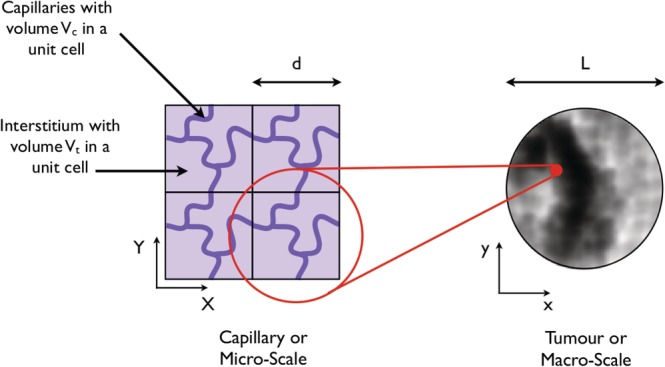
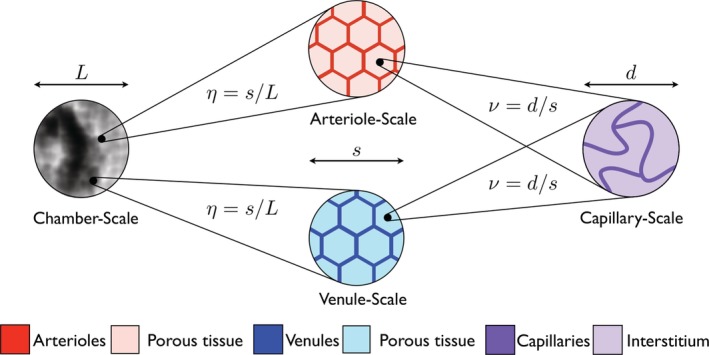
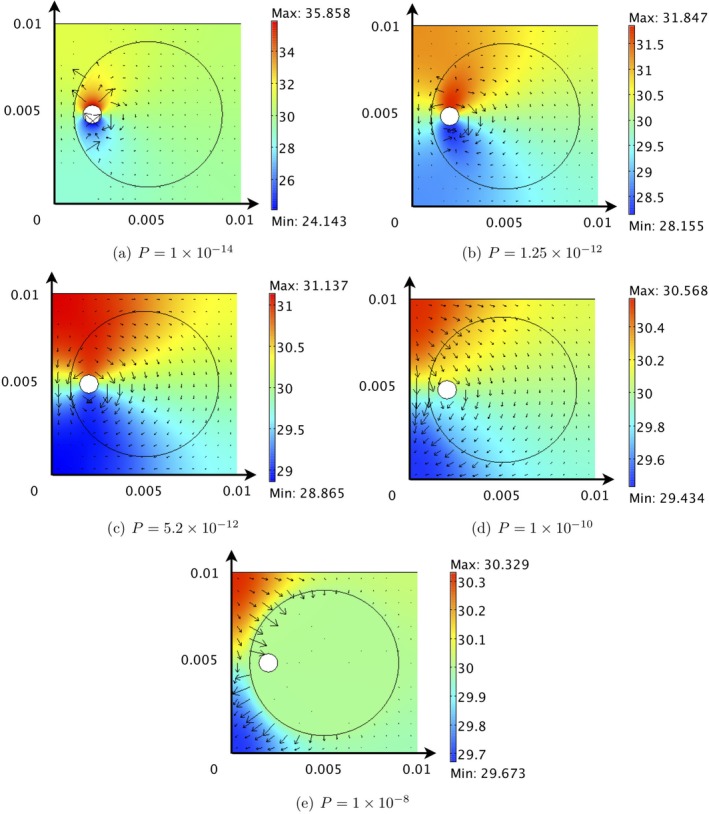
The subtle relationship between vascular network structure and mass transport is vital to predict and improve the efficacy of anticancer treatments. Here, mathematical homogenisation is used to derive a new multiscale continuum model of blood and chemotherapy transport in the vasculature and interstitium of a vascular tumour. This framework enables information at a range of vascular hierarchies to be fed into an effective description on the length scale of the tumour. The model behaviour is explored through a demonstrative case study of a simplified representation of a dorsal skinfold chamber, to examine the role of vascular network architecture in influencing fluid and drug perfusion on the length scale of the chamber. A single parameter, P, is identified that relates tumour-scale fluid perfusion to the permeability and density of the capillary bed. By fixing the topological and physiological properties of the arteriole and venule networks, an optimal value for P is identified, which maximises tumour fluid transport and is thus hypothesised to benefit chemotherapy delivery. We calculate the values for P for eight explicit network structures; in each case, vascular intervention by either decreasing the permeability or increasing the density of the capillary network would increase fluid perfusion through the cancerous tissue. Chemotherapeutic strategies are compared and indicate that single injection is consistently more successful compared with constant perfusion, and the model predicts optimal timing of a second dose. These results highlight the potential of computational modelling to elucidate the link between vascular architecture and fluid, drug distribution in tumours.
血管网络结构和质量传输之间的细微关系对预测和提高抗癌治疗效果至关重要。在这里,数学均匀化被用于推导出一个新的多尺度连续体模型,用于描述血管和肿瘤间质中的血液和化疗物质的传输。该框架能够将不同血管层次的信息输入到肿瘤长度尺度的有效描述中。通过对简化的背部皮肤囊室的示范案例研究,探讨了血管网络结构在影响腔内流体和药物灌注方面的作用。确定了一个单一参数 P,它将肿瘤尺度的流体灌注与毛细血管床的渗透性和密度联系起来。通过固定小动脉和小静脉网络的拓扑和生理特性,确定了 P 的最佳值,该值最大化了肿瘤的流体传输,因此假设可以有益于化疗药物的输送。我们计算了 8 种显式网络结构的 P 值;在每种情况下,通过降低毛细血管网络的渗透性或增加其密度来干预血管,都将增加癌症组织中的流体灌注。比较了化疗策略,并表明与持续灌注相比,单次注射始终更成功,并且模型预测了第二次剂量的最佳时间。这些结果强调了计算建模在阐明血管结构与肿瘤内流体和药物分布之间联系的潜力。