Cincinnati Children's Hospital Medical Center, Department of Pediatrics, University of Cincinnati College of Medicine, Cincinnati, OH.
Department of Pediatrics, Icahn School of Medicine at Mount Sinai, Kravis Children's Hospital, New York, NY.
Transplantation. 2020 Nov;104(11):2346-2353. doi: 10.1097/TP.0000000000003157.
Neighborhood socioeconomic deprivation is associated with adverse health outcomes. We sought to determine if neighborhood socioeconomic deprivation was associated with adherence to immunosuppressive medications after liver transplantation.
We conducted a secondary analysis of a multicenter, prospective cohort of children enrolled in the medication adherence in children who had a liver transplant study (enrollment 2010-2013). Participants (N = 271) received a liver transplant ≥1 year before enrollment and were subsequently treated with tacrolimus. The primary exposure, connected to geocoded participant home addresses, was a neighborhood socioeconomic deprivation index (range 0-1, higher indicates more deprivation). The primary outcome was the medication level variability index (MLVI), a surrogate measure of adherence to immunosuppression in pediatric liver transplant recipients. Higher MLVI indicates worse adherence behavior; values ≥2.5 are predictive of late allograft rejection.
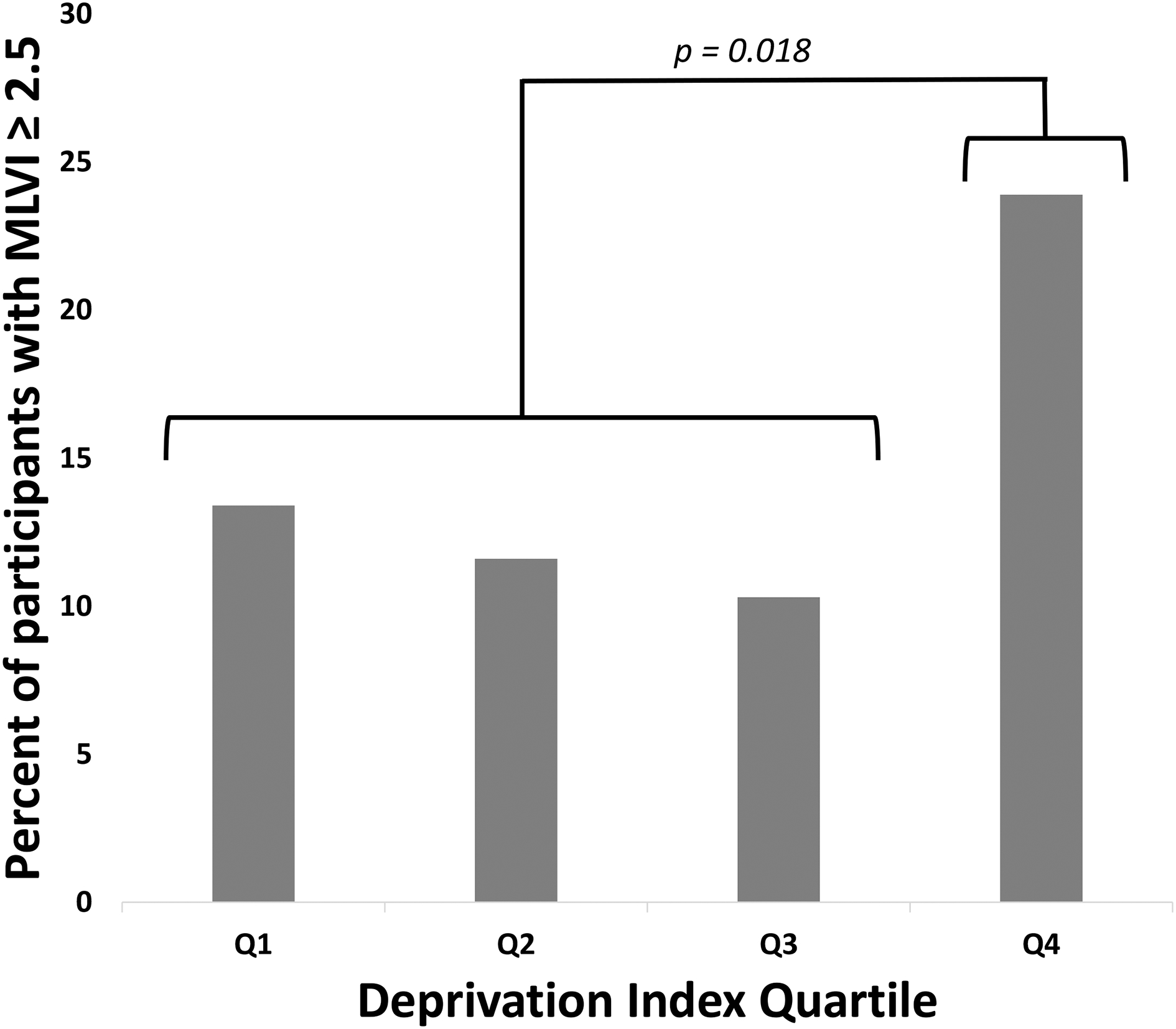
There was a 5% increase in MLVI for each 0.1 increase in deprivation index (95% confidence interval, -1% to 11%; P = 0.08). Roughly 24% of participants from the most deprived quartile had an MLVI ≥2.5 compared with 12% in the remaining 3 quartiles (P = 0.018). Black children were more likely to have high MLVI even after adjusting for deprivation (adjusted odds ratio 4.0 95% confidence interval, 1.7-10.6).
This is the first study to evaluate associations between neighborhood socioeconomic deprivation and an objective surrogate measure of medication adherence in children posttransplant. These findings suggest that neighborhood context may be an important consideration when assessing adherence. Differential rates of medication adherence may partly explain links between neighborhood factors and adverse health outcomes following pediatric liver transplantation.
社区社会经济剥夺与不良健康结果相关。我们试图确定社区社会经济剥夺是否与肝移植后免疫抑制药物的依从性相关。
我们对一项多中心、前瞻性儿童队列研究(2010-2013 年入组)进行了二次分析。参与者(N=271)在入组前至少接受了 1 年的肝移植,并随后接受了他克莫司治疗。主要暴露因素与参与者家庭住址的地理编码相关,是一种社区社会经济剥夺指数(范围 0-1,数值越高表示剥夺程度越高)。主要结局是药物水平变异指数(MLVI),它是儿童肝移植受者免疫抑制药物依从性的替代指标。较高的 MLVI 表示较差的依从行为;值≥2.5 可预测晚期移植物排斥。
MLVI 每增加 0.1,剥夺指数就增加 5%(95%置信区间,-1%至 11%;P=0.08)。在最贫困的四分位组中,约 24%的参与者的 MLVI≥2.5,而其余 3 个四分位组中只有 12%的参与者 MLVI≥2.5(P=0.018)。即使在调整了剥夺因素后,黑人儿童仍更有可能出现高 MLVI(调整后的优势比为 4.0,95%置信区间为 1.7-10.6)。
这是第一项评估社区社会经济剥夺与儿童移植后药物依从性客观替代指标之间关系的研究。这些发现表明,在评估依从性时,邻里环境可能是一个重要的考虑因素。药物依从性的差异率可能部分解释了邻里因素与儿童肝移植后不良健康结果之间的联系。