Department for Computational Biology of Infection Research, Helmholtz Center for Infection Research, Braunschweig, Germany.
German Center for Infection Research (DZIF), Braunschweig, Germany.
PLoS Comput Biol. 2020 Feb 7;16(2):e1007101. doi: 10.1371/journal.pcbi.1007101. eCollection 2020 Feb.
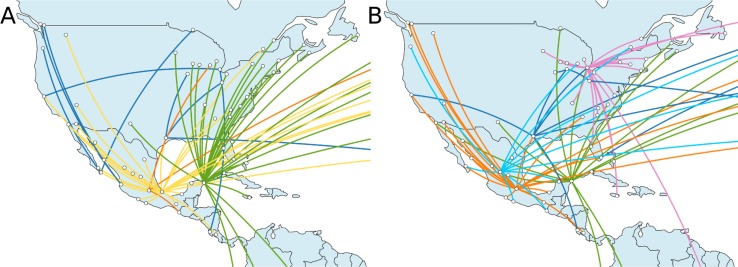
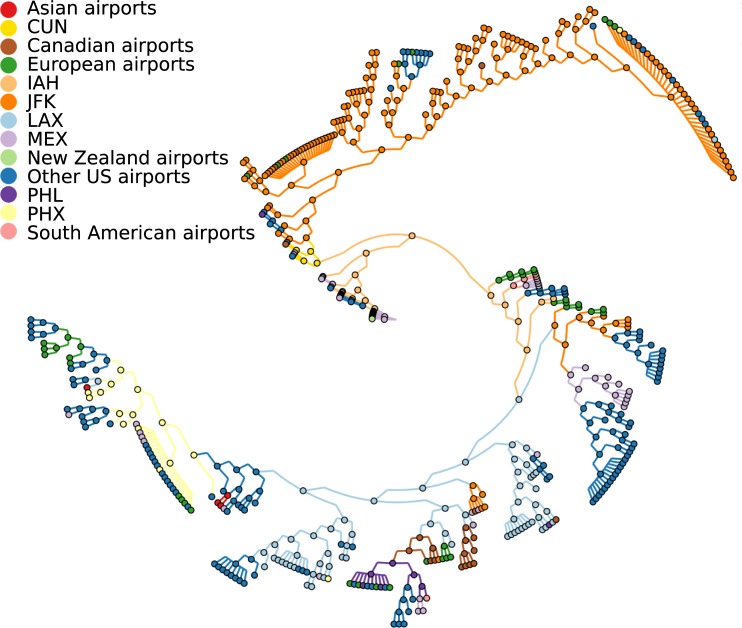
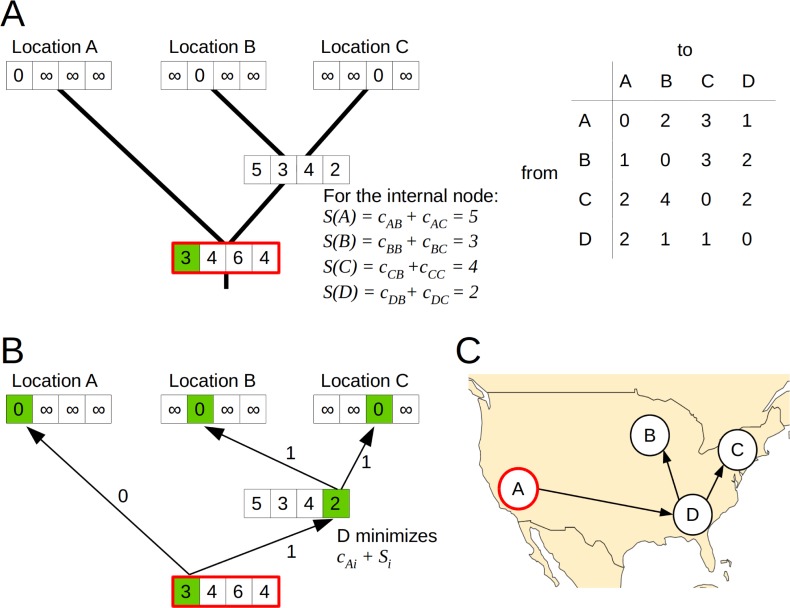
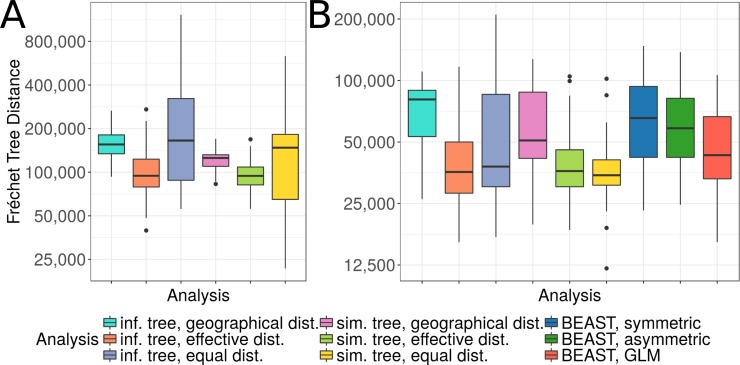
Influenza A viruses cause seasonal epidemics and occasional pandemics in the human population. While the worldwide circulation of seasonal influenza is at least partly understood, the exact migration patterns between countries, states or cities are not well studied. Here, we use the Sankoff algorithm for parsimonious phylogeographic reconstruction together with effective distances based on a worldwide air transportation network. By first simulating geographic spread and then phylogenetic trees and genetic sequences, we confirmed that reconstructions with effective distances inferred phylogeographic spread more accurately than reconstructions with geographic distances and Bayesian reconstructions with BEAST that do not use any distance information, and led to comparable results to the Bayesian reconstruction using distance information via a generalized linear model. Our method extends Bayesian methods that estimate rates from the data by using fine-grained locations like airports and inferring intermediate locations not observed among sampled isolates. When applied to sequence data of the pandemic H1N1 influenza A virus in 2009, our approach correctly inferred the origin and proposed airports mainly involved in the spread of the virus. In case of a novel outbreak, this approach allows to rapidly analyze sequence data and infer origin and spread routes to improve disease surveillance and control.
甲型流感病毒在人类中引起季节性流行和偶发性大流行。虽然季节性流感的全球传播情况至少在一定程度上是可以理解的,但各国、各州或各城市之间的确切迁移模式尚未得到充分研究。在这里,我们使用 Sankoff 算法进行简约系统地理学重建,并结合基于全球航空运输网络的有效距离。通过首先模拟地理传播,然后是系统发育树和遗传序列,我们证实了基于有效距离的重建比基于地理距离的重建以及不使用任何距离信息的基于贝叶斯推断的 BEAST 重建更准确地推断系统地理学传播,并且与通过广义线性模型使用距离信息的贝叶斯重建产生可比的结果。我们的方法扩展了贝叶斯方法,该方法通过使用机场等细粒度位置从数据中估计速率,并推断出在采样分离株中未观察到的中间位置。当应用于 2009 年大流行性 H1N1 流感病毒的序列数据时,我们的方法正确推断了起源和主要参与病毒传播的机场。在发生新的爆发时,这种方法允许快速分析序列数据并推断起源和传播途径,以改善疾病监测和控制。