Institute of Structural Lightweight Design, Johannes Kepler University Linz, 4040 Linz, Austria.
Christian Doppler Laboratory for Structural Strength Control of Lightweight Constructions, Johannes Kepler University Linz, 4040 Linz, Austria.
Sensors (Basel). 2020 Feb 4;20(3):826. doi: 10.3390/s20030826.
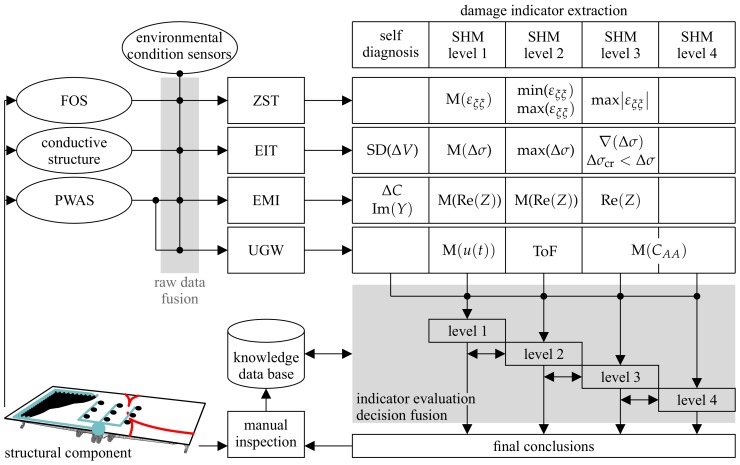
Structural health monitoring (SHM) is the continuous on-board monitoring of a structure's condition during operation by integrated systems of sensors. SHM is believed to have the potential to increase the safety of the structure while reducing its deadweight and downtime. Numerous SHM methods exist that allow the observation and assessment of different damages of different kinds of structures. Recently data fusion on different levels has been getting attention for joint damage evaluation by different SHM methods to achieve increased assessment accuracy and reliability. However, little attention is given to the question of which SHM methods are promising to combine. The current article addresses this issue by demonstrating the theoretical capabilities of a number of prominent SHM methods by comparing their fundamental physical models to the actual effects of damage on metal and composite structures. Furthermore, an overview of the state-of-the-art damage assessment concepts for different levels of SHM is given. As a result, dynamic SHM methods using ultrasonic waves and vibrations appear to be very powerful but suffer from their sensitivity to environmental influences. Combining such dynamic methods with static strain-based or conductivity-based methods and with additional sensors for environmental entities might yield a robust multi-sensor SHM approach. For demonstration, a potent system of sensors is defined and a possible joint data evaluation scheme for a multi-sensor SHM approach is presented.
结构健康监测(SHM)是通过集成的传感器系统对结构在运行过程中的状态进行连续的 onboard 监测。SHM 有望在提高结构安全性的同时减轻其自重和停机时间。存在许多 SHM 方法,可用于观察和评估不同类型结构的不同类型的损伤。最近,不同层次的数据融合已引起关注,通过不同的 SHM 方法对联合损伤进行评估,以提高评估的准确性和可靠性。然而,对于哪些 SHM 方法具有结合的潜力,关注甚少。本文通过将一些突出的 SHM 方法的基本物理模型与金属和复合材料结构实际损伤的影响进行比较,展示了它们的理论能力,从而解决了这个问题。此外,还概述了不同层次 SHM 的最新损伤评估概念。因此,使用超声波和振动的动态 SHM 方法似乎非常强大,但它们对环境影响的敏感性使其受到限制。将这种动态方法与基于静态应变或电导率的方法以及环境实体的附加传感器相结合,可能会产生一种强大的多传感器 SHM 方法。为此,定义了一种强大的传感器系统,并提出了一种用于多传感器 SHM 方法的联合数据评估方案。