School of Environment, Faculty of Science, University of Auckland, Auckland, 1010, New Zealand.
Departamento de Ciencias y Tecnicas del Agua y del Medio Ambiente, Universidad de Cantabria, Santander, Spain.
Sci Rep. 2020 Feb 7;10(1):2137. doi: 10.1038/s41598-020-59018-y.
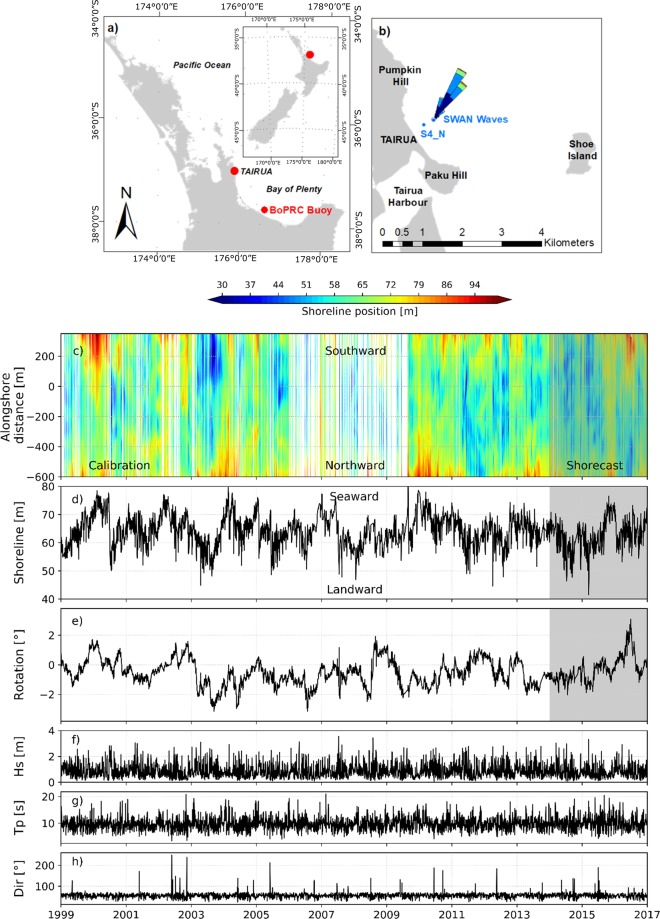
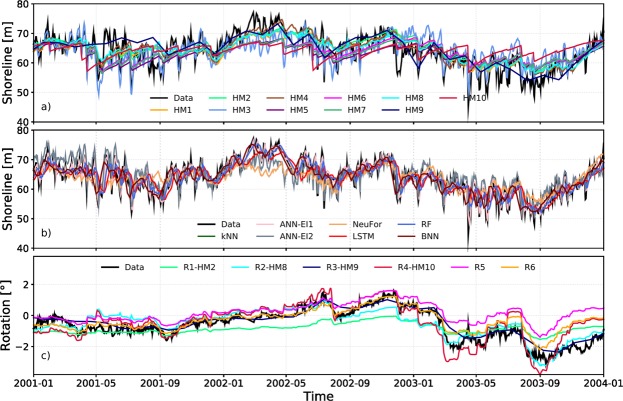
Beaches around the world continuously adjust to daily and seasonal changes in wave and tide conditions, which are themselves changing over longer time-scales. Different approaches to predict multi-year shoreline evolution have been implemented; however, robust and reliable predictions of shoreline evolution are still problematic even in short-term scenarios (shorter than decadal). Here we show results of a modelling competition, where 19 numerical models (a mix of established shoreline models and machine learning techniques) were tested using data collected for Tairua beach, New Zealand with 18 years of daily averaged alongshore shoreline position and beach rotation (orientation) data obtained from a camera system. In general, traditional shoreline models and machine learning techniques were able to reproduce shoreline changes during the calibration period (1999-2014) for normal conditions but some of the model struggled to predict extreme and fast oscillations. During the forecast period (unseen data, 2014-2017), both approaches showed a decrease in models' capability to predict the shoreline position. This was more evident for some of the machine learning algorithms. A model ensemble performed better than individual models and enables assessment of uncertainties in model architecture. Research-coordinated approaches (e.g., modelling competitions) can fuel advances in predictive capabilities and provide a forum for the discussion about the advantages/disadvantages of available models.
世界各地的海滩不断适应波浪和潮汐条件的日常和季节性变化,而这些条件本身也在更长的时间尺度上发生变化。已经实施了不同的方法来预测多年海岸线的演变;然而,即使在短期(短于十年)情况下,海岸线演变的稳健和可靠预测仍然是一个问题。在这里,我们展示了一项建模竞赛的结果,其中 19 个数值模型(包括成熟的海岸线模型和机器学习技术的混合体)使用从相机系统获得的 18 年每日平均沿岸海岸线位置和海滩旋转(方向)数据对新西兰泰鲁阿海滩的数据进行了测试。一般来说,传统的海岸线模型和机器学习技术能够在正常条件下重现校准期(1999-2014 年)的海岸线变化,但一些模型难以预测极端和快速的波动。在预测期(未见过的数据,2014-2017 年),这两种方法都显示出模型预测海岸线位置的能力下降。对于一些机器学习算法来说,这种情况更为明显。模型集合的表现优于单个模型,并能够评估模型结构的不确定性。研究协调的方法(例如建模竞赛)可以推动预测能力的进步,并为讨论现有模型的优缺点提供一个论坛。