Department of Pathology, Shuang Ho Hospital, Taipei Medical University, Taipei, Taiwan.
Department of Pathology, School of Medicine, College of Medicine, Taipei Medical University, Taipei, Taiwan.
Mod Pathol. 2020 Jul;33(7):1341-1349. doi: 10.1038/s41379-020-0495-2. Epub 2020 Feb 7.
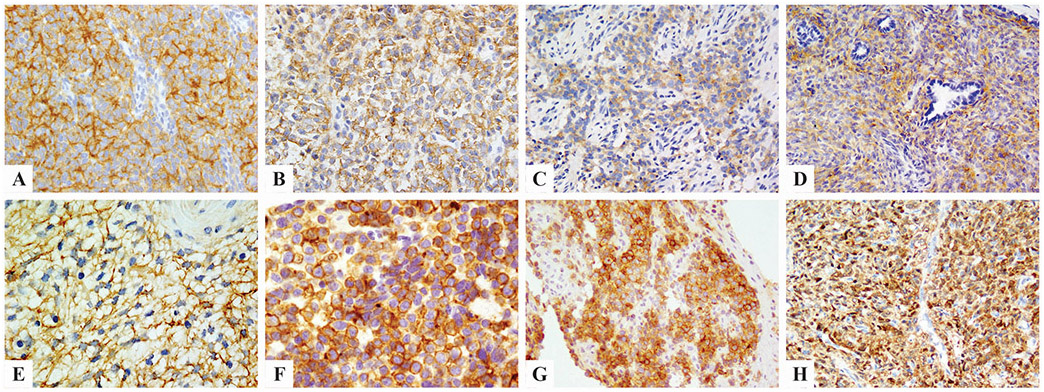
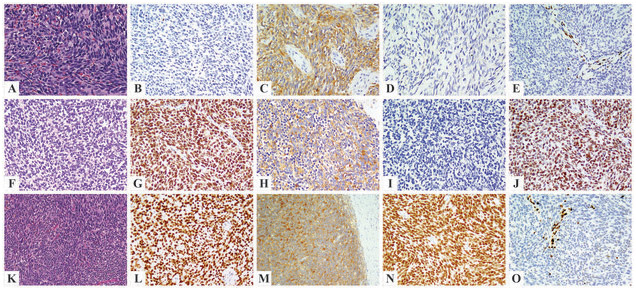
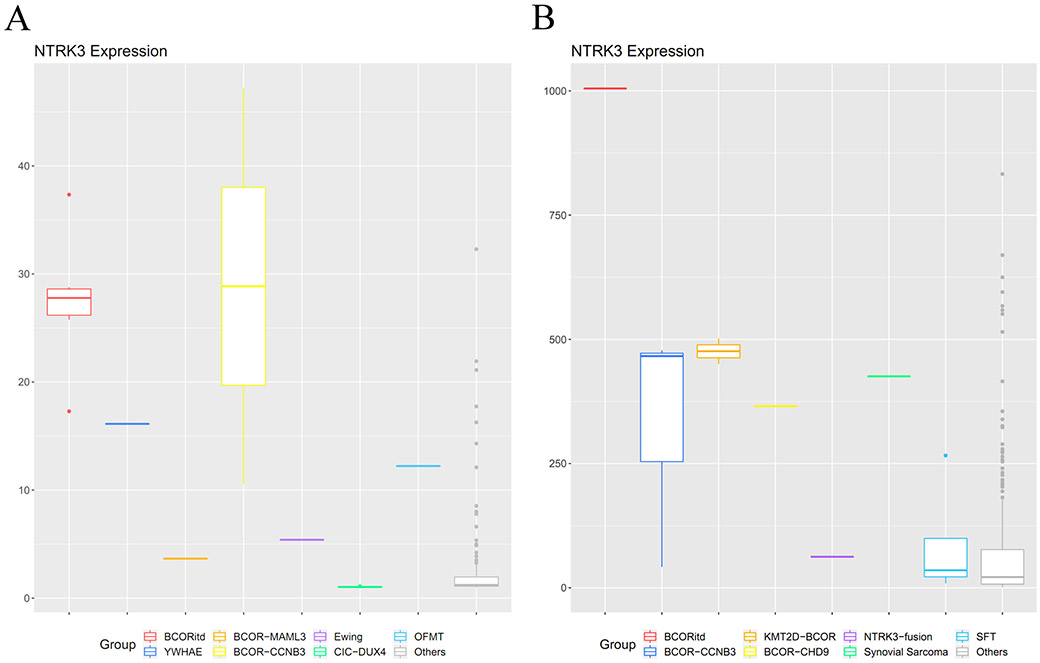
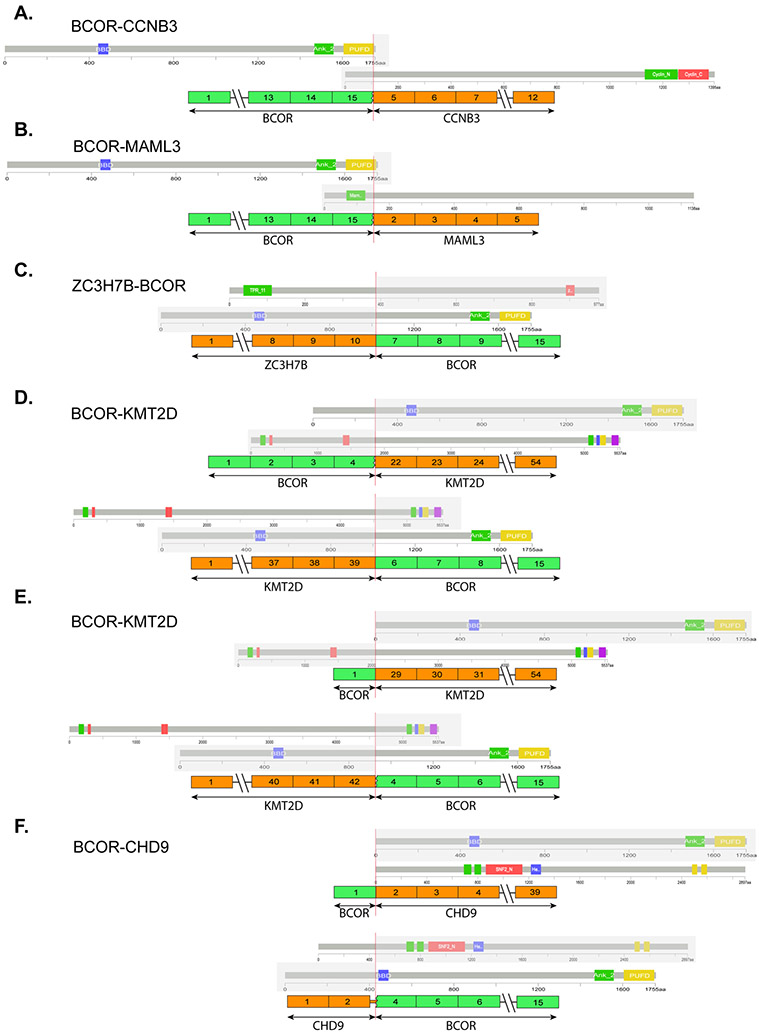
The BCOR family of tumors includes a number of undifferentiated sarcomas, occurring in various age groups and anatomic sites, characterized by a spindle and round cell phenotype and diffuse immunoreactivity for BCOR. Prior RNA sequencing data revealed that NTRK3 was a top-upregulated gene in BCOR-CCNB3 sarcomas. In this study, we investigate a large cohort of tumors harboring BCOR/YWHAE genetic alterations for NTRK3 upregulation at both the mRNA and protein levels, compared with other sarcoma types. Pan-Trk immunohistochemistry was assessed for intensity and extent. A correlation between NTRK3 expression and the type of BCOR alteration and BCOR immunoreactivity was also performed. Most soft tissue undifferentiated round cell sarcomas with YWHAE or BCOR rearrangements or BCOR internal tandem duplications (ITD) showed NTRK3, but not NTRK1 or NTRK2, upregulation by RNA sequencing data analysis. Cytoplasmic pan-Trk immunoreactivity was also observed in most soft tissue round cell sarcomas with YWHAE rearrangements (100%), BCOR ITD (80%), and BCOR-CCNB3 fusions (67%), as well as clear cell sarcomas of kidney (75%), another BCOR family tumor, and ossifying fibromyxoid tumors with ZC3H7B-BCOR fusion (100%), with variable staining intensity and extent. Pan-Trk staining was also seen in solitary fibrous tumors (100%) and less frequently in synovial sarcoma and Ewing sarcoma, but rarely in other sarcomas tested. Tumors harboring rare fusion variants of BCOR, such as BCOR-CHD9, a novel fusion identified by targeted RNA sequencing, and KMT2D-BCOR, were also positive for pan-Trk staining and NTRK3 overexpression. In conclusion, NTRK3 upregulation resulting in pan-Trk overexpression is common in the BCOR family of tumors as well as in subsets of BCOR-expressing sarcomas through alternative mechanisms. The therapeutic implication of this finding awaits further investigation.
BCOR 家族肿瘤包括多种未分化肉瘤,发生于不同年龄组和解剖部位,具有梭形和圆形细胞表型,并弥漫表达 BCOR。先前的 RNA 测序数据显示,NTRK3 是 BCOR-CCNB3 肉瘤中上调幅度最大的基因。在这项研究中,我们研究了一大群携带 BCOR/YWHAE 基因改变的肿瘤,比较了其他肉瘤类型,检测了这些肿瘤在 mRNA 和蛋白水平上 NTRK3 的上调情况。对泛 Trk 免疫组化进行了强度和范围的评估。还对 NTRK3 表达与 BCOR 改变类型和 BCOR 免疫反应性之间的相关性进行了分析。大多数具有 YWHAE 或 BCOR 重排或 BCOR 内部串联重复(ITD)的软组织未分化圆形细胞肉瘤通过 RNA 测序数据分析显示 NTRK3 上调,但不包括 NTRK1 或 NTRK2。细胞质泛 Trk 免疫组化也见于大多数具有 YWHAE 重排(100%)、BCOR ITD(80%)和 BCOR-CCNB3 融合(67%)的软组织圆形细胞肉瘤、肾透明细胞肉瘤(另一种 BCOR 家族肿瘤)和 ZC3H7B-BCOR 融合的骨化性纤维黏液样肿瘤(100%),具有不同的染色强度和范围。泛 Trk 染色也见于孤立性纤维瘤(100%),在滑膜肉瘤和尤文肉瘤中较少见,但在其他检测的肉瘤中很少见。携带 BCOR 罕见融合变体的肿瘤,如靶向 RNA 测序鉴定的新型融合 BCOR-CHD9,以及 KMT2D-BCOR,也对泛 Trk 染色和 NTRK3 过表达呈阳性。总之,在 BCOR 家族肿瘤以及通过替代机制表达 BCOR 的肉瘤亚群中,NTRK3 上调导致泛 Trk 过表达是常见的。这一发现的治疗意义有待进一步研究。