Centre for Heart Lung Innovation, St. Paul's Hospital, University of British Columbia, Vancouver, BC, Canada.
Department of Pathology and Laboratory Medicine, University of British Columbia, Vancouver, BC, Canada.
Cell Death Differ. 2020 Aug;27(8):2363-2382. doi: 10.1038/s41418-020-0509-0. Epub 2020 Feb 7.
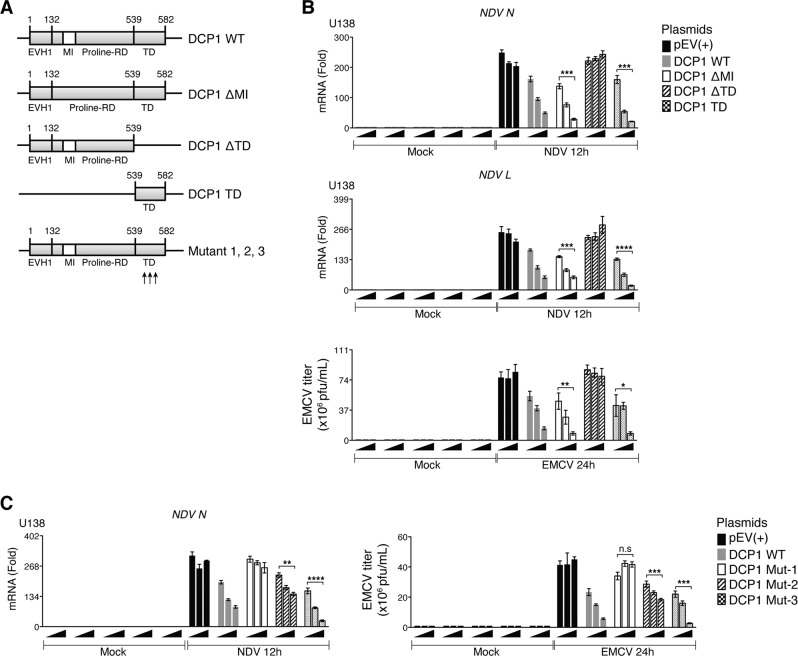
Host nucleases are implicated in antiviral response through the processing of pathogen-derived nucleic acids. Among many host RNases, decapping enzymes DCP1 and 2, and 5'→3' exonuclease XRN1, which are components of the RNA decay machinery, have been extensively studied in prokaryotes, plants, and invertebrates but less so in mammalian systems. As a result, the implication of XRN1 and DCPs in viral replication, in particular, the spatio-temporal dynamics during RNA viral infections remains elusive. Here, we highlight that XRN1 and DCPs play a critical role in limiting several groups of RNA viral infections. This antiviral activity was not obvious in wild-type cells but clearly observed in type I interferon (IFN-I)-deficient cells. Mechanistically, infection with RNA viruses induced the enrichment of XRN1 and DCPs in viral replication complexes (vRCs), hence forming distinct cytoplasmic aggregates. These aggregates served as sites for direct interaction between XRN1, DCP1/2, and viral ribonucleoprotein that contains viral RNA (vRNA). Although these XRN1-DCP1/2-vRC-containing foci resemble antiviral stress granules (SGs) or P-body (PB), they did not colocalize with known SG markers and did not correlate with critical PB functions. Furthermore, the presence of 5' mono- and 5' triphosphate structures on vRNA was not required for the formation of XRN1-DCP1/2-vRC-containing foci. On the other hand, single-, double-stranded, and higher-ordered vRNA species play a role but are not deterministic for efficient formation of XRN1-DCP1/2 foci and consequent antiviral activity in a manner proportional to RNA length. These results highlight the mechanism behind the antiviral function of XRN1-DCP1/2 in RNA viral infections independent of IFN-I response, protein kinase R and PB function.
宿主核酸酶通过加工病原体衍生的核酸参与抗病毒反应。在许多宿主核糖核酸酶中,脱帽酶 DCP1 和 2 以及 5'→3'外切核酸酶 XRN1 是 RNA 降解机制的组成部分,在原核生物、植物和无脊椎动物中得到了广泛研究,但在哺乳动物系统中研究较少。因此,XRN1 和 DCP 在病毒复制中的作用,特别是在 RNA 病毒感染期间的时空动态仍然难以捉摸。在这里,我们强调 XRN1 和 DCP 在限制几类 RNA 病毒感染方面发挥着关键作用。这种抗病毒活性在野生型细胞中并不明显,但在 I 型干扰素(IFN-I)缺陷细胞中观察到明显。在机制上,RNA 病毒感染诱导 XRN1 和 DCP 在病毒复制复合物(vRC)中的富集,从而形成独特的细胞质聚集体。这些聚集体充当 XRN1、DCP1/2 和含有病毒 RNA(vRNA)的病毒核糖核蛋白之间直接相互作用的位点。尽管这些含有 XRN1-DCP1/2-vRC 的聚集体类似于抗病毒应激颗粒(SG)或 P 体(PB),但它们与已知的 SG 标记物不共定位,也与 PB 的关键功能无关。此外,vRNA 上 5'单磷酸和 5'三磷酸结构的存在对于形成含有 XRN1-DCP1/2-vRC 的聚集体不是必需的。另一方面,单链、双链和更高阶的 vRNA 物种在形成 XRN1-DCP1/2 聚集体和随后的抗病毒活性方面发挥作用,但不是决定性的,其效率与 RNA 长度成正比。这些结果突出了 XRN1-DCP1/2 在 RNA 病毒感染中的抗病毒功能的机制,独立于 IFN-I 反应、蛋白激酶 R 和 PB 功能。