Lu Xinguo, Zorumski Charles F, Mennerick Steven
Department of Psychiatry, Washington University School of Medicine, St. Louis, MO, United States.
Department of Neuroscience, Washington University School of Medicine, St. Louis, MO, United States.
Front Mol Neurosci. 2020 Jan 23;13:6. doi: 10.3389/fnmol.2020.00006. eCollection 2020.
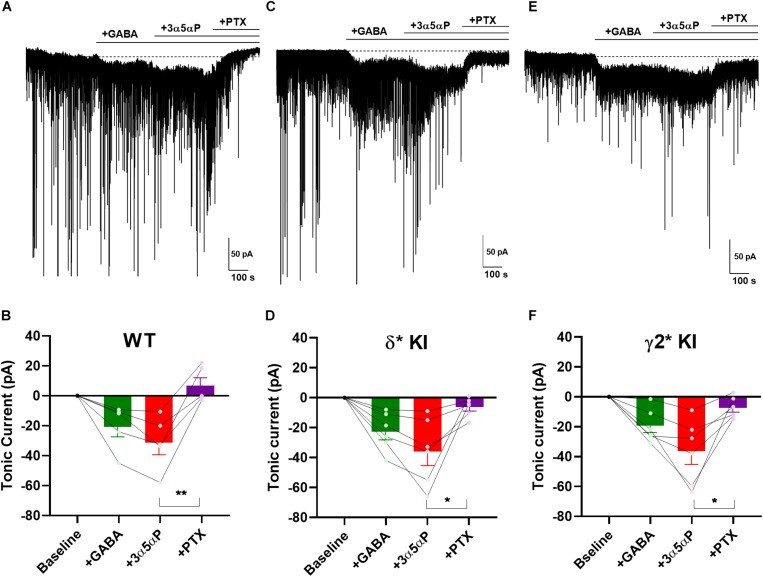
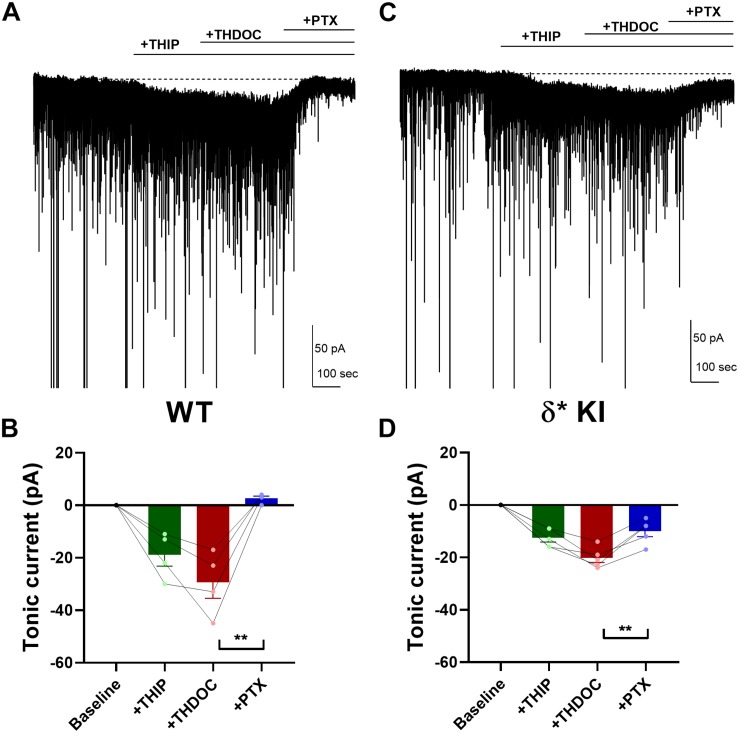
GABA receptors mediate a large fraction of inhibitory neurotransmission in the central nervous system. Two major classes of GABA receptors are γ2-containing receptors and δ-containing receptors, which are largely located synaptically and extrasynaptically, respectively. Neuroactive steroids such as allopregnanolone (3α5αP) and allotetrahydrodeoxycorticosterone (THDOC) are hypothesized to selectively affect δ-containing receptors over γ2-containing receptors. However, the selectivity of neurosteroids on GABA receptor classes is controversial. In this study, we re-examined this issue using mice with picrotoxin resistance associated with either the δ or γ2 subunit. Our results show that 3α5αP potentiated phasic inhibition of GABA receptors, and this is mainly through γ2-containing receptors. 3α5αP, with or without exogenous GABA, potentiated tonic inhibition through GABA receptors. Surprisingly, potentiation arose from both γ2- and δ-containing receptors, even when a δ selective agonist THIP was used to activate current. Although ethanol has been proposed to act through neurosteroids and to act selectively at δ receptors, we found no evidence for ethanol potentiation of GABA receptor function at 50 mM under our experimental conditions. Finally, we found that the actions of pentobarbital exhibited very similar effects on tonic current as 3α5αP, emphasizing the broad spectrum nature of neurosteroid potentiation. Overall, using chemogenetic analysis, our evidence suggests that in a cell population enriched for δ-containing receptors, neurosteroids act through both δ-containing and non-δ-containing receptors.
γ-氨基丁酸(GABA)受体介导中枢神经系统中大部分抑制性神经传递。GABA受体的两大主要类别是含γ2的受体和含δ的受体,它们分别主要位于突触和突触外。诸如别孕烯醇酮(3α5αP)和别四氢脱氧皮质酮(THDOC)等神经活性甾体被认为对含δ的受体具有比对含γ2的受体更强的选择性影响。然而,神经甾体对GABA受体类别的选择性存在争议。在本研究中,我们使用对印防己毒素具有抗性且与δ或γ2亚基相关的小鼠重新审视了这个问题。我们的结果表明,3α5αP增强了GABA受体的相位抑制,并且这主要是通过含γ2的受体实现的。无论有无外源性GABA,3α5αP都通过GABA受体增强了紧张性抑制。令人惊讶的是,即使使用δ选择性激动剂THIP来激活电流,增强作用也来自含γ2和含δ的受体。尽管有人提出乙醇通过神经甾体起作用并且选择性作用于δ受体,但在我们的实验条件下,我们没有发现50 mM乙醇增强GABA受体功能的证据。最后,我们发现戊巴比妥的作用对紧张性电流表现出与3α5αP非常相似的影响,强调了神经甾体增强作用的广谱性质。总体而言,通过化学遗传学分析,我们的证据表明,在富含含δ受体的细胞群体中,神经甾体通过含δ和不含δ的受体起作用。