Scarf Damian, Colombo Michael
Department of Psychology, University of Otago, Dunedin, New Zealand.
Front Psychol. 2020 Jan 17;10:3017. doi: 10.3389/fpsyg.2019.03017. eCollection 2019.
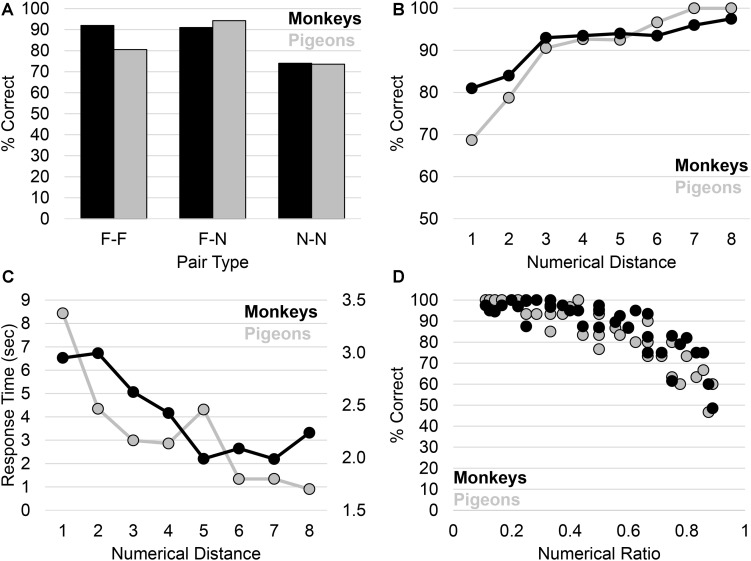
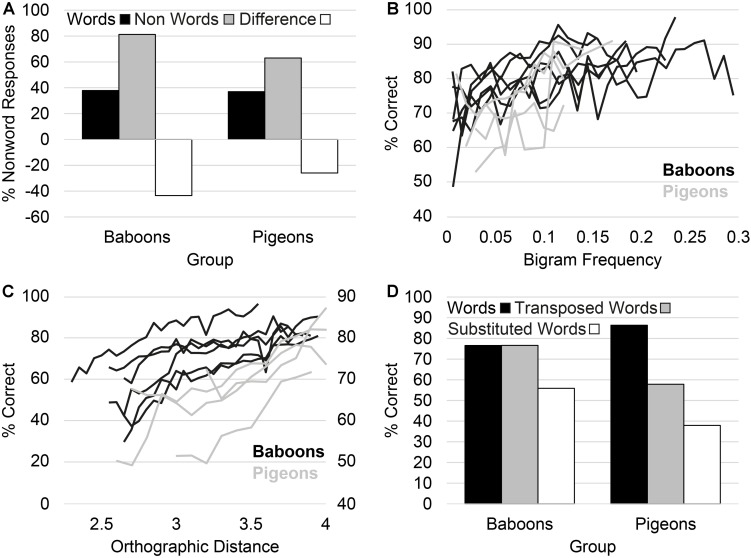
Thirty years ago Burrhus Frederic Skinner and Robert Epstein began what is known as the Columban Simulation Project. With pigeons as their subjects, they simulated a series of studies that purportedly demonstrated insight, self-recognition, and symbolic communication in chimpanzees. In each case, with the appropriate training, they demonstrated that pigeons performed in a comparable manner to chimpanzees. When discussing these studies in the context of his Null Hypothesis, Macphail paid little attention to how the pigeons and chimpanzees solved the tasks and simply assumed that successful performance on the tasks reflected a similar underlying mechanism. Here, following a similar process to the original Columban Simulation Project, we go beyond this success testing and employ the signature testing approach to assess whether pigeons and primates employ a similar mechanism on tasks that tap numerical competence and orthographic processing. Consistent with the Null Hypothesis, pigeons and primates successfully passed novel transfer tests and, critically, displayed comparable cognitive signatures. While these findings demonstrate the absence of a qualitative difference, the time taken to train pigeons on these tasks revealed a clear quantitative difference.
30年前,伯尔赫斯·弗雷德里克·斯金纳和罗伯特·爱泼斯坦启动了所谓的哥伦布模拟项目。他们以鸽子为实验对象,模拟了一系列据称能证明黑猩猩具有洞察力、自我识别能力和符号交流能力的研究。在每种情况下,经过适当训练,他们证明鸽子的表现与黑猩猩相当。在其零假设的背景下讨论这些研究时,麦克菲尔几乎没有关注鸽子和黑猩猩是如何解决任务的,只是简单地假设任务的成功完成反映了一种类似的潜在机制。在这里,我们遵循与最初的哥伦布模拟项目类似的过程,超越这种成功测试,采用特征测试方法来评估鸽子和灵长类动物在涉及数字能力和正字法处理的任务上是否采用类似的机制。与零假设一致,鸽子和灵长类动物成功通过了新的迁移测试,关键的是,它们表现出了类似的认知特征。虽然这些发现表明不存在质的差异,但在这些任务上训练鸽子所花费的时间显示出明显的量的差异。