Loeuillard Emilien, Conboy Caitlin B, Gores Gregory J, Ilyas Sumera I
Division of Gastroenterology and Hepatology, Mayo Clinic, Rochester, Minnesota.
Department of Internal Medicine, Mayo Clinic, Rochester, Minnesota.
JHEP Rep. 2019 Jul 10;1(4):297-311. doi: 10.1016/j.jhepr.2019.06.003. eCollection 2019 Oct.
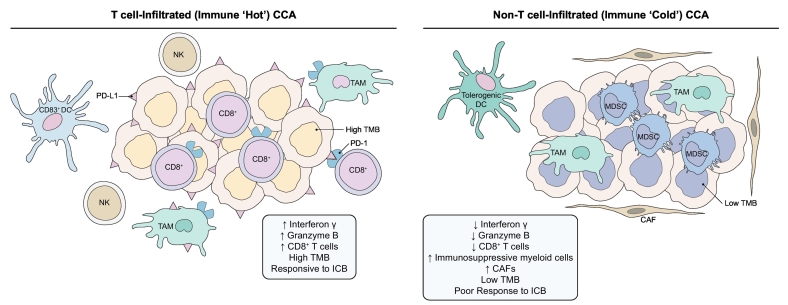
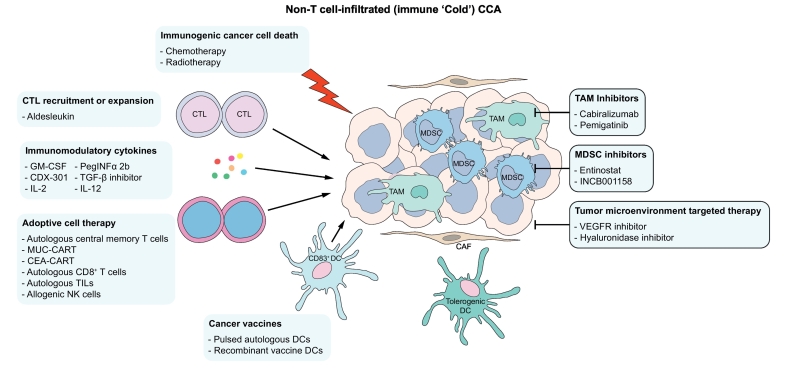
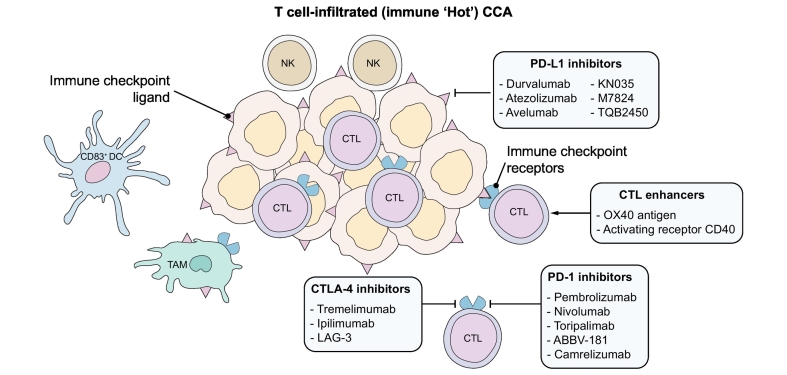
Cholangiocarcinoma (CCA) represents a heterogeneous group of epithelial tumours that are classified according to anatomical location as intrahepatic (iCCA), perihilar (pCCA), or distal (dCCA). Although surgical resection and liver transplantation following neoadjuvant therapy are potentially curative options for a subset of patients with early-stage disease, the currently available medical therapies for CCA have limited efficacy. Immunotherapeutic strategies such as immune checkpoint blockade (ICB) harness the host immune system to unleash an effective and durable antitumour response in a subset of patients with a variety of malignancies. However, response to ICB monotherapy has been relatively disappointing in CCA. CCAs are desmoplastic tumours with an abundant tumour immune microenvironment (TIME) that contains immunosuppressive innate immune cells such as tumour-associated macrophages and myeloid-derived suppressor cells. A subset of CCAs may be classified as immune 'hot' tumours with a high density of CD8 T cells and enhanced expression of immune checkpoint molecules. Immune 'hot' tumour types are associated with higher response rates to ICB. However, the suboptimal response rates to ICB monotherapy in human clinical trials of CCA imply that the preponderance of CCAs are immune 'cold' tumours with a non-T cell infiltrated TIME. An enhanced comprehension of the immunobiology of CCA, particularly the innate immune response to CCA, is essential in the effort to develop effective combination immunotherapeutic strategies that can target a larger subset of CCAs.
胆管癌(CCA)是一组异质性上皮肿瘤,根据解剖位置可分为肝内胆管癌(iCCA)、肝门周围胆管癌(pCCA)或远端胆管癌(dCCA)。尽管手术切除和新辅助治疗后的肝移植对一部分早期疾病患者可能是治愈性选择,但目前可用的CCA医学疗法疗效有限。免疫治疗策略,如免疫检查点阻断(ICB),利用宿主免疫系统在一部分患有各种恶性肿瘤的患者中引发有效且持久的抗肿瘤反应。然而,在CCA中,对ICB单药治疗的反应相对令人失望。CCA是促结缔组织增生性肿瘤,具有丰富的肿瘤免疫微环境(TIME),其中包含免疫抑制性先天免疫细胞,如肿瘤相关巨噬细胞和髓系来源的抑制细胞。一部分CCA可能被归类为免疫“热”肿瘤,具有高密度的CD8 T细胞和免疫检查点分子的表达增强。免疫“热”肿瘤类型与对ICB的较高反应率相关。然而,在CCA的人体临床试验中,ICB单药治疗的反应率不理想,这意味着大多数CCA是免疫“冷”肿瘤,其TIME没有T细胞浸润。加强对CCA免疫生物学的理解,特别是对CCA的先天免疫反应的理解,对于开发能够针对更大比例CCA的有效联合免疫治疗策略至关重要。