Trauner Michael, Gindin Yevgeniy, Jiang Zhaoshi, Chung Chuhan, Subramanian G Mani, Myers Robert P, Gulamhusein Aliya, Kowdley Kris V, Levy Cynthia, Goodman Zachary, Manns Michael P, Muir Andrew J, Bowlus Christopher L
Division of Gastroenterology and Hepatology, Department of Medicine III, Medical University of Vienna, Vienna, Austria.
Gilead Sciences, Inc., Foster City, CA, USA.
JHEP Rep. 2019 Dec 5;2(1):100060. doi: 10.1016/j.jhepr.2019.11.004. eCollection 2020 Feb.
BACKGROUND & AIMS: A DNA methylation (DNAm) signature derived from 353 CpG sites (the Horvath clock) has been proposed as an epigenetic measure of chronological and biological age. This epigenetic signature is accelerated in diverse tissue types in various disorders, including non-alcoholic steatohepatitis, and is associated with mortality. Here, we assayed whole blood DNAm to explore age acceleration in patients with primary sclerosing cholangitis (PSC).
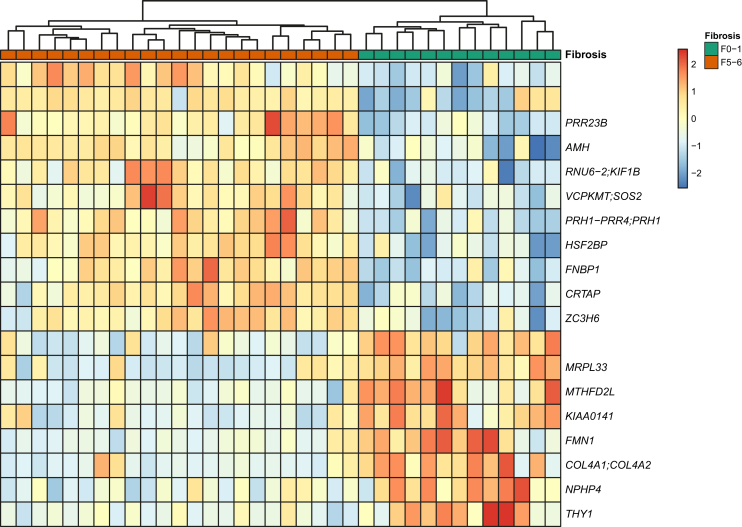
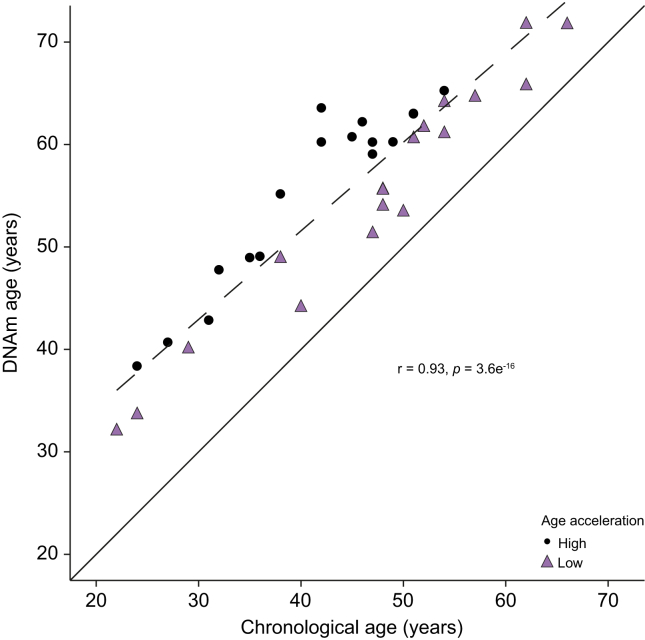
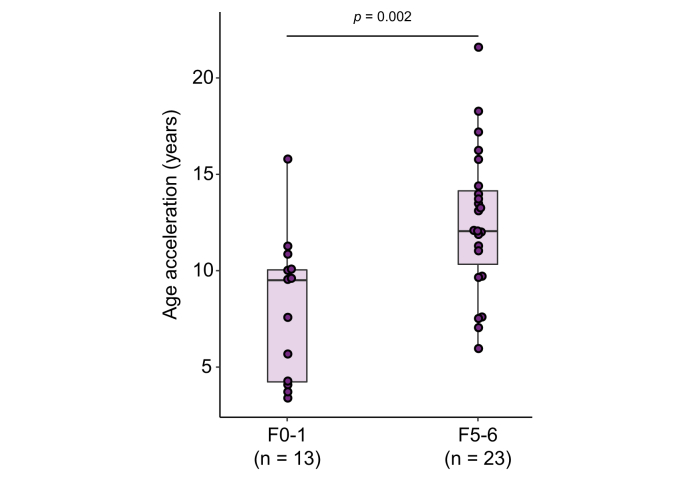
Using the MethylationEPIC BeadChip (850K) array, DNAm signatures in whole blood were analyzed in 36 patients with PSC enrolled in a 96-week trial of simtuzumab (Ishak F0-1, n = 13; F5-6, n = 23). Age acceleration was calculated as the difference between DNAm age and chronological age. Comparisons between patients with high and low age acceleration (≥ . < the median) were made and Cox regression evaluated the association between age acceleration and PSC-related clinical events ( decompensation, cholangitis, transplantation).
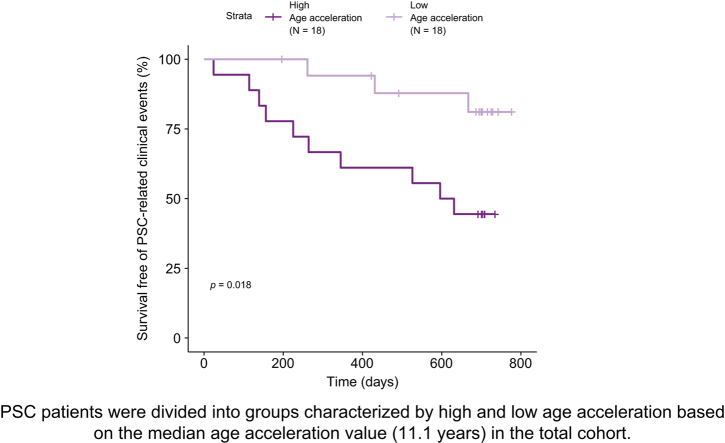
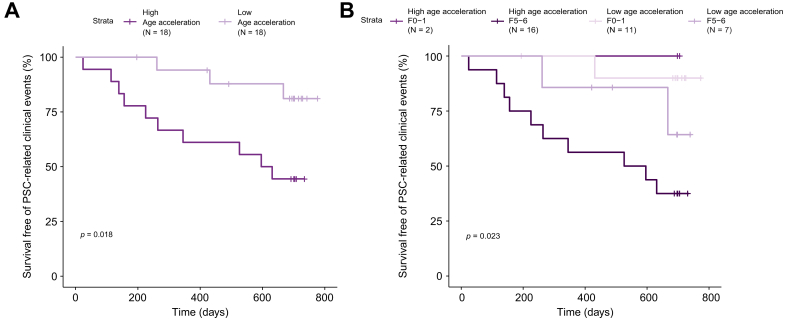
Age acceleration was significantly higher in patients with PSC compared to a healthy reference cohort (median, 11.1 years, <2.2 × 10). In PSC, demographics, presence of inflammatory bowel disease, and ursodeoxycholic acid use were similar between patients with low and high age acceleration. However, patients with high age acceleration had increased serum alkaline phosphatase, gamma glutamyltransferase, alanine aminotransferase, enhanced liver fibrosis test scores, and greater hepatic collagen and α-smooth muscle actin expression on liver biopsy (all <0.05). Moreover, patients with high age acceleration had an increased prevalence of cirrhosis (89% 39%; = 0.006) and greater likelihood of PSC-related events (hazard ratio 4.19; 95% CI 1.15-15.24).
This analysis of blood DNAm profiles suggests that compared with healthy controls, patients with PSC - particularly those with cirrhosis - exhibit significant acceleration of epigenetic age. Future studies are required to evaluate the prognostic implications and effect of therapies on global methylation patterns and age acceleration in PSC.
An epigenetic clock based on DNA methylation has been proposed as a marker of age. In liver diseases such as non-alcoholic steatohepatitis, age acceleration based on this epigenetic clock has been observed. Herein, we show that patients with primary sclerosing cholangitis have marked age acceleration, which is further accentuated by worsening fibrosis. This measure of age acceleration could be a useful marker for prognostication or risk stratification in primary sclerosing cholangitis.
源自353个CpG位点的DNA甲基化(DNAm)特征(霍瓦斯时钟)已被提议作为按时间顺序和生物学年龄的表观遗传学指标。这种表观遗传学特征在包括非酒精性脂肪性肝炎在内的各种疾病的不同组织类型中加速,并与死亡率相关。在此,我们检测全血DNAm以探索原发性硬化性胆管炎(PSC)患者的年龄加速情况。
使用甲基化EPIC BeadChip(850K)芯片,对36例参与simtuzumab 96周试验的PSC患者(伊沙克F0 - 1期,n = 13;F5 - 6期,n = 23)的全血DNAm特征进行分析。年龄加速计算为DNAm年龄与实际年龄之差。对年龄加速高和低(≥... <中位数)的患者进行比较,并采用Cox回归评估年龄加速与PSC相关临床事件(失代偿、胆管炎、移植)之间的关联。
与健康对照队列相比,PSC患者的年龄加速显著更高(中位数,11.1岁,<2.2×10)。在PSC中,年龄加速低和高的患者在人口统计学、炎症性肠病的存在情况以及熊去氧胆酸的使用方面相似。然而,年龄加速高的患者血清碱性磷酸酶、γ-谷氨酰转移酶、丙氨酸氨基转移酶升高,肝纤维化检测评分增强,肝活检时肝胶原和α-平滑肌肌动蛋白表达更高(均<0.05)。此外,年龄加速高的患者肝硬化患病率增加(89%对39%;P = 0.006),发生PSC相关事件的可能性更大(风险比4.19;95%置信区间1.15 - 15.24)。
对血液DNAm谱的这项分析表明,与健康对照相比,PSC患者 - 尤其是肝硬化患者 - 表现出表观遗传年龄的显著加速。未来需要开展研究以评估预后意义以及治疗对PSC中整体甲基化模式和年龄加速的影响。
基于DNA甲基化的表观遗传时钟已被提议作为年龄的标志物。在非酒精性脂肪性肝炎等肝脏疾病中,已观察到基于这种表观遗传时钟的年龄加速。在此,我们表明原发性硬化性胆管炎患者有明显的年龄加速,且随着纤维化加重而进一步加剧。这种年龄加速测量可能是原发性硬化性胆管炎预后或风险分层的有用标志物。