Wassman E Robert, Ho Karen S, Bertrand Diana, Davis Kyle W, Martin Megan M, Page Stephanie, Peiffer Andreas, Prasad Aparna, Serrano Moises A, Twede Hope, Vanzo Rena, Scherer Stephen W, Uddin Mohammed, Hensel Charles H
Lineagen Inc. (E.R.W., K.S.H., D.B., K.W.D., M.M.M., S.P., A. Peiffer, A. Prasad, M.A.S., H.T., R.V., C.H.H.); Life Designs Ventures (E.R.W.), Park City, UT; Department of Pediatrics (K.S.H., A. Peiffer), University of Utah; The Centre for Applied Genomics (S.W.S., M.U.), The Hospital for Sick Children, Toronto, Ontario, Canada; Program in Genetics and Genome Biology (S.W.S), The Hospital for Sick Children; McLaughlin Centre (S.W.S), University of Toronto, Toronto, Ontario, Canada; and Department of Molecular Genetics (S.W.S), University of Toronto, Toronto, Ontario, Canada.
Neurol Genet. 2019 Dec 6;5(6):e378. doi: 10.1212/NXG.0000000000000378. eCollection 2019 Dec.
To evaluate a new tool to aid interpretation of copy number variants (CNVs) in individuals with neurodevelopmental disabilities.
Critical exon indexing (CEI) was used to identify genes with critical exons (CEGs) from clinically reported CNVs, which may contribute to neurodevelopmental disorders (NDDs). The 742 pathogenic CNVs and 1,363 variants of unknown significance (VUS) identified by chromosomal microarray analysis in 5,487 individuals with NDDs were subjected to CEI to identify CEGs. CEGs identified in a subsequent random series of VUS were evaluated for relevance to CNV interpretation.
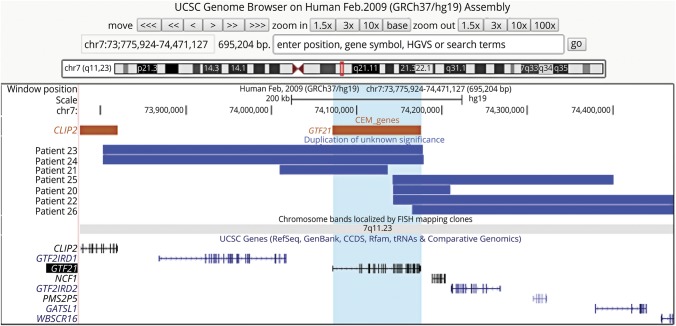
CEI identified a total of 2,492 unique CEGs in pathogenic CNVs and 953 in VUS compared with 259 CEGs in 6,965 CNVs from 873 controls. These differences are highly significant ( < 0.00001) whether compared as frequency, average, or normalized by CNV size. Twenty-one percent of VUS CEGs were not represented in Online Mendelian Inheritance in Man, highlighting limitations of existing resources for identifying potentially impactful genes within CNVs. CEGs were highly correlated with other indices and known pathways of relevance. Separately, 136 random VUS reports were reevaluated, and 76% of CEGs had not been commented on. In multiple cases, further investigation yielded additional relevant literature aiding interpretation. As one specific example, we discuss as a CEG, which likely alters interpretation of several reported duplication VUS in the Williams-Beuren region.
Application of CEI to CNVs in individuals with NDDs can identify genes of potential clinical relevance, aid laboratories in effectively searching the clinical literature, and support the clinical reporting of poorly annotated VUS.
评估一种有助于解读神经发育障碍个体拷贝数变异(CNV)的新工具。
使用关键外显子索引(CEI)从临床报告的CNV中识别具有关键外显子的基因(CEG),这些基因可能导致神经发育障碍(NDD)。对5487例NDD个体通过染色体微阵列分析鉴定出的742个致病性CNV和1363个意义未明的变异(VUS)进行CEI,以识别CEG。对后续随机系列VUS中鉴定出的CEG进行相关性评估,以用于CNV解读。
与来自873名对照的6965个CNV中的259个CEG相比,CEI在致病性CNV中总共鉴定出2492个独特的CEG,在VUS中鉴定出953个。无论以频率、平均值比较,还是按CNV大小进行归一化,这些差异都非常显著(<0.00001)。21%的VUS CEG在《人类孟德尔遗传在线》中未被收录,这突出了现有资源在识别CNV内潜在影响基因方面的局限性。CEG与其他相关指数和已知途径高度相关。另外,对136份随机的VUS报告进行了重新评估,76%的CEG此前未被评论。在多个案例中,进一步调查产生了有助于解读的额外相关文献。作为一个具体例子,我们讨论了 作为一个CEG,它可能改变对威廉姆斯-贝伦区域几个报告的重复VUS的解读。
将CEI应用于NDD个体的CNV可识别具有潜在临床相关性的基因,帮助实验室有效检索临床文献,并支持对注释不佳的VUS进行临床报告。