Department of Medicine, Massachusetts General Hospital, Boston, MA, USA.
Liver Center, Division of Gastroenterology, Department of Medicine, Massachusetts General Hospital, Boston, MA, USA.
Aliment Pharmacol Ther. 2020 Apr;51(7):728-736. doi: 10.1111/apt.15660. Epub 2020 Feb 11.
Non-alcoholic fatty liver disease (NAFLD) is associated with an increased risk of cardiovascular disease. It is not well understood, however, which individuals with NAFLD are at highest risk for cardiovascular disease.
To determine the factors associated with incident cardiovascular events in a prospective cohort of individuals with biopsy-proven NAFLD without pre-existing cardiovascular disease.
From 2011 to 2018, adults with biopsy-proven NAFLD without cardiovascular disease were enrolled in a tissue repository and were followed prospectively to the first recorded date of incident cardiovascular disease, death or the end of follow-up (11/1/2018). Competing risks analysis was performed to identify predictors of incident cardiovascular disease.
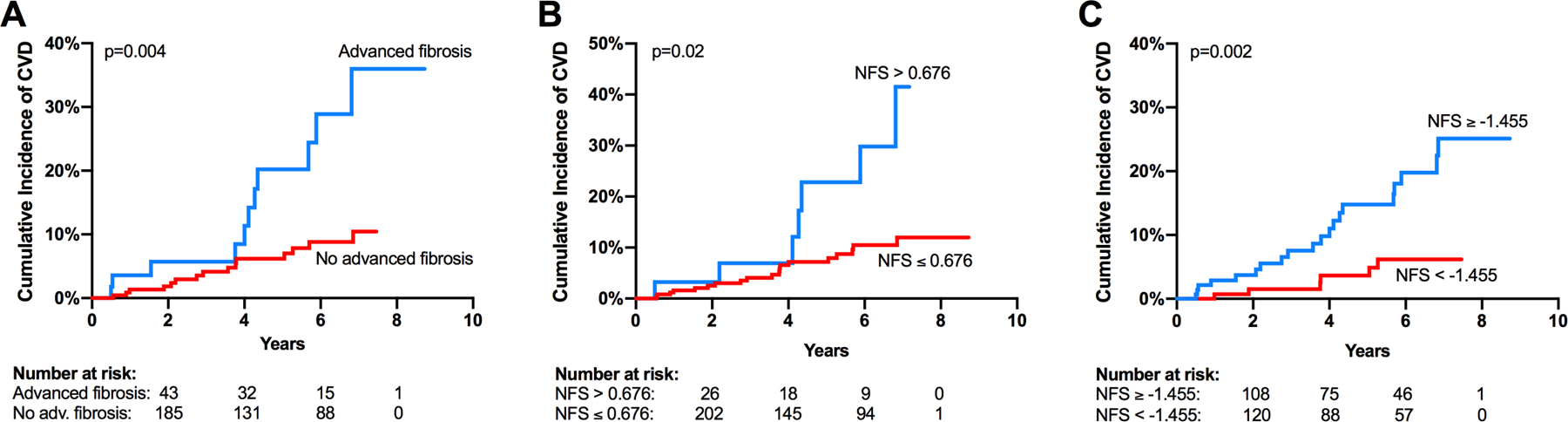
After a median follow-up time of 5.2 years, 26/285 (9.1%) individuals experienced an incident cardiovascular event. Advanced fibrosis (stage 3-4) on biopsy was a significant predictor of incident cardiovascular disease, and this persisted on multivariable analysis (SHR 2.86, 95% CI 1.36-6.04) after considering relevant covariates, including cardiovascular risk scores, which were not independent predictors. Of the non-invasive indicators of fibrosis, the NAFLD fibrosis score was the only independent predictor of cardiovascular disease. Other histologic features, including steatohepatitis, were not associated with incident cardiovascular disease.
In adults with biopsy-proven NAFLD, advanced fibrosis on biopsy and higher NAFLD fibrosis score were significant and independent predictors of incident cardiovascular disease, even after considering traditional risk factors and cardiovascular risk scores. These findings should be considered when evaluating NAFLD patients for primary prevention of cardiovascular disease, and further evaluation into the link between advanced fibrosis and cardiovascular disease is needed.
非酒精性脂肪性肝病(NAFLD)与心血管疾病风险增加相关。然而,哪些 NAFLD 患者患心血管疾病的风险最高尚不清楚。
在无预先存在心血管疾病的经活检证实的 NAFLD 患者前瞻性队列中,确定与心血管事件发生相关的因素。
2011 年至 2018 年,招募了无心血管疾病的经活检证实的 NAFLD 成人患者,进入组织库,并前瞻性随访至首次记录的心血管事件、死亡或随访结束日期(2018 年 11 月 1 日)。采用竞争风险分析来确定心血管疾病发生的预测因素。
中位随访时间为 5.2 年后,285 例患者中有 26 例(9.1%)发生心血管事件。活检时的晚期纤维化(3-4 期)是心血管疾病发生的显著预测因素,并且在考虑了相关协变量后,包括心血管风险评分,这些评分不是独立的预测因素,在多变量分析中仍然存在(SHR 2.86,95%CI 1.36-6.04)。在纤维化的非侵入性指标中,NAFLD 纤维化评分是心血管疾病的唯一独立预测因素。其他组织学特征,包括脂肪性肝炎,与心血管事件无相关性。
在经活检证实的 NAFLD 成人患者中,活检时的晚期纤维化和较高的 NAFLD 纤维化评分是心血管疾病发生的显著和独立的预测因素,即使在考虑了传统的危险因素和心血管风险评分之后也是如此。在评估 NAFLD 患者进行心血管疾病一级预防时应考虑这些发现,并且需要进一步评估晚期纤维化与心血管疾病之间的关系。