Ius Tamara, Pauletto Giada, Tomasino Barbara, Maieron Marta, Budai Riccardo, Isola Miriam, Cesselli Daniela, Lettieri Christian, Skrap Miran
Neurosurgery Unit, Department of Neuroscience, Santa Maria della Misericordia University Hospital, 33100 Udine, Italy.
Neurology Unit, Department of Neuroscience, Santa Maria della Misericordia University Hospital, 33100 Udine, Italy.
Cancers (Basel). 2020 Feb 8;12(2):397. doi: 10.3390/cancers12020397.
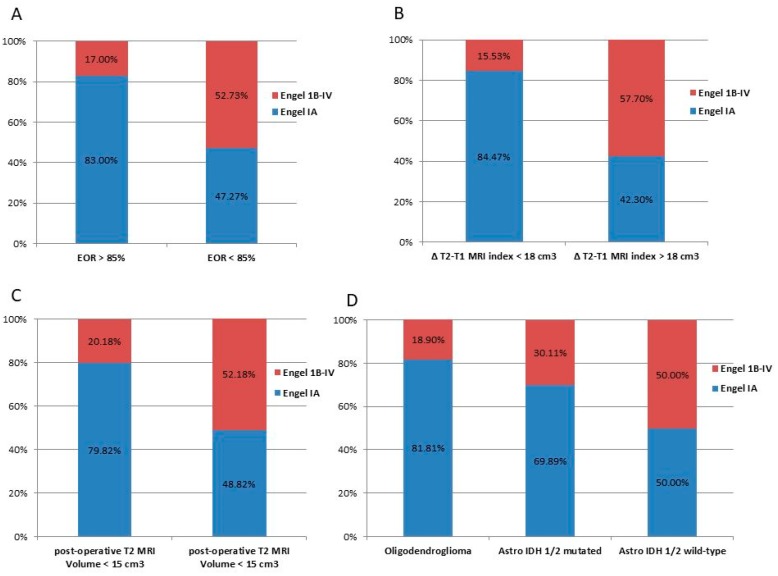
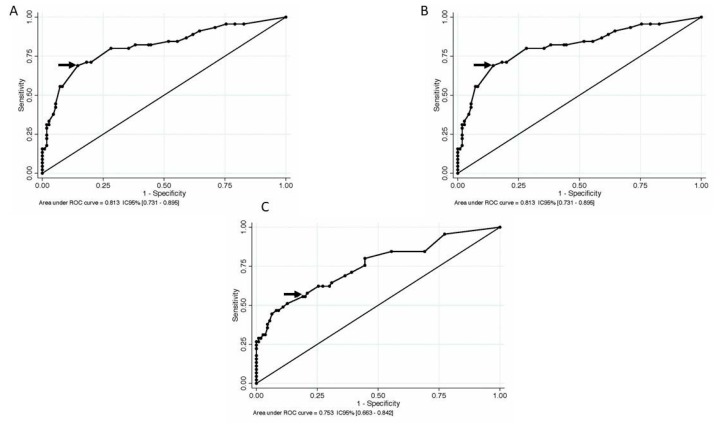
The importance of the extent of resection (EOR) has been widely demonstrated as the main predictor for survival, nevertheless its effect on tumor related epilepsy is less investigated. A total of 155 patients were enrolled after a first-line surgery for supratentorial Diffuse Low Grade Gliomas (DLGGs). Postoperative seizure outcome was analyzed stratifying the results by tumor volumetric data and molecular markers according to 2016 WHO classification. Receiver operating characteristic (ROC) curves were computed to asses EOR, residual tumor volume, and ΔT2T1 MRI index (expressing the tumor growing pattern) corresponding to optimal seizure outcome. A total of 70.97% of patients were seizure-free 18 months after surgery. Better seizure outcome was observed in IDH1/2 mutated and 1p/19q codeleted subgroup. At multivariate analysis, age ( = 0.014), EOR ( = 0.030), ΔT2T1 MRI index ( = 0.016) resulted as independent predictors of postoperative seizure control. Optimal parameters to improve postoperative seizure outcome were EOR ≥ 85%, ΔT2T1 MRI index ≤ 18 cm, residual tumor volume ≤ 15 cm. This study confirms the role of EOR and tumor growing pattern on postoperative seizure outcome independently from the molecular class. Higher ΔT2T1 MRI index, representing the infiltrative component of the tumor, is associated with worse seizure outcome and strengthens the evidence of common pathogenic mechanisms underlying tumor growth and postoperative seizure outcome.
手术切除范围(EOR)的重要性已被广泛证明是生存的主要预测指标,然而其对肿瘤相关性癫痫的影响研究较少。共有155例患者在接受幕上弥漫性低级别胶质瘤(DLGGs)一线手术后入组。根据2016年世界卫生组织分类,通过肿瘤体积数据和分子标志物对术后癫痫发作结果进行分层分析。计算受试者工作特征(ROC)曲线以评估与最佳癫痫发作结果相对应的EOR、残余肿瘤体积和ΔT2T1 MRI指数(表示肿瘤生长模式)。共有70.97%的患者在术后18个月无癫痫发作。在IDH1/2突变和1p/19q共缺失亚组中观察到更好的癫痫发作结果。多因素分析显示,年龄(P = 0.014)、EOR(P = 0.030)、ΔT2T1 MRI指数(P = 0.016)是术后癫痫控制的独立预测因素。改善术后癫痫发作结果的最佳参数为EOR≥85%、ΔT2T1 MRI指数≤18 cm、残余肿瘤体积≤15 cm。本研究证实了EOR和肿瘤生长模式对术后癫痫发作结果的作用,独立于分子类别。较高的ΔT2T1 MRI指数代表肿瘤的浸润成分,与较差的癫痫发作结果相关,并强化了肿瘤生长和术后癫痫发作结果潜在共同致病机制的证据。